French brands invested 587 million euros in influencer marketing in 2025. In three years, that figure has grown by more than 80%.
Influencer marketing has left the experimental stage. It is no longer a side budget handed to a junior community manager, but a structured discipline built into the marketing plan from the start, with its own conventions, legal obligations and performance metrics.
For a brand starting out, though, the subject still feels opaque. How much should you invest? Which type of creator should you choose? How do you know whether the campaign returned anything at all? This guide answers those questions using the most recent market data, and gives you a method you can apply to your very first campaign.
- The real state of the French market in 2026
- The five creator tiers and which to choose
- The selection criteria that actually matter
- Collaboration formats and the legal framework
- What budget to plan for and how to measure returns
- The six steps to launching a campaign
A market that has come of age
The figures tell a clear story. According to the study conducted by France Pub with the French advertising regulator ARPP, French advertisers invested 587 million euros in influencer marketing in 2025, up 13.1% year on year. That now represents 5.2% of all digital advertising spend.
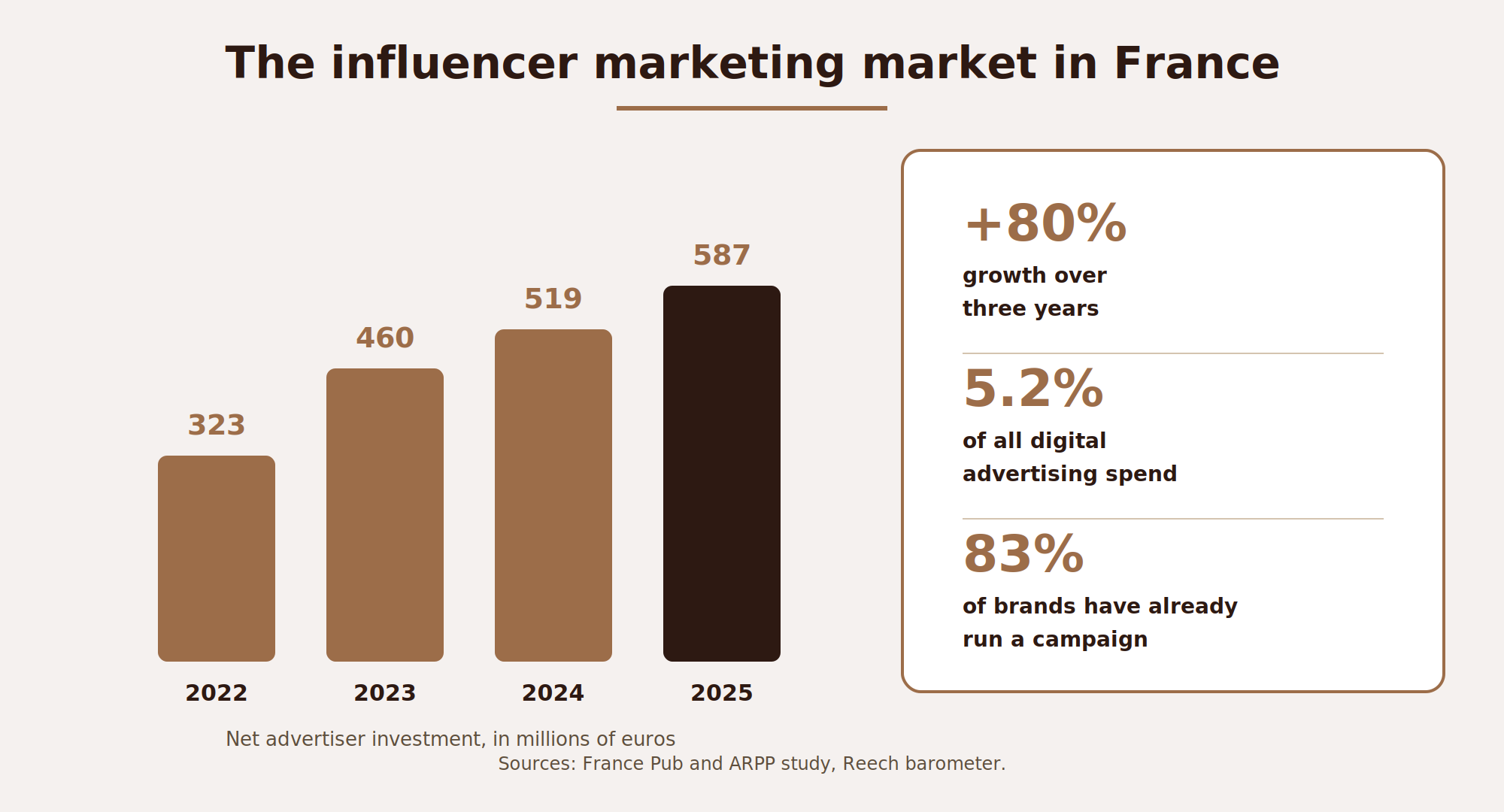
This growth reflects a change in status. According to the tenth edition of the Reech barometer, 83% of brands have run at least one campaign in the past two years, nine points more than in 2022. More tellingly, 94% consider the channel effective and 98% expect its share to keep rising. On budgets, 69% of professionals surveyed plan to increase theirs in 2026.
Professionalisation also shows in the tooling. The share of advertisers using technology to target creators doubled in a year, from 10% to 21%. Influencer marketing is gradually adopting the measurement instruments used across the rest of digital marketing.
The five creator tiers
Creators are usually ranked by audience size. That is convenient, but misleading if you stop there, because engagement follows the opposite curve: the larger the community, the smaller the proportion that actually reacts.
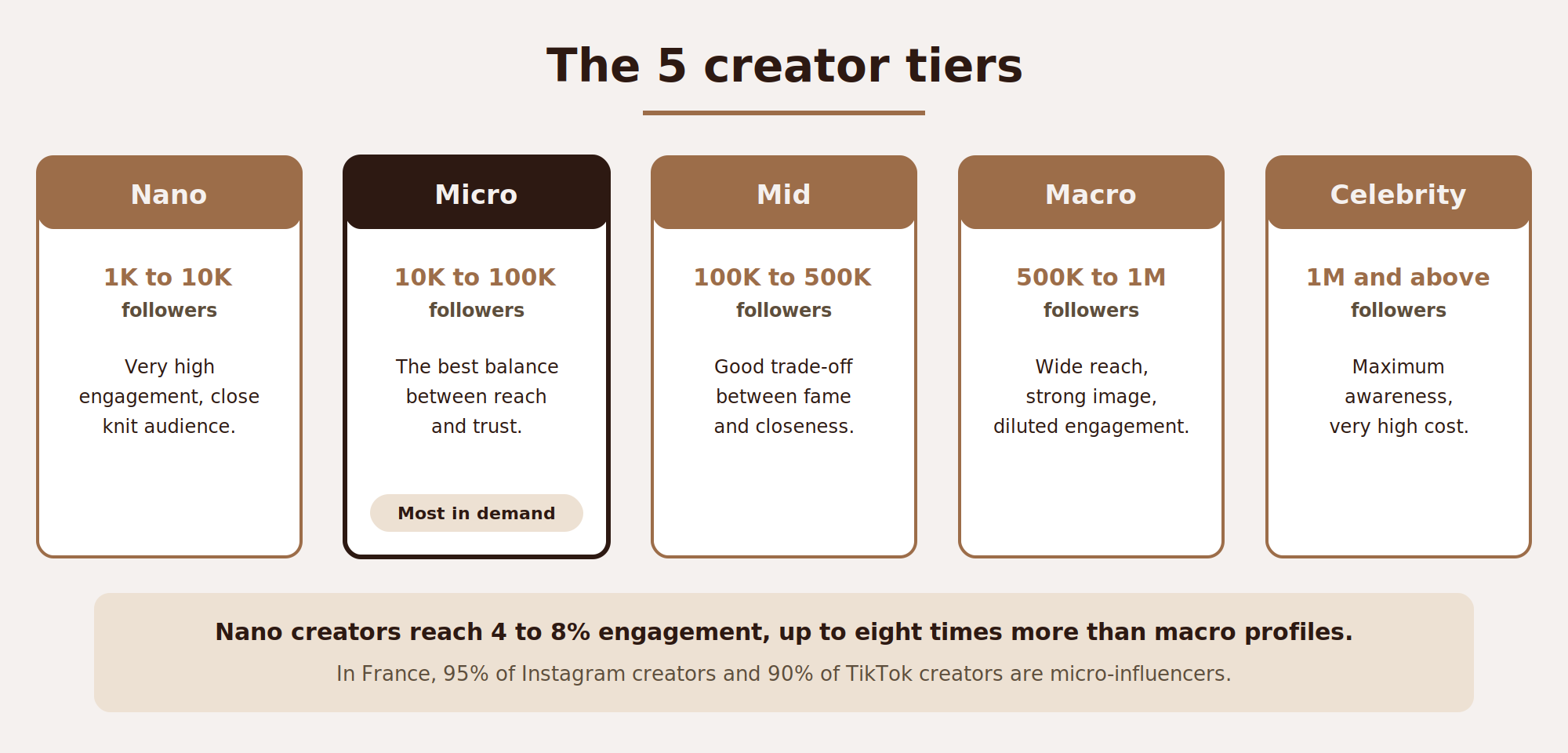
This is why the centre of gravity has shifted down the scale. Nano creators reach engagement rates of 4 to 8%, up to eight times more than macro profiles. France counts roughly 152,000 creators, of whom 95% are micro-influencers on Instagram and 90% on TikTok.
In practice, activating ten relevant micro creators often outperforms a single collaboration with a big name, on a tighter budget and with a more credible message. The question is not who has the most followers, but who genuinely speaks to your audience.
How to choose your creators
Selection criteria have shifted substantially. Brands no longer look first at follower counts, but at the quality of the bond between creator and community, and at how well the creator fits their own image.
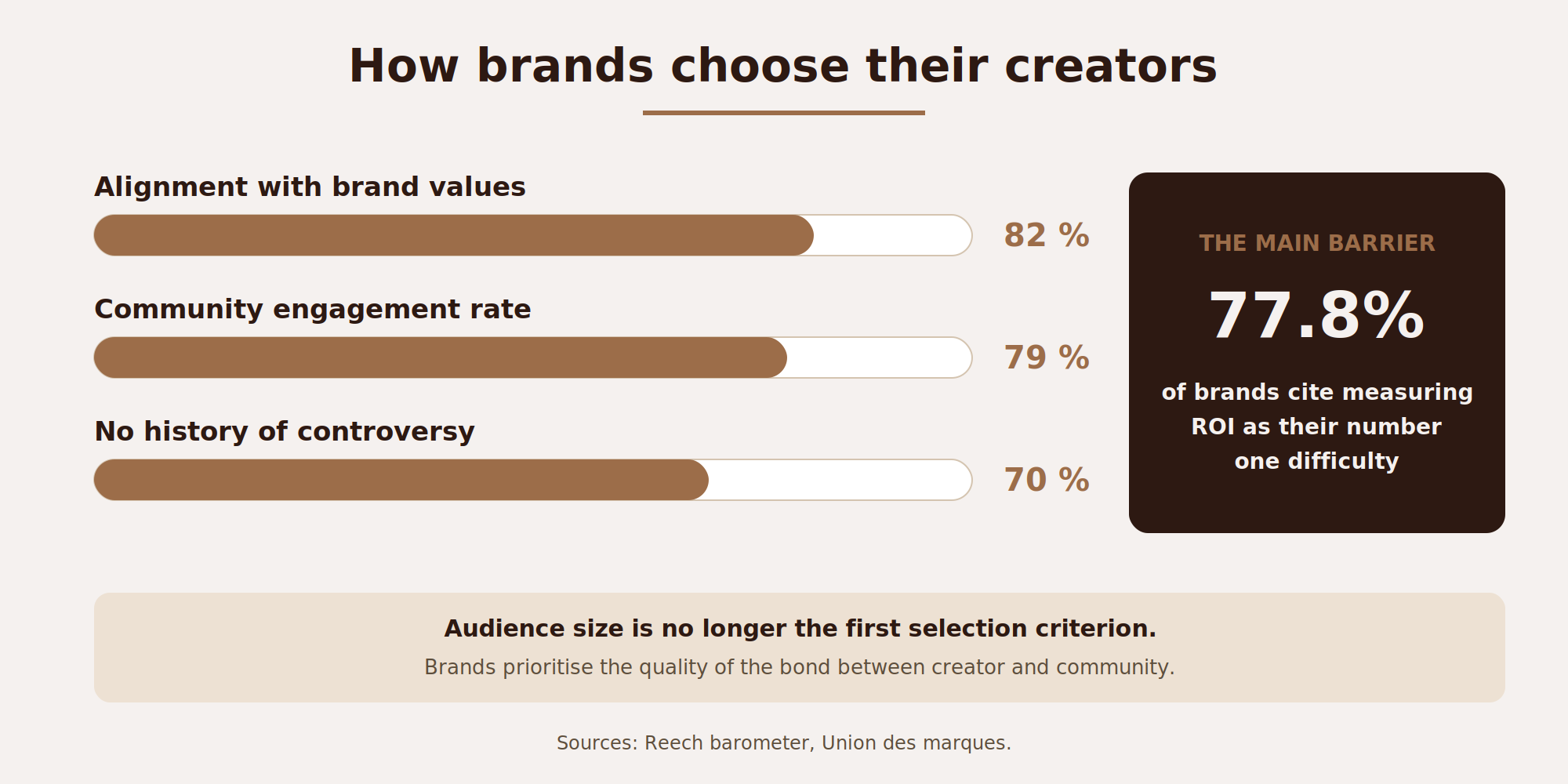
Value alignment comes first, cited by 82% of brands, ahead of engagement rate at 79%. Brand safety weighs heavily too: 70% rule out profiles with a history of controversy. That caution explains the rise of long-term partnerships, seen as safer and more profitable than one-off activations.
One practical point: check the real quality of the audience before committing. Follower location, age bracket, past partnerships and possible fake followers are all easy to verify today, and doing so avoids paying for reach that does not exist.
Collaboration formats
Two formats clearly dominate brand intentions for 2026, each cited by 77.8% of them according to Union des marques: long-term ambassador partnerships, and UGC.
- Sponsored content remains the entry format: a post, story or video published on the creator's own account.
- UGC means having a creator produce content that you then distribute on your own channels, including in paid advertising. The line between influence and content production is blurring: brands no longer buy an audience alone, they buy creative expertise.
- Gifting involves sending products in exchange for exposure, with no direct payment.
- Ambassadorship establishes a collaboration over time, which strengthens credibility and improves returns month after month.
A legal requirement since January 2026: as soon as payment, in cash or in kind, exceeds 1,000 € excl. VAT per year with a single advertiser, a written contract becomes mandatory in France. Make sure, too, that the commercial nature of the collaboration is clearly disclosed on every published piece of content.
What budget should you plan for?
There is no universal minimum, but several useful benchmarks exist. A simple rule guides many brands: allocate between 3 and 10% of monthly marketing spend to influencer marketing. Across Europe, median annual spend reaches 175,000 euros according to the Kolsquare barometer, with France standing out for a high share of budgets between 200,000 euros and one million.
Those figures apply to established brands. To test the channel, a credible pilot campaign built around a panel of nano and micro creators starts at a few thousand euros, enough to measure a first return before committing further. We break down the ranges by tier and format in our article on influencer campaign costs.
Measuring return on investment
This is the sore point of the industry. Difficulty measuring ROI is cited as the number one obstacle by 77.8% of brands, well ahead of budget trade-offs. Yet the data exists: influencer marketing is estimated to return close to six euros for every euro invested, with an even better ratio on nano and micro campaigns, where entry costs are lower.
Three habits are enough to stop flying blind. Define your metrics before launch, clearly separating an awareness campaign from a conversion campaign. Give every collaboration its own promo code or trackable link. Then analyse results profile by profile, so you can repeat what worked rather than starting from scratch each season.
Launching a campaign in six steps
The method below applies equally to a first campaign and to recurring activity. Each step conditions the next.
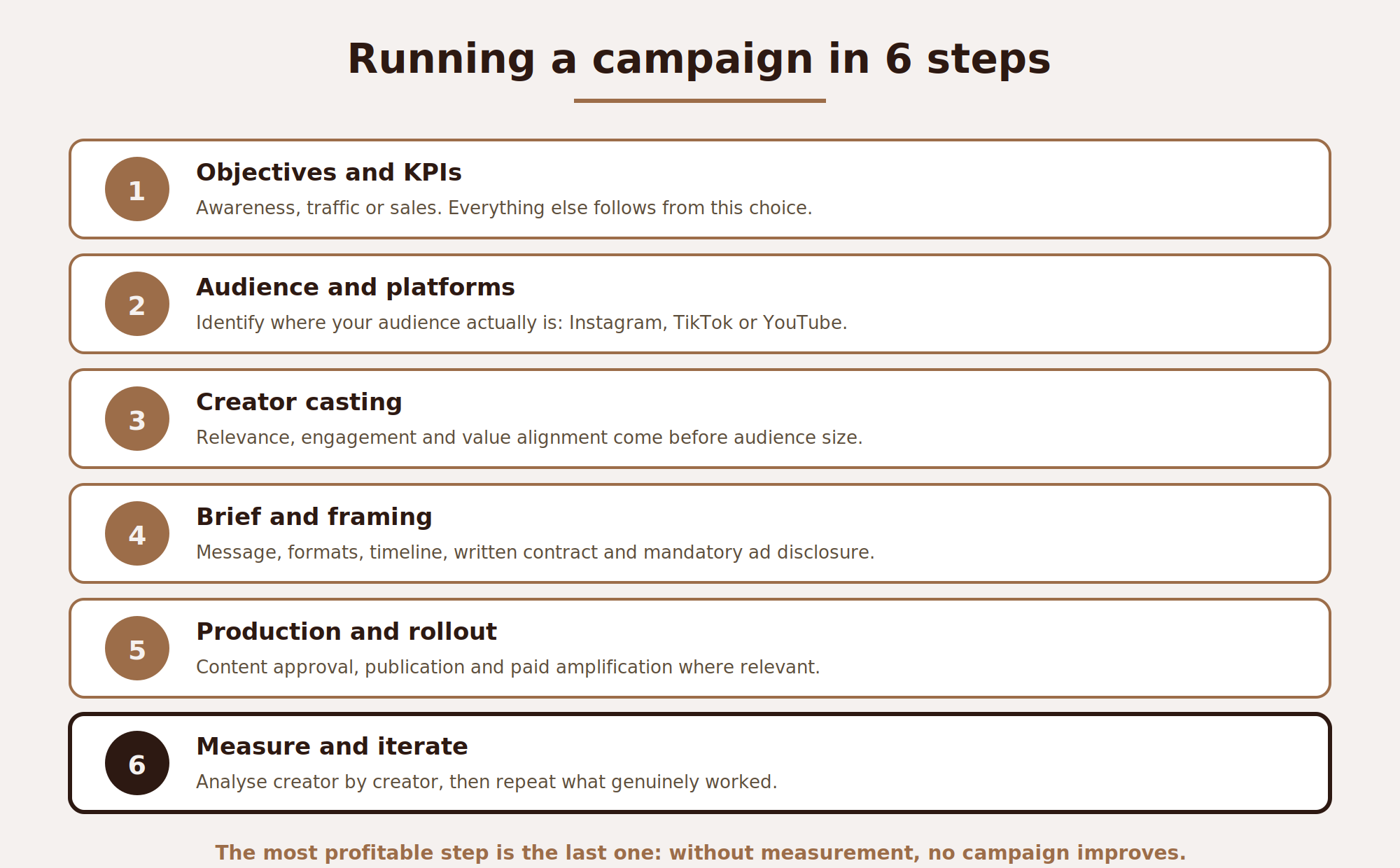
The most common mistake is starting at step three, hunting for creators before the objective has been set. An awareness campaign is not run like a conversion campaign: the former prioritises reach and the number of profiles activated, the latter concentrates budget on highly engaged creators with proper tracking in place.
Running it in-house or delegating
Managing a campaign takes time: sourcing, audience verification, negotiation, contracting, briefing, content approval, then reporting. For a small marketing team, that workload competes directly with everything else on the plan.
Influencer marketing also sits within a broader content strategy, alongside your photoshoots and e-commerce visuals. Creators now produce part of the content your paid campaigns will run on, which makes coordination between the two all the more important.
That is the role Shaare Agency plays. Our directory of fashion creators and talent is free for brands to browse, and you can contact profiles directly with no intermediary and no commission. You can also hand us your casting, or the full management of your campaign from sourcing through to reporting.
Frequently asked questions
Does influencer marketing really work?
94% of brands using it consider it effective, and 98% expect its share to grow. The channel drives real purchasing behaviour, provided you choose creators well and measure results.
Should I work with large influencers?
Rarely. Nano and micro creators show engagement rates up to eight times higher, at a far lower cost. They now form the heart of the market.
What budget do I need for a first campaign?
A pilot campaign with a panel of nano and micro creators starts at a few thousand euros. The goal is to test, measure, then reinvest in what works.
Is a written contract mandatory?
In France, yes, as soon as payment in cash or in kind exceeds 1,000 € excl. VAT per year with a single advertiser. Disclosing the commercial nature of the content is also mandatory.
How do I measure a campaign's return?
By setting your metrics before launch and giving each creator a dedicated promo code or trackable link. You can then compare profiles and repeat the most profitable ones.
Conclusion
Influencer marketing has become a pillar of brand communication, with a French market worth 587 million euros and growth showing no sign of slowing. Three principles separate profitable campaigns from the rest: choose creators for the quality of their bond with their community rather than their size, favour long-term relationships over isolated activations, and measure consistently so each campaign teaches you something for the next.
To identify the creators that fit your brand, or to delegate your campaign entirely, explore the Shaare directory and contact the profiles you are interested in directly.