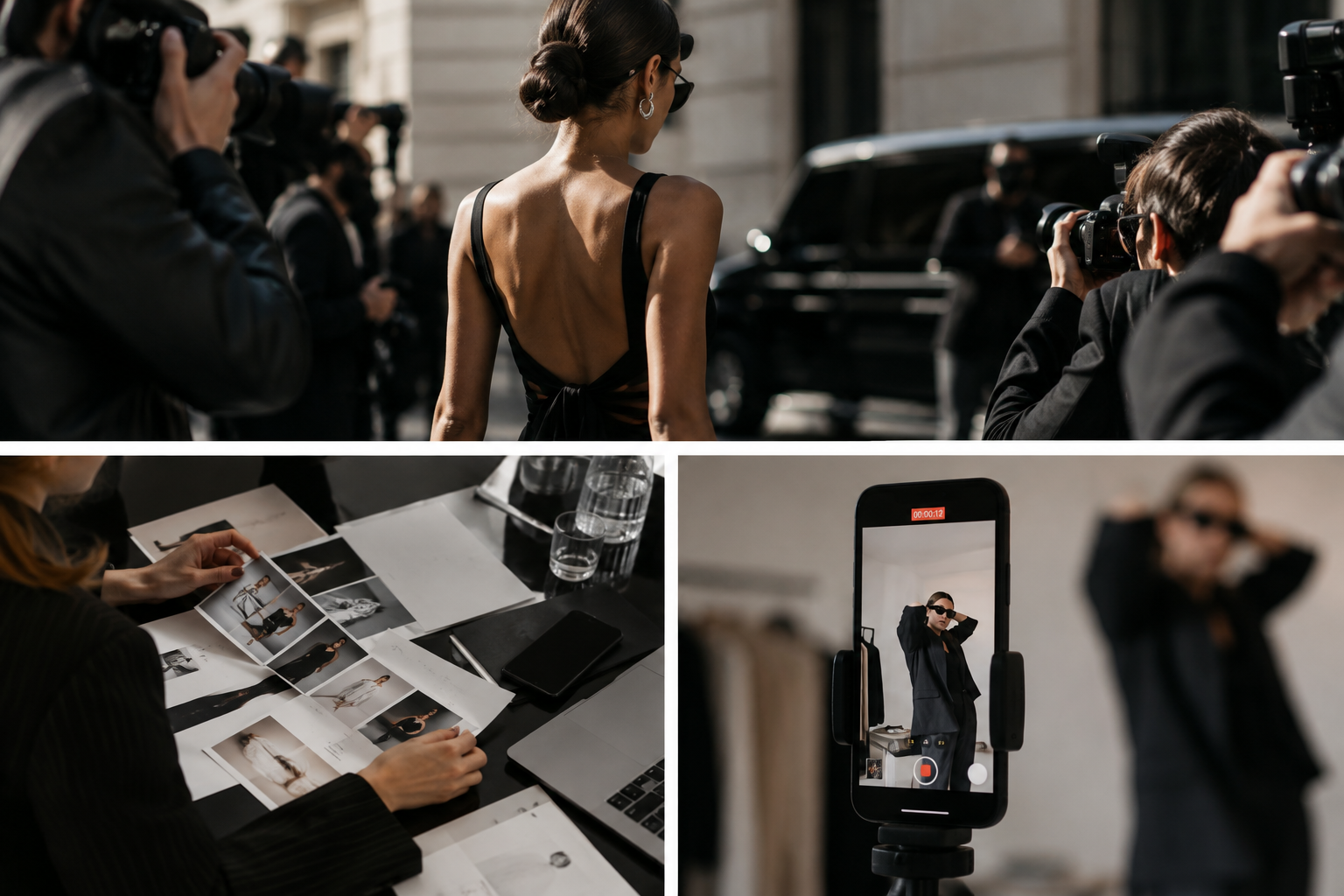

In 2026, a fashion brand is no longer judged solely by its products, but by its ability to produce high-quality content on a continuous basis.
E-commerce photos, lookbooks, vertical videos, creator content: every channel demands its own visual raw material, and the appetite of these platforms is endless. The global creator content (UGC) market illustrates this shift: it is estimated to be worth nearly $18.65 billion in 2026, growing at about 26% per year according to Grand View Research.
Yet, for most brands, fashion content production remains a headache: expensive, time-consuming, and difficult to sustain over the long term. This comprehensive guide explains what to produce, in what quantity, at what cost, and how to organize a production process that truly supports your sales, whether you choose to handle it in-house or partner with an agency.
- Why content has become the primary sales driver
- The 4 main types of brand content in 2026
- How much to produce, and at what pace
- The true cost of production, and the 3 possible models
- How to structure an efficient production process, step by step
Why content production has become vital
On an online store, visuals are the first—and sometimes only—selling point. Customers cannot touch the product: they buy what they see. And they increasingly trust content that feels like real life rather than polished advertisements.
The numbers are clear. According to Nielsen, 92% of consumers trust authentic content more than traditional advertising. According to Bazaarvoice, user-generated content (UGC) drives up to 4.5x higher conversion rates in campaigns. According to Meta, nearly 70% of top-performing ads today rely on this authentic format.
The conclusion is simple: the winning brands aren't those that produce the most beautiful content once a year, but those that produce it consistently, across multiple formats, at the right cost. Content production is no longer a one-off expense: it is an ongoing business function.
The 4 main types of brand content in 2026
Not all images serve the same purpose. A solid content strategy combines four complementary categories, each playing a specific role in the customer journey.
1. Studio and e-commerce: for conversion
These are your product page visuals: crisp packshots, neutral backgrounds, and multi-angle shots. They provide reassurance and trigger purchases. This is the non-negotiable foundation for any brand selling online. Our e-commerce lookbook shooting guide details how to get visuals that sell.
2. Lookbook and editorial: for creating desire
Staged series, seasonal campaigns, and a distinct brand identity: this content builds your image and perceived value. It transforms a product into a desirable object and sets your brand apart from the competition.
3. UGC and creator content: for social proof
Authentic-style videos produced by creators, designed to be repurposed for advertising. This is the fuel for high-performing campaigns. To learn more, check out our article dedicated to UGC and how to implement it.
4. Short-form video (Reels, TikTok): for reach
Vertical, fast-paced formats designed for discovery and sharing. They capture new audiences where they spend their time. Our guide to vertical brand video dives deeper into the subject.
How much content should you produce, and at what pace?
The question isn't "how many perfect photos?" but "what pace can I sustain?". In both SEO and social media, consistency beats one-off perfection. Here are some realistic benchmarks by channel:
- E-commerce: every product deserves multiple angles, a lifestyle shot, and a detail shot. This is your foundation, to be updated with every new collection or restock.
- Instagram: a steady flow mixing a polished feed, daily stories, and Reels. The algorithm rewards consistency.
- TikTok: volume and frequency take precedence over high-end production. It is better to have several authentic videos than one highly produced one.
- Advertising: plan for multiple creative variations per campaign to test performance and avoid ad fatigue.
The right approach: think in terms of a content calendar rather than isolated shoots. We detail the method in our article creating a brand content calendar.
The true cost of content production
A production budget is broken down into three areas: pre-production (art direction, casting, location scouting), the shoot (studio or location, team including the photographer, model, makeup artist, and stylist, equipment) and the post-production (retouching, editing, variations). Each element impacts the final invoice, and underestimating pre- and post-production is often what causes a budget to spiral.
For itemized price ranges, check out our dedicated guide: how much does a fashion photo shoot cost in 2026. Beyond the price of a one-off shoot, the real question is the production model : ad hoc, in-house, or via a retainer partner?
Should you handle production in-house or outsource it?
This is the key trade-off. In-house production offers total control and high responsiveness, but entails heavy fixed costs (salaries, equipment, studio) and requires mastering diverse skills, from photography and styling to makeup and editing. Outsourcing, conversely, turns these fixed costs into variable ones and gives you access to specialized talent without the need for hiring.
For most growing brands, a hybrid model—with an outsourced retainer base supplemented by occasional in-house work—offers the best balance of quality, flexibility, and cost. We compare both approaches in detail in in-house vs. outsourced content production.
How to structure an efficient content production process
Successful content is never a matter of chance: it is a process. Here are the six steps to a streamlined production.
1. Strategy and requirements
First, define your objective (sales, brand awareness, audience building), the target channels, and the required volume. Everything else follows from this.
2. Creative brief
The brief aligns the entire team: art direction, references, mood, and expected deliverables. A good brief prevents unpleasant surprises on the big day. See our guide: how to brief a shooting team.
3. Talent casting
This is the most underestimated step. Yet, the right talent accounts for 80% of the result. The right model embodies the brand, the right photographer captures the aesthetic, and the right makeup artist enhances without distorting. Finding these profiles quickly changes everything.
4. The shoot
Organization, timing, and coordination of all parties: a well-prepared day produces more usable content of higher quality.
5. Post-production
Retouching, editing, and adapting to the formats of each channel (square, vertical, story). A single shoot can provide weeks of content if it is properly repurposed.
6. Distribution
Content is only valuable if it is published in the right place, at the right time, within a coherent schedule. The loop closes back on the initial strategy.
Key takeaway: the link that makes the difference is the casting. An impeccable production with the wrong talent will result in lackluster content, whereas the opposite is rarely true.
Outsource to a turnkey partner
For many brands, especially those just starting out or entering the French market, the most effective approach is to entrust everything to a single partner who orchestrates production from A to Z: strategy, casting, Parisian shooting, post-production, and distribution.
This is precisely the role of Shaare Agency. Our directory of fashion talent (models, photographers, makeup artists, stylists, creators) is accessible for free and directly For brands: you can reach out to the profiles that match your needs, or entrust us with your casting and content production on a retainer basis. The result: a steady stream of content that reflects your brand, without the overhead of an in-house team.
Frequently asked questions
How much does fashion content production cost?
It depends on the format, volume, and the team involved. A creator video typically ranges from €150 to €500, while a full studio shoot requires a significantly higher budget. You can find a detailed breakdown in our guide how much does a fashion photo shoot cost in 2026.
Should you handle production in-house or outsource it?
In-house production is suitable for high-volume brands, while outsourcing offers more flexibility for the majority. A hybrid model is often the best approach. See our full comparison: in-house vs outsourcing.
Which content should you prioritize on a small budget?
Two priorities: sharp e-commerce visuals (they drive direct conversions) and UGC (excellent cost-to-performance ratio). Lookbooks and short-form video can be added to strengthen your strategy as your budget grows.
How often should you produce content?
As regularly as possible, at a sustainable pace. A consistent flow is better than one big, isolated shoot followed by months of silence. Think in terms of a monthly calendar.
Conclusion
In 2026, fashion content production is no longer optional: it is the engine of visibility and sales. Three key takeaways: combine the four types of content based on their specific roles, aim for consistency rather than occasional perfection, and choose the production model that fits your current stage, keeping in mind that talent casting remains the deciding factor.
Whether you want to manage your production in-house or delegate it entirely, Shaare Agency gives you access to the talent and production expertise your brand needs. Explore the directory or entrust us with your next project.