

"Instagram or TikTok" is the wrong question. For a fashion brand, the marginal cost of posting to both is close to nil, since the source format is identical. The real decision is where you concentrate the effort: production, community, and media budget.
The two platforms do not do the same job. One excels at making a brand discoverable to people who have never heard of it, the other at turning an existing audience into customers. Choosing means deciding which of those two problems is yours today.
What each platform does well
The difference is not the audience, which overlaps heavily, but the distribution mechanic.

TikTok distributes to the content. A video can travel far beyond the account's followers if it holds attention in the first seconds. It is the discovery platform, and the only one where a brand with no audience can still get known without media spend.
Instagram distributes to the relationship. The feed and Reels favour accounts the user already interacts with. Organic reach among non-followers exists, but it is weaker. In exchange, the platform converts better: a structured profile, a link in bio, a shop, direct messages, stories that speak to an audience you already have.
Engagement data points the same way. According to Socialinsider's benchmarks published in 2026 (2025 data, brand accounts), a post averages 3.7% engagement by followers on TikTok, against 0.48% on Instagram. The two figures are not strictly comparable, since TikTok also counts shares and saves. But the gap says what matters: attention is easier to capture on TikTok, the relationship easier to maintain on Instagram.
How to decide based on your situation
Four situations cover most cases, and each has a clear answer.
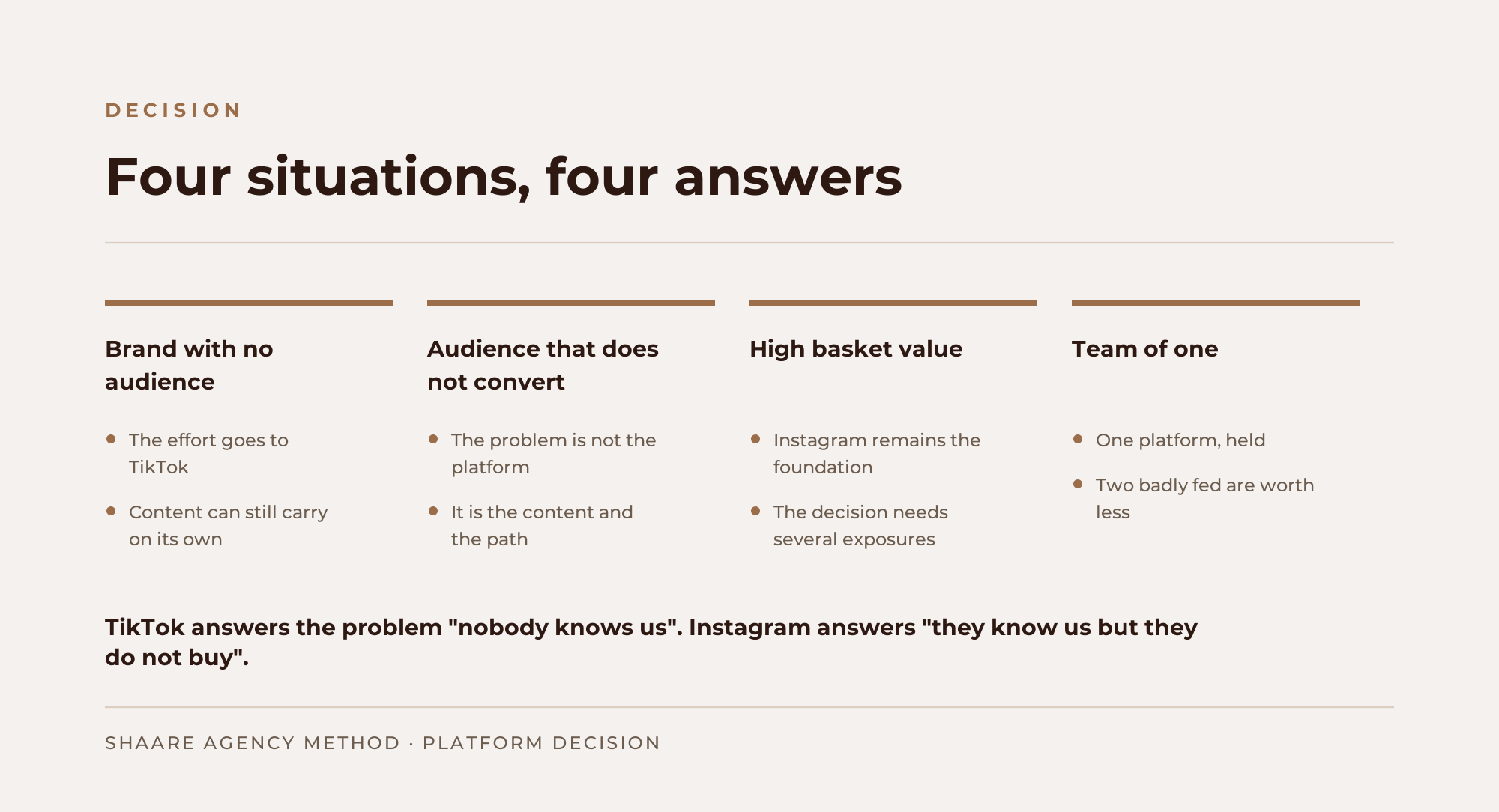
If you are launching a brand with no audience, the effort goes to TikTok. It is the only place where content can still carry on its own, and the cost of failing there is low.
If you have an Instagram audience that does not convert, the problem is not the platform. It is in the content and in the purchase path. Adding TikTok will not solve it, and will spread the effort thinner.
If you sell at a high basket value, Instagram remains the foundation. The purchase decision needs several exposures and an established relationship, which the discovery mechanic does not produce.
If you are a team of one, pick a single platform and hold it. Two badly fed platforms are worth less than one regular one.
The practical rule: TikTok answers the problem "nobody knows us". Instagram answers the problem "they know us but they do not buy". Identify yours before splitting the effort.
What changes in production
The source format is the same, the edit is not. This is where most brands lose their performance.
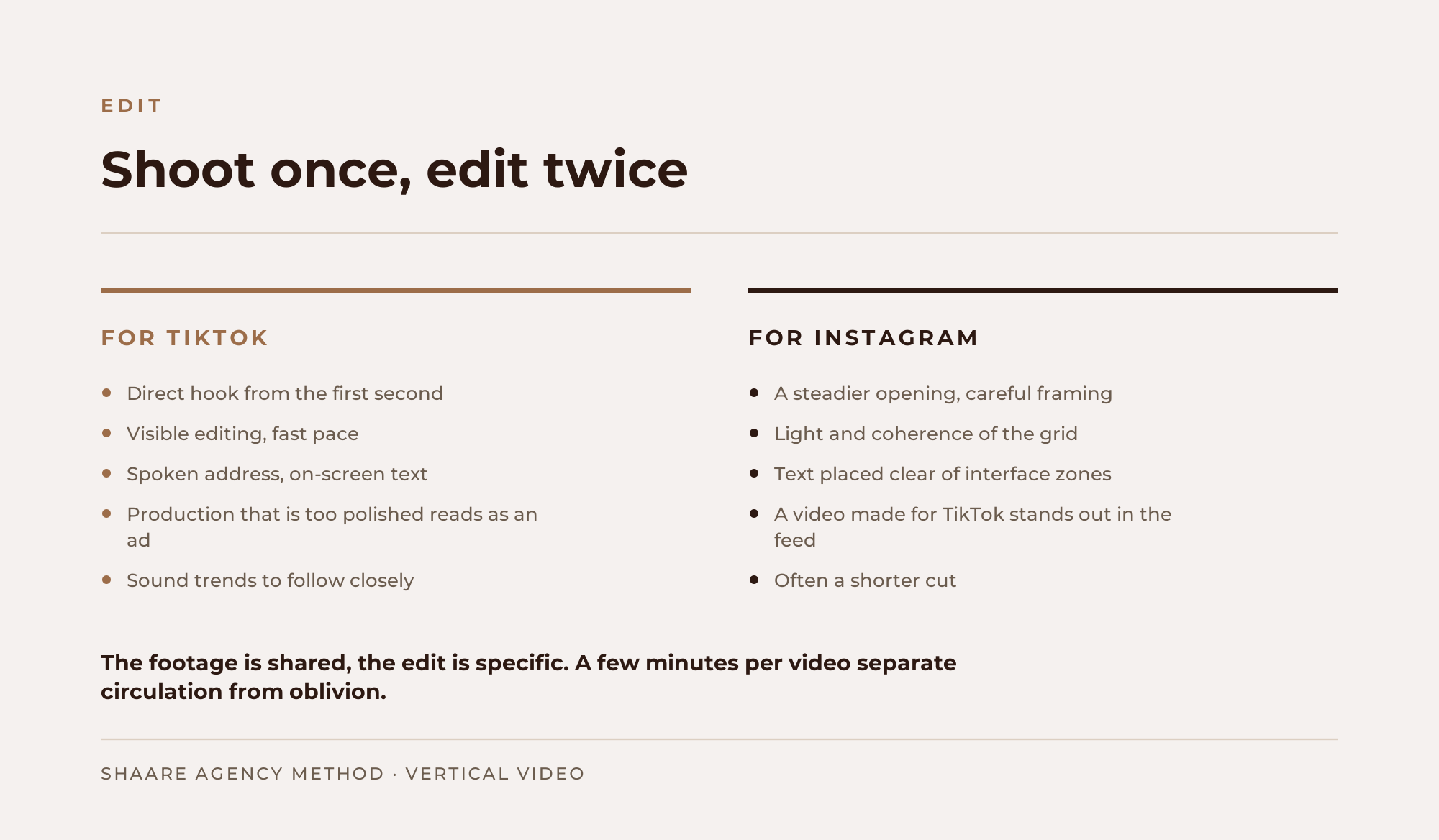
On TikTok, the register tolerates and rewards rough: fast pace, direct speech, on-screen text, visible editing. Production that is too polished often reads as an ad and gets ignored.
On Instagram, visual composure counts for more. Framing, light and the coherence of the grid feed how the brand is perceived, and a video visibly made for another platform stands out for the wrong reasons.
The operational consequence: shoot once, edit twice. The opening frame, the hook text and the length are decided per platform. That is how we run production for the brands we support in social media: one shoot, two edits. The formats that work in vertical are covered in our brand video guide.
Why cross-posting fails
Reposting identically is the most common decision and the least profitable.
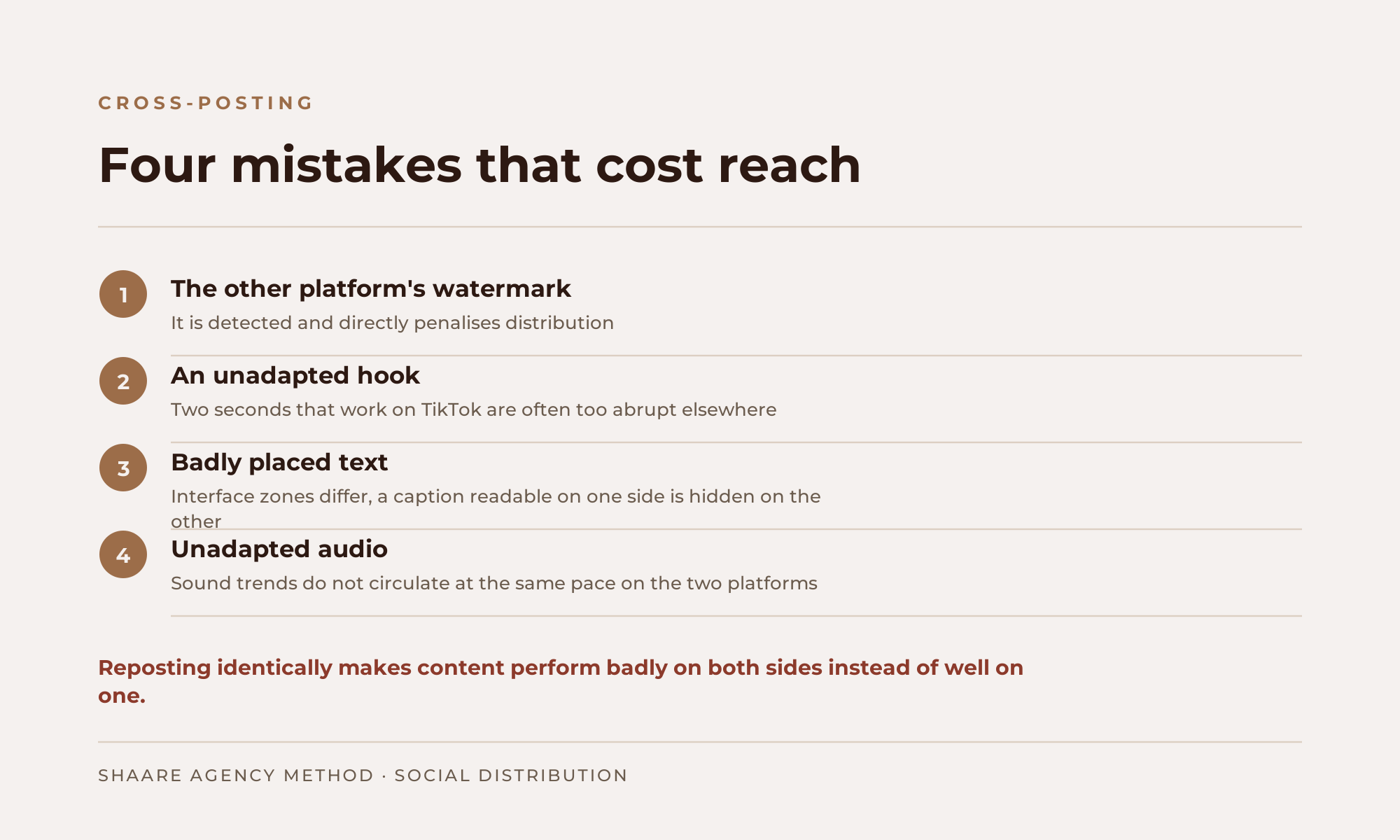
- The other platform's watermark. It is detected and penalises distribution.
- The shape of the hook. The opening two seconds that work on TikTok are often too abrupt on Instagram, and the reverse holds.
- Badly placed on-screen text. Interface zones differ, and a caption readable on one side ends up hidden on the other.
- No adapted audio. Sound trends do not circulate at the same pace on the two platforms.
A platform-specific edit costs a few minutes per video. That is the gap between content that circulates and content that disappears.
When you work with influencers
On influencer campaigns the decision works differently: you are not the one posting, and the platform that matters is where the profile built its audience.
A profile that is strong on TikTok and weak on Instagram will not transfer its performance. So select on the target platform, not on total combined followers. And plan usage rights from the brief, so you can reuse the content on your own channels and in advertising. How to frame those campaigns is covered in our UGC strategy guide.
Where to start
List what you can produce every week without exceptional effort. If that volume only covers one platform, pick the one that answers your current problem and hold it for a quarter before judging. If you can cover both, keep one shoot and two edits.
To produce that content, you can contact videographers and influencers directly in the Shaare directory, with no commission, or hand us production and account management through our social media offer.