
In 2026, an influencer costs anywhere from a few tens of dollars per post for a nano account (under 10,000 followers) to several thousand for an account with 500,000 followers. In France, the median actually paid for an Instagram post with a story reached €3,000 for micro influencers and €8,000 for macro influencers in the first half of 2026. The grid below sets out the published ranges, platform by platform.
- Nano (1,000 to 10,000 followers): Instagram post $10 to $100; Instagram Reel $100 to $200; TikTok video $50 to $200; France, post + story (median paid, H1 2026) not documented.
- Micro (10,000 to 100,000 followers): Instagram post $100 to $500; Instagram Reel $200 to $1,000; TikTok video $200 to $1,000; France, post + story (median paid, H1 2026) €3,000 (Matriochka tier: 10,000 to 50,000).
- Mid-tier (100,000 to 500,000 followers): Instagram post not documented; Instagram Reel $1,500 to $5,000; TikTok video $1,000 to $5,000; France, post + story (median paid, H1 2026) €4,500 (Matriochka tier: 50,000 to 500,000).
- Macro (500,000 to 1 million followers): Instagram post not documented; Instagram Reel $5,000 to $7,000 and up; TikTok video $5,000 to $10,000; France, post + story (median paid, H1 2026) €8,000 (500,000 to 1 million).
Sources: Instagram post, Influencer Marketing Hub, Influencer Rates 2026 (this source gives a single bracket of $5,000 to $10,000+ for 100,000 to 1 million followers, hence the undocumented cells). Instagram Reel, Later, Creator Rates Report 2025 (survey of more than 500 creators). TikTok, Modash, Influencer Pricing 2026 (North American creators). France, Matriochka Influences study of more than 600 paid collaborations signed in 2025 and the first half of 2026, reported by CB News (September 2026, in French).

The first three columns are international benchmarks, mostly North American, in dollars. We have not converted them, because an exchange rate does not turn one market into another. The last column is the only recent French data we found. It is based on amounts actually paid rather than listed rates, but on a heavier format (post plus story) and on collaborations negotiated by an agency. That explains part of the gap with the international grids, which is wide at micro level. It also says something about the French market: according to the same study, the micro median tripled between 2025 and the first half of 2026.
For a brand based outside France, the practical reading is simple. Do not budget a French campaign from US benchmarks: the French figures are the closer reference, and they are rising.
The sources do not agree on tiers either. Influencer Marketing Hub and Later put micro between 10,000 and 100,000 followers, Matriochka between 10,000 and 50,000. Read each column as an order of magnitude, not a rate card.
Five factors that move the price
Follower count sets a base. Five factors then shift it, sometimes more than the size of the account itself.
Format
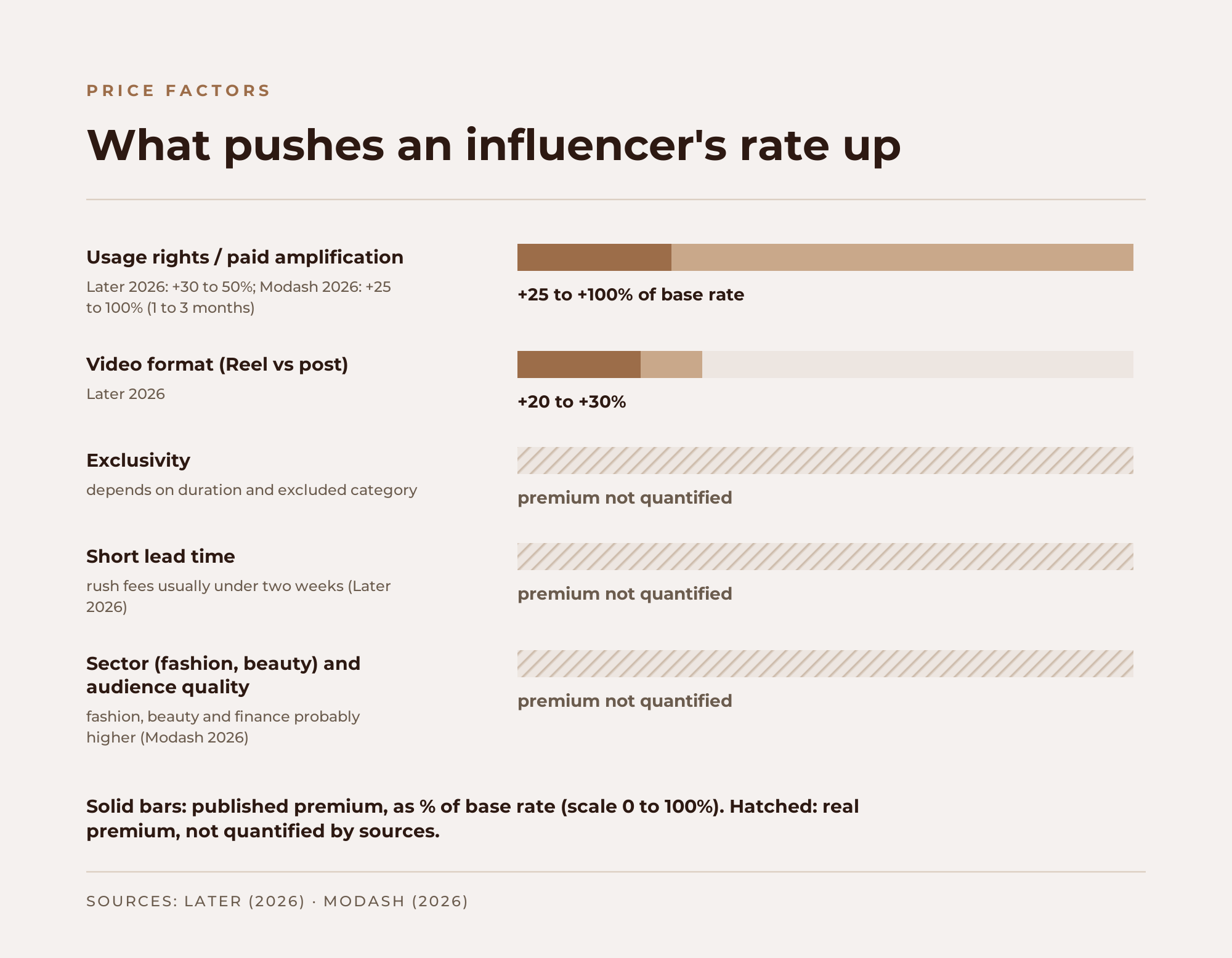
Video costs more than a still image. According to Later's 2026 pricing guide, a Reel adds 20 to 30% to the base rate on Instagram, and a story costs roughly half as much. On TikTok, the same guide notes that rates are often calculated on average views rather than follower count.
Usage rights and paid amplification
This is the largest item. Reusing content on your own channels, or running it as an ad from the creator's account (whitelisting, Spark Ads), is charged on top. Later puts it at 30 to 50% of the base rate. Modash (2026) sees a wider range, 25 to 100% of the base rate for one to three months of rights. Influencer Marketing Hub (2026) notes that a budget can rise by 30% to more than 100% once content runs as paid media.
Exclusivity
Asking a creator not to work with a competitor during the campaign, or after it, has a cost. None of the sources we consulted publishes a reliable percentage: the premium is negotiated and depends on the duration and on how broad the excluded category is.
Lead time
Short notice is paid for. Later says rush fees usually apply when production time is under two weeks, without putting a figure on the premium.
Sector and audience quality
Modash specifies that its Instagram ranges mostly cover home and lifestyle, and that beauty, fashion and finance are probably higher. An audience concentrated on your target is worth more than a large, scattered one.
On that last point, engagement matters more than size. According to HypeAuditor (2025), nano accounts had the highest average engagement rate on Instagram in 2024, at 1.73%, against 1.59% across all accounts. The French market is starting to price this in: in the Matriochka study, the price gap between a mega and a micro influencer fell from 13 times in 2025 to 4 times in the first half of 2026. Our article on micro vs macro influencers covers that trade-off.
Three quotes, figure by figure
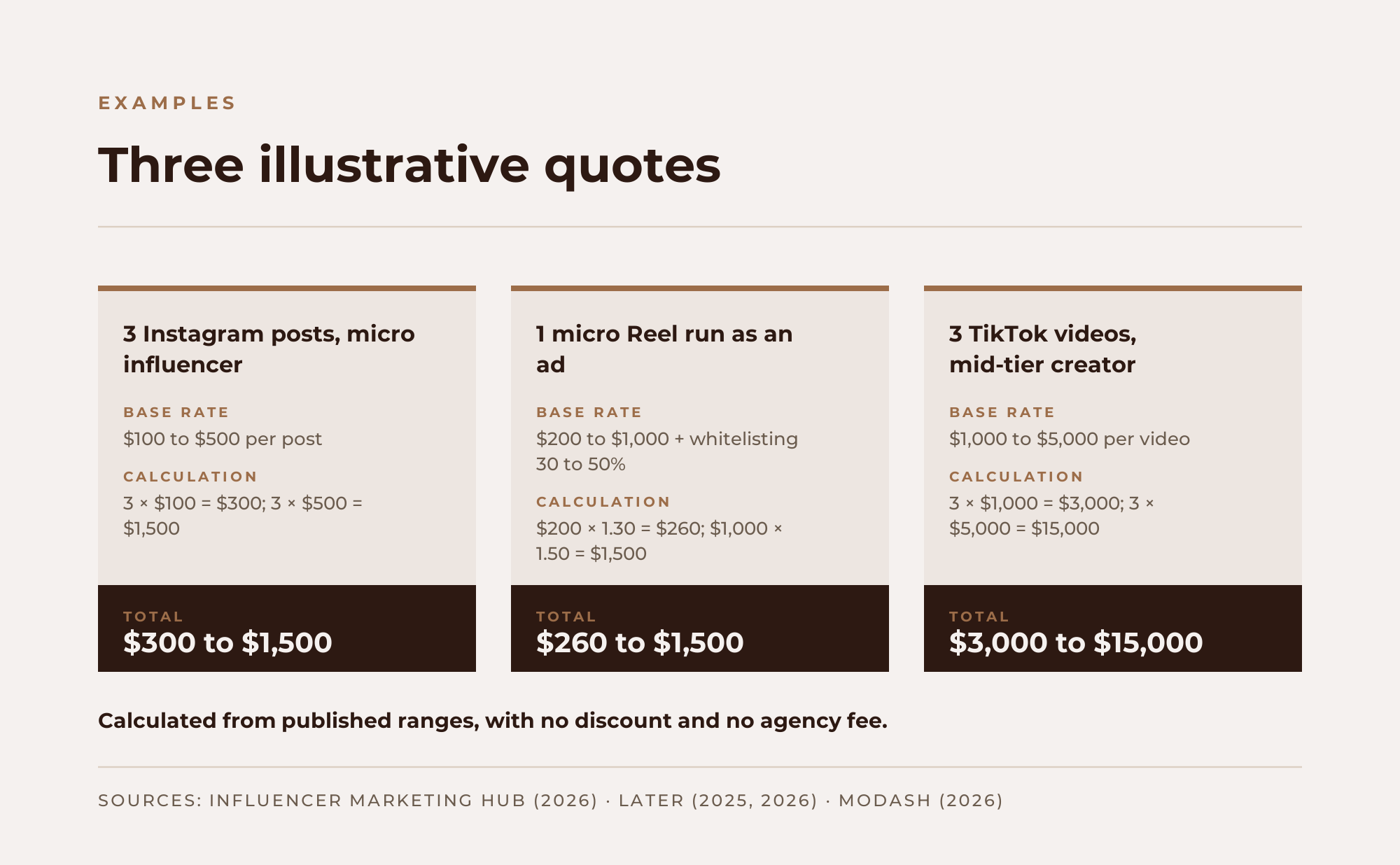
The three examples below are illustrations. They are built only from the ranges cited above, with no discount and no agency fee, to show how a quote takes shape.
Example 1: three Instagram posts with a micro influencer
Influencer Marketing Hub range for a micro post: $100 to $500. For three posts: 3 × $100 = $300 at the low end, 3 × $500 = $1,500 at the high end. For comparison, the French median for a single post with a story from a micro influencer is €3,000.
Example 2: one micro Reel run as an ad
Later range for a micro Reel: $200 to $1,000. Whitelisting premium according to Later: 30 to 50%. Low end: $200 × 1.30 = $260. High end: $1,000 × 1.50 = $1,500. Rights can therefore add up to half the price of a Reel.
Example 3: a series of three TikTok videos with a mid-tier creator
Modash range for a TikTok video from an account with 100,000 to 500,000 followers: $1,000 to $5,000. For three videos: 3 × $1,000 = $3,000 at the low end, 3 × $5,000 = $15,000 at the high end. A series is often negotiated below the unit rate, but no reliable source puts a figure on that discount.
These amounts cover creator fees only. For the full budget of a campaign, production and management included, see our article on influencer campaign costs in 2026. If you would rather hand over selection and negotiation, Shaare also works with brands on their social media strategy and on campaigns with influencers in France.
UGC is a different market
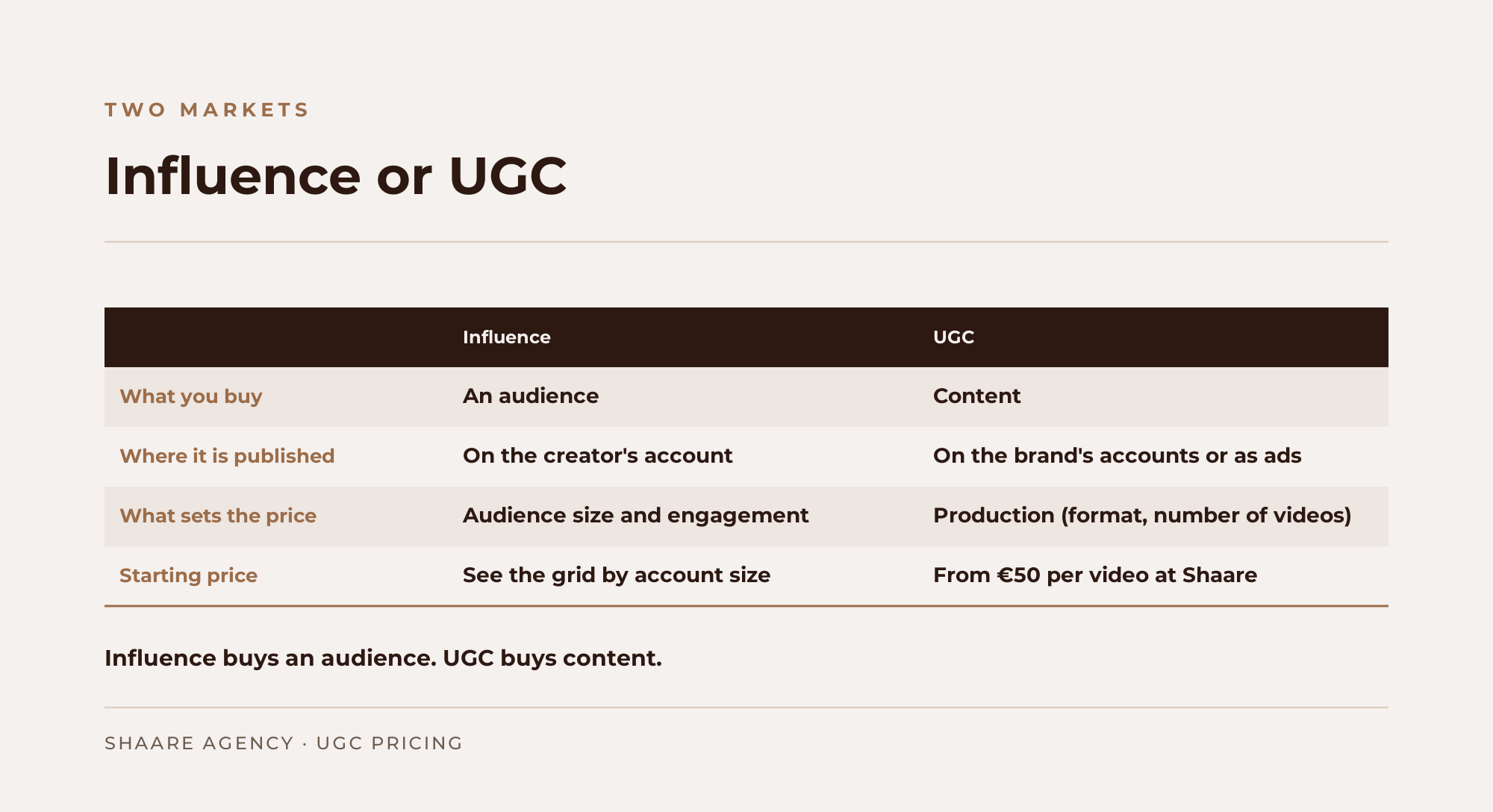
UGC (user-generated content) cannot be compared with the grid above. The creator produces a video or photos and delivers them to the brand, which publishes them on its own accounts or as ads. Nothing is posted on the creator's account: you pay for production, not audience. Follower count matters little, and prices are lower. At Shaare, UGC starts at €50 per video.
The Matriochka study leaves UGC out of its calculation for exactly that reason: it is not the same product. To decide which one fits, see our UGC strategy guide.
What the grid does not tell you
A grid gives a price per account size. It says nothing about three things that decide the result.
These checks take time, which is why many brands use an intermediary. Our article on choosing an influencer marketing agency in Paris explains what that changes.
From grid to quote
Start from the range for your platform and account size, then add what you are actually asking for: format, rights, exclusivity, lead time. The figure you get is a basis for negotiation, not a fixed price. To contact fashion and beauty influencers in France directly, with no commission, browse the Shaare Agency influencer directory.