

The question comes up as soon as a brand reaches a certain volume: should you hire a photographer and build a studio, or keep working with external providers?
It usually surfaces at the wrong moment, after a shoot invoice that felt too high, and gets settled on instinct rather than calculation. Yet the two models have neither the same cost structure nor the same limits, and the volume at which one becomes more advantageous than the other can be calculated precisely.
This article compares both approaches on hard numbers, identifies the volume at which bringing content production in-house pays off, and offers a decision framework you can apply to your own situation.
What an in-house team really costs
The most common mistake is comparing a salary to a supplier invoice. An in-house team is not just a wage: it is a set of fixed costs that run whether you produce or not.
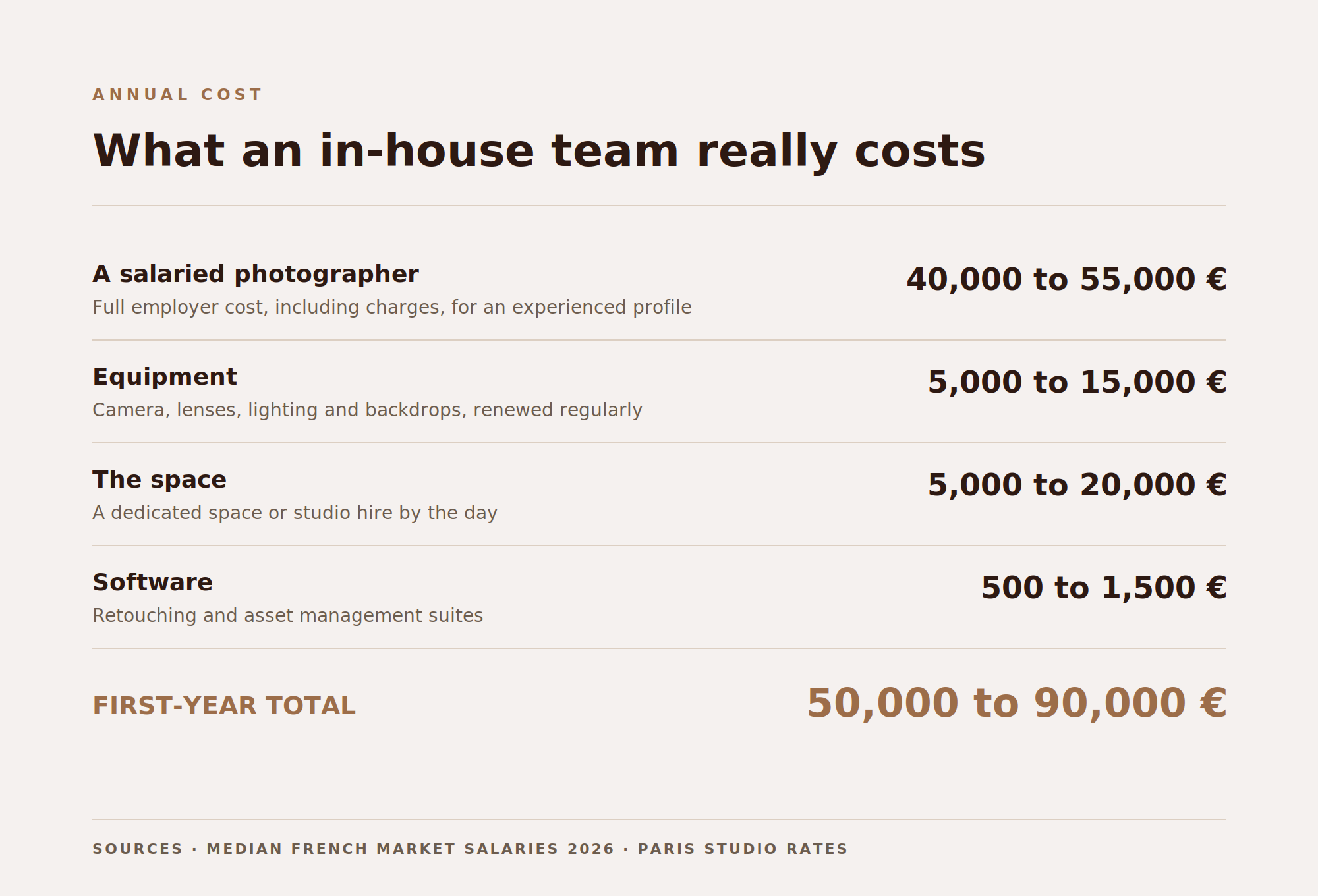
An experienced photographer's salary sits around 28,000 to 38,000 euros gross a year on the French market. Including employer charges, the full cost therefore approaches 40,000 to 55,000 euros. On top of that come equipment, with an initial investment of 5,000 to 15,000 euros for a properly equipped position, the shooting space, and retouching software.
In the first year, the total lands between 50,000 and 90,000 euros depending on your standards. That is the figure to compare against your production invoices, not the salary alone.
An invisible but real cost: management time. Recruiting, supervising, scheduling and reviewing a creative role takes up your team's time. It is not a budget line, but it is a cost.
The break-even point
The comparison becomes clear as soon as you plot it. On one side a fixed cost, independent of volume. On the other a variable cost, proportional to the number of images produced. The two lines cross at a precise point.
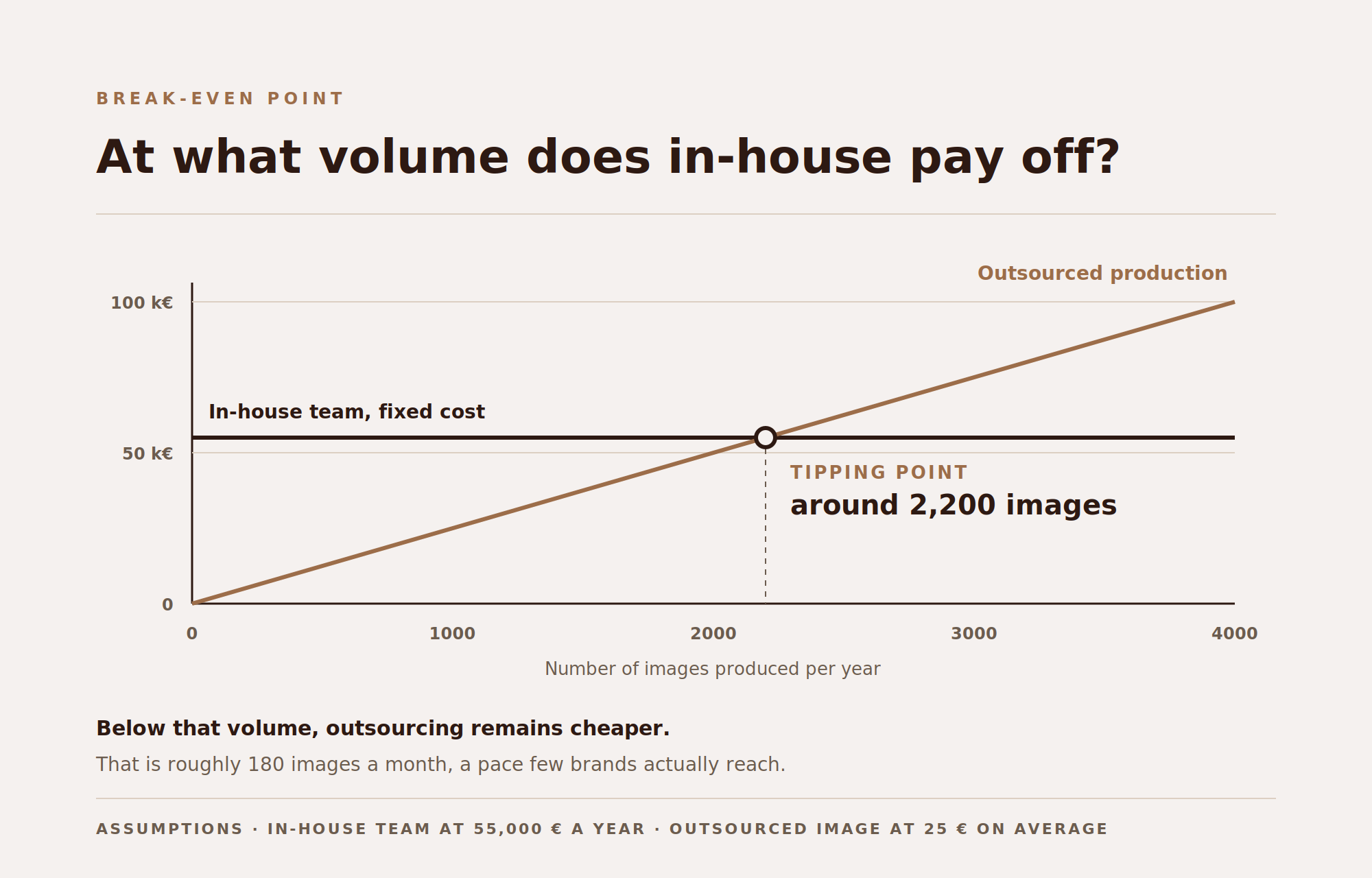
Taking an in-house team at 55,000 euros a year and an average cost of 25 euros per outsourced image, the tipping point sits around 2,200 images a year, roughly 180 a month. Below that volume, outsourcing is cheaper. Above it, going in-house becomes economically defensible.
That figure deserves a reality check. Producing 180 images a month implies a constantly refreshed catalogue, several collections a year and a sustained pace of social content. Few independent brands reach it. To situate your own volume, our article on fashion photoshoot costs details the production rates observed in studio.
What going in-house does not solve
Here is the point most analyses skip, and the one that often decides the matter. Hiring a photographer does not make you self-sufficient on a full production.
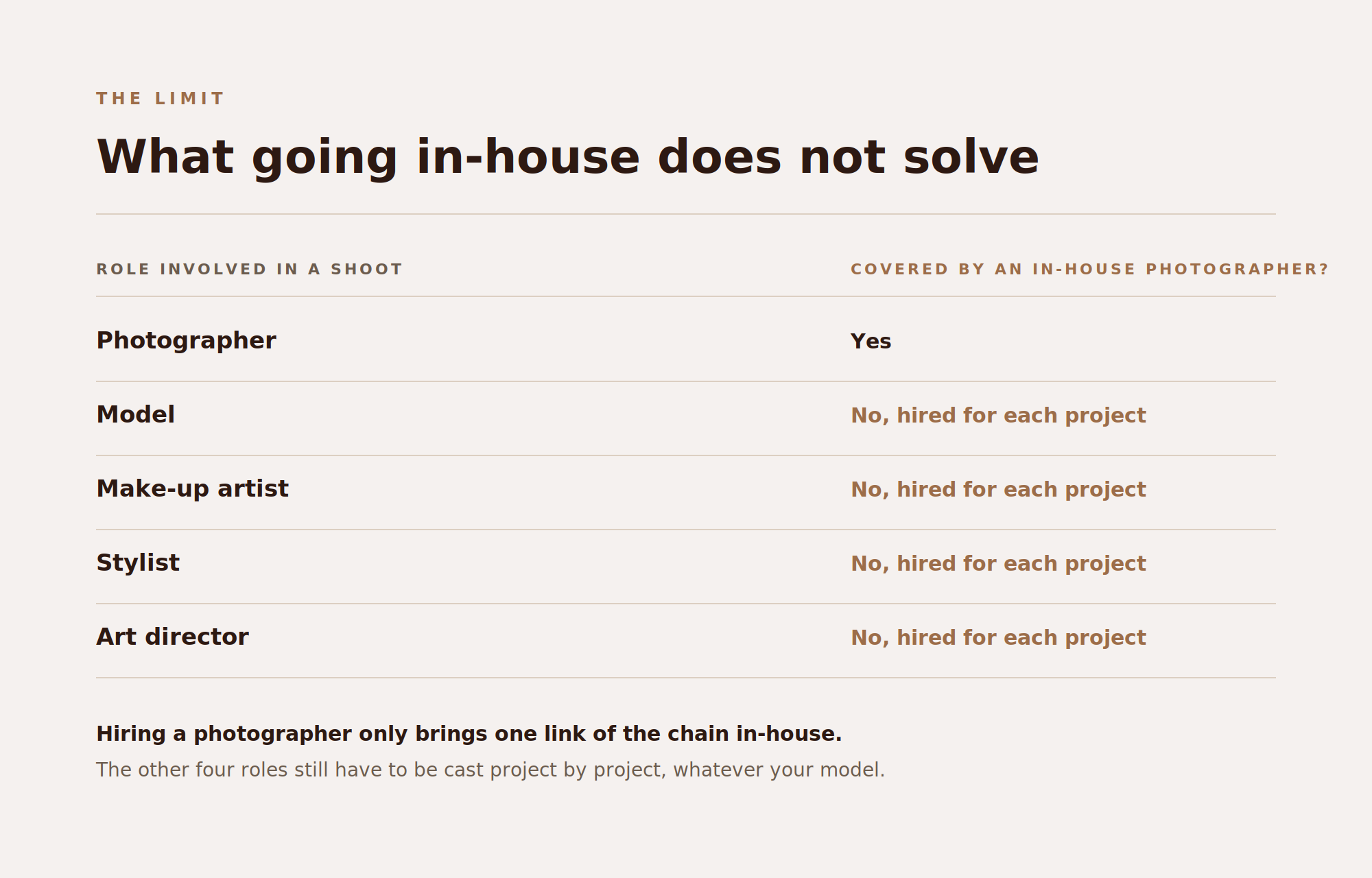
A fashion shoot involves a photographer, but also a model, a make-up artist, a stylist and sometimes an art director. Those four roles still have to be cast project by project, whatever your model. You never fully escape external hiring, unless you recruit a complete team, which pushes the break-even point far beyond the 2,200 images mentioned above.
A second limit concerns variety. An in-house photographer naturally develops a signature, which is a strength for brand consistency and a weakness the moment you need a different register, for instance between an e-commerce packshot and an editorial campaign.
The strengths of each model
What in-house brings
- Responsiveness: an urgent need is handled the same day, with no quote and no scheduling hunt.
- Consistency: one hand produces all the visuals, which unifies the brand identity.
- Product knowledge: the internal team knows the materials, the constraints and the brand's habits.
- Marginal cost: beyond the threshold, each additional image costs almost nothing.
What outsourcing brings
- Variability: you pay for what you produce, with no fixed cost during quiet periods.
- Access to specialists: a packshot photographer, a videographer and a portraitist are three different jobs.
- A fresh eye: rotating contributors avoids the visual fatigue of a single signature.
- No management burden: no recruitment, no supervision, no employment risk.
The hybrid model, where most brands land
In practice, the opposition is often artificial. The most common configuration among growing brands is to bring the repetitive work in-house and outsource whatever demands specialist expertise or creative renewal.
Concretely, that can mean one versatile internal role handling everyday visuals and social content, complemented by an external partner brought in for seasonal campaigns, lookbooks and video production. Or, more simply, a monthly baseline handled by a partner on retainer, with additional support around key moments.
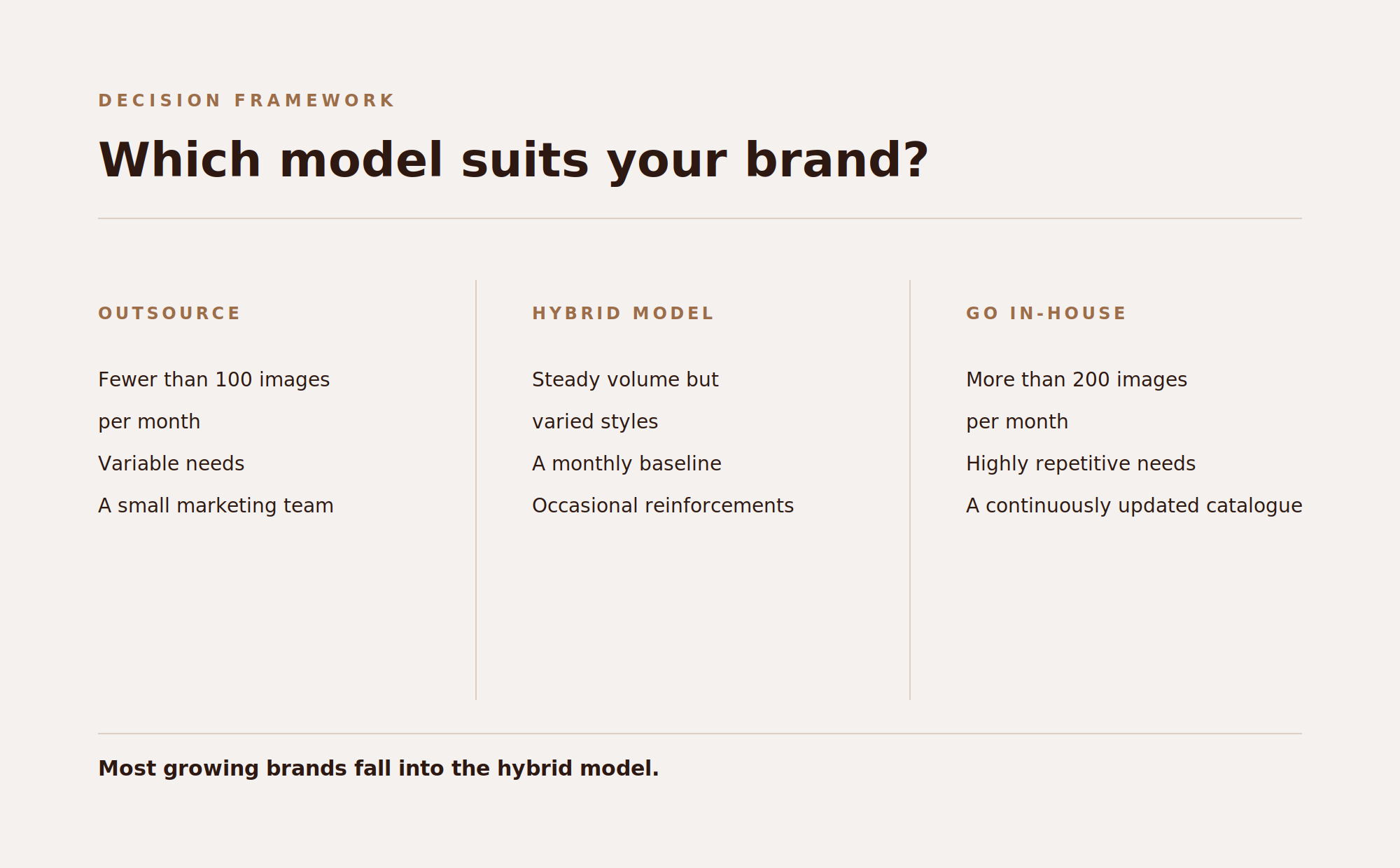
This formula has a decisive financial advantage: it converts part of your fixed costs into variable costs, which protects the brand during a slowdown while still guaranteeing a steady content flow.
How to decide
Four questions are usually enough to point you in the right direction.
- What is your real volume? Count the images you produced over the past twelve months, not the ones you wish you had produced.
- Are your needs repetitive or varied? A homogeneous catalogue suits in-house production; a brand with multiple worlds far less so.
- Is your activity seasonal? Pronounced peaks argue for a variable model.
- Can you supervise a creative role? A poorly briefed photographer delivers less than a well-briefed supplier.
Whatever your answer, one thing holds: you will need external talent to complete your team. Models, make-up artists, stylists and videographers are cast project by project. The Shaare directory lets you contact them directly, with no commission, whichever model you have chosen.
Frequently asked questions
At what volume should I bring production in-house?
Around 2,200 images a year, roughly 180 a month, assuming an in-house team at 55,000 euros a year and an average outsourced cost of 25 euros per image. Below that, outsourcing remains cheaper.
How much does a staff photographer cost in France?
The median salary sits around 27,500 euros gross a year, ranging from 20,000 to 45,000 depending on experience. Including charges, the full employer cost approaches 40,000 to 55,000 euros for an experienced profile.
Is hiring a photographer enough to internalise production?
No. A shoot also involves a model, a make-up artist, a stylist and sometimes an art director, all of whom still have to be cast project by project.
What is a hybrid model?
It means keeping repetitive visuals in-house while outsourcing productions that require specific expertise or creative renewal. It is the most common setup among growing brands.
Does outsourcing cost more in the long run?
Only beyond the break-even point. Below it, the fixed costs of an in-house team weigh more heavily, particularly during quiet periods when production slows.
Conclusion
Choosing between in-house and outsourced content production is not a matter of principle but of volume and variety. Below roughly 180 images a month, the fixed costs of an internal team are hard to absorb. Above it, and provided your needs are consistent, going in-house starts to make sense.
Either way, you will keep working with external talent to complete your teams. Explore the Shaare directory to find and contact them directly.