

Launching a fashion brand no longer requires a fashion school or an investment fund. It requires respecting the order of the steps, and not rushing the ones that cost money.
The context has changed. Tools have become accessible, short supply chains have developed, selling platforms are open to everyone. But the market has hardened in parallel: the French sector is declining in value, international platforms are pushing prices down, and consumer attention is harder to capture than ever.
This guide sets out what you actually need to plan in order to launch a fashion brand in France in 2026: the budget matching your ambition, the right legal structure, the order of steps to follow, and the mistakes that sink most projects.
What budget to plan for
This is the first question, and the available answers range from 10,000 to 100,000 euros, which helps nobody. The spread has a simple explanation: it covers three very different ambitions.
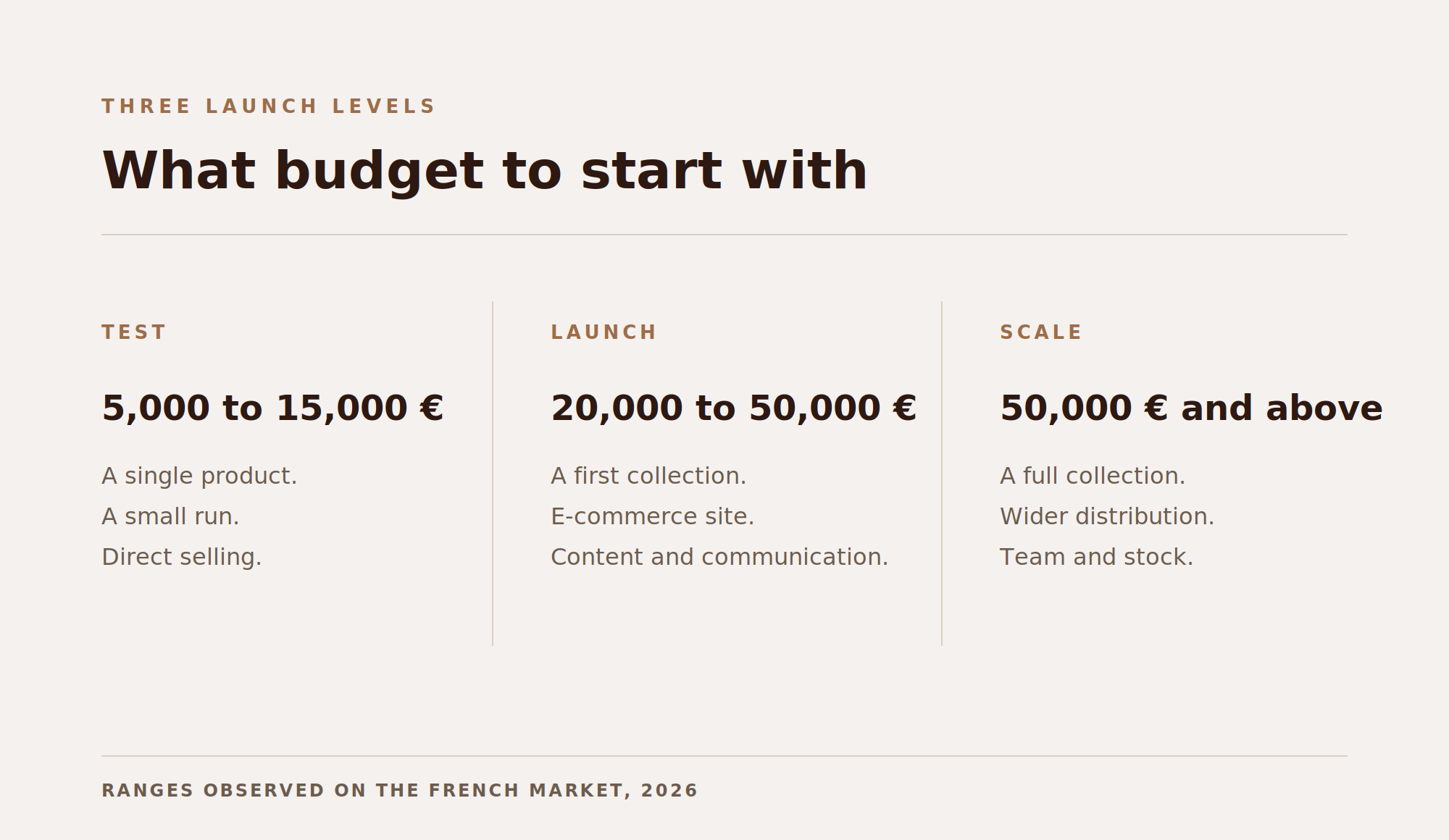
The first level means testing a single product in a small run, handling as much as possible yourself. The second funds a first collection with an e-commerce site and enough to communicate. The third corresponds to a structured launch, with a full collection, stock and wider distribution.
The advice I would give anyone starting out is to aim for the first level, even if the means allow the second. Validating that a product sells before producing a full collection avoids the sector's costliest mistake: unsold stock tying up all the cash.
Where the money actually goes
The budget spreads across five lines, some of which are systematically underestimated at planning stage.
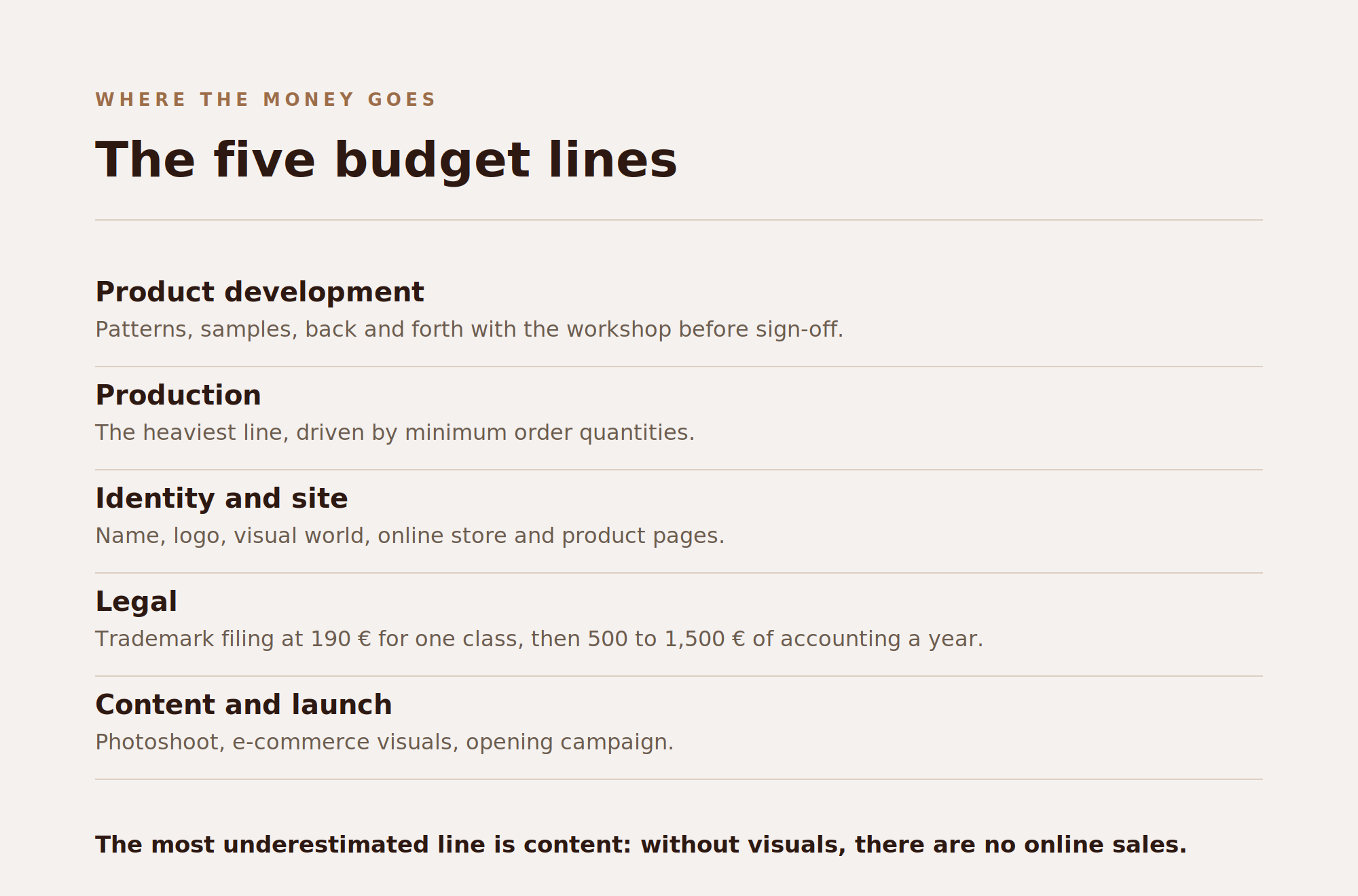
Production is the heaviest line, and its size depends directly on the minimum order quantities imposed by the workshop. That is the central negotiation point with a supplier: a high minimum can sink a project before it launches.
The most neglected line is content. Many founders budget production to the last cent then discover they need visuals to sell, having planned nothing. Yet in online retail, the image is the sales argument: it triggers the purchase, not the description. We cover this in our guide to e-commerce lookbook photography.
Two figures worth knowing: filing a trademark with the French INPI costs 190 euros for one product class, then 40 euros per additional class, for ten years of renewable protection. Basic accounting support runs between 500 and 1,500 euros a year for a simple structure.
Choosing your legal structure
This choice determines your tax treatment, your social charges and your ability to raise funds. Fortunately, it is not permanent.
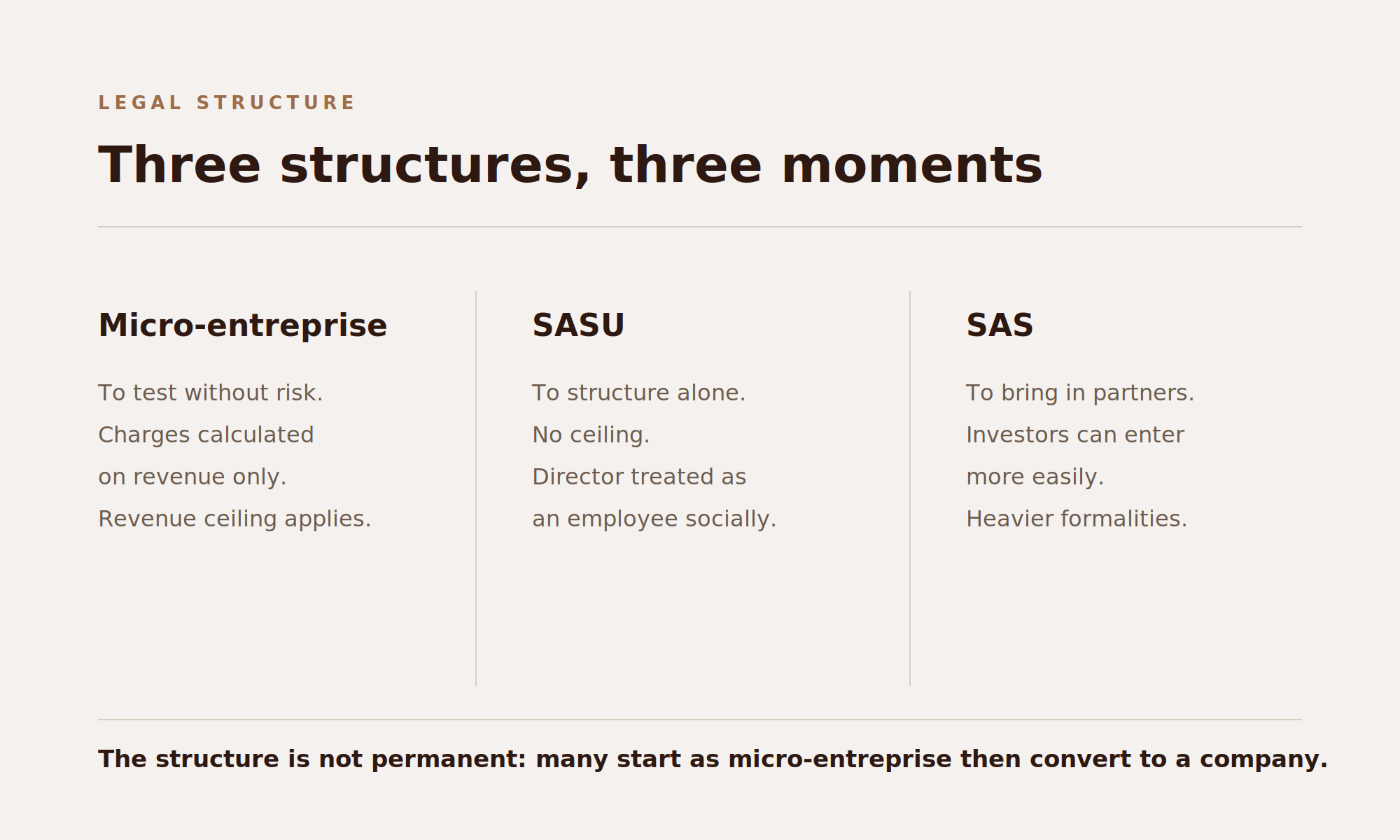
The micro-entreprise remains the most common entry point, precisely because it allows risk-free testing: no revenue, no charges. It suits the validation phase perfectly, with a revenue ceiling as its only real limit, one a growing brand eventually reaches.
The SASU and SAS become relevant as soon as the project structures itself, when you want partners or investors. Converting from one to the other is routine, so there is no need to over-think this choice at the outset.
One point of caution: garment making is classified as a craft activity in France, which may require specific registration depending on how you produce. Check this with an accountant from the start.
The order of the steps
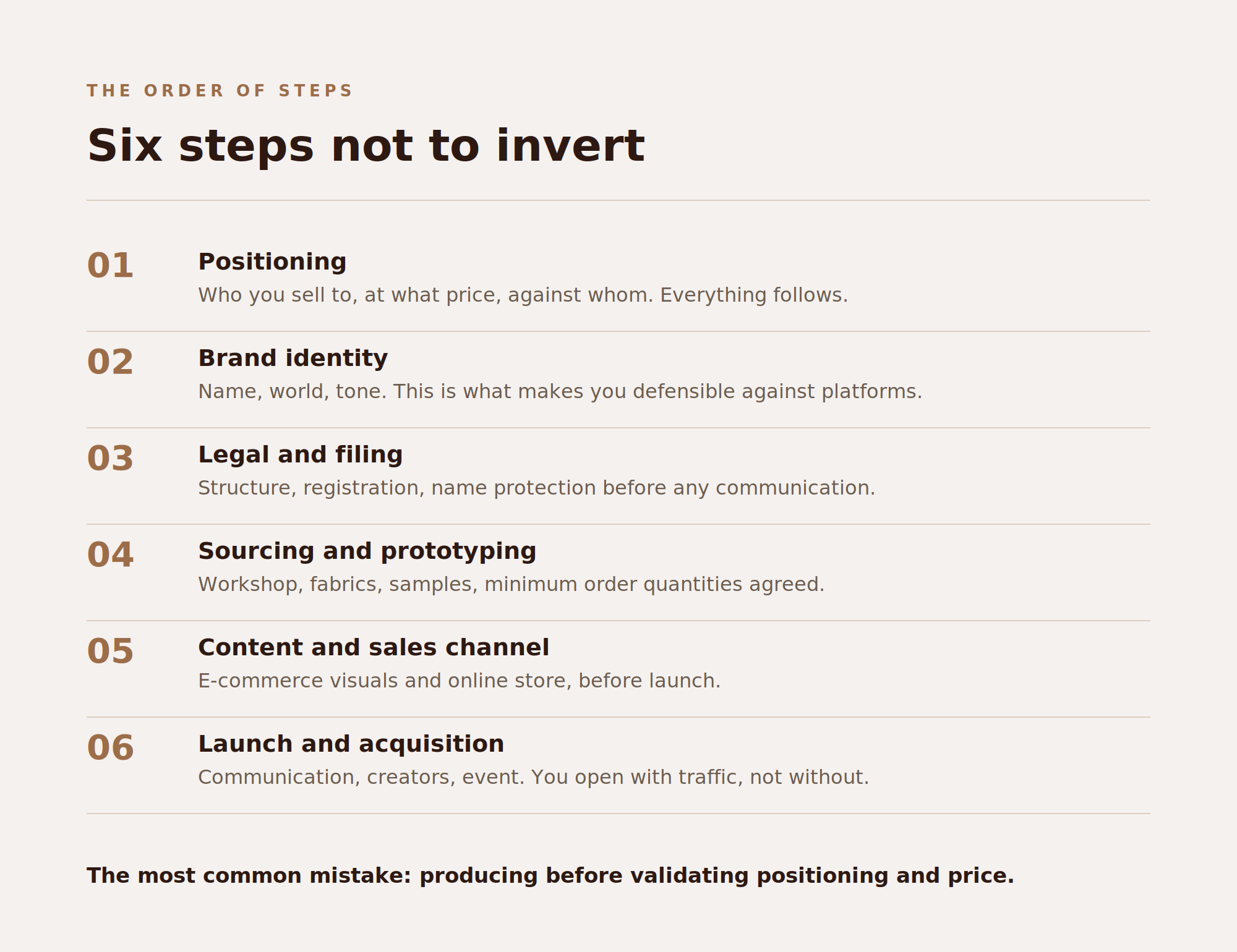
Most failures come not from lack of means but from an inverted order. Producing before validating the positioning, communicating before protecting the name, launching without visuals: these are hard mistakes to undo.
1. Positioning
Who are you selling to, at what price, against whom? In a market where international platforms dominate on price, an independent brand cannot win there. Its defence lies in singularity, world-building and perceived quality. This thinking determines everything else, including the choice of workshop.
2. Brand identity
Name, visual world, tone. This is what makes your brand memorable and defensible. Check name availability before getting attached to it, by searching existing trademark databases.
3. Legal setup and trademark filing
Create your structure and file your trademark before communicating publicly. Discovering your name is already protected after launching your communication means starting over.
4. Sourcing and prototyping
Identify your workshops, order samples, validate fabrics and negotiate minimum quantities. Plan several rounds: a first prototype is rarely the right one. This is also where your cost price, and therefore your margin, is decided.
5. Content and sales channel
Your online store and product visuals must be ready before opening, not after. A product page without proper photos does not convert, whatever the product.
6. Launch and acquisition
Opening a store does not generate traffic. Plan an opening mechanism: creator collaborations, event presence, targeted communication. A brand that opens without an acquisition plan waits for visitors who never come.
The market context to understand
Launching in 2026 means understanding where demand sits. The French fashion market is declining in value, but that average hides considerable gaps: online commerce is growing while physical retail falls, and second-hand is growing three to five times faster than new.
For a brand starting out, that naturally points towards a direct online strategy, with controlled production and a strong identity. We detail these dynamics in our analysis of the French fashion market.
The costliest mistakes
- Producing before validating. Unsold stock ties up cash and blocks everything else.
- Neglecting cost price. A miscalculated margin is discovered too late, once public prices are announced.
- Communicating before protecting the name. Filing costs 190 euros; changing name after launch costs far more.
- Underestimating content. Without quality visuals, the best product does not sell online.
- Trying to do everything alone. Sourcing, photography, communication and management are separate crafts.
Frequently asked questions
What is the minimum budget to launch a fashion brand?
A launch built on a single product in a small run starts around 5,000 to 15,000 euros. A first collection with an e-commerce site sits rather between 20,000 and 50,000 euros.
Which legal structure should I choose?
Micro-entreprise to test without risk, SASU to structure alone, SAS to bring in partners or investors. The structure can change later.
How much does filing a trademark cost?
190 euros for one product class with the French INPI, then 40 euros per additional class. Protection runs for ten years and is renewable.
Should I produce in France?
It depends on your positioning and your selling price. French production strengthens the brand story but weighs on cost price. That trade-off is made at positioning stage, not afterwards.
When should I invest in content?
Before the store opens. Product visuals directly determine conversion: planning them after launch means opening without being able to sell.
Conclusion
Launching a fashion brand in France in 2026 remains achievable, provided you accept one discipline: validate before producing, protect before communicating, and prepare your visuals before opening. The budget matters less than the order in which it is spent.
To build your launch team, from photographer to model to content creators, explore the Shaare directory or hand us your production from end to end.