

Ads built on creator content convert up to four and a half times better than studio-produced creative. At a fraction of the cost.
That double finding explains the shift of the past two years. UGC, or user generated content, is no longer an experimental format reserved for digitally native brands: it has become the main fuel of paid campaigns on Meta and TikTok, and a content source in its own right for fashion and beauty brands.
What persists is a stubborn confusion between UGC and influencer marketing, which leads many brands to frame their first projects badly. This guide clarifies the distinction, sets out performance and budget benchmarks, and details the method for launching your first batch.
What UGC actually changes
Creator content rests on a simple principle: a video that looks like a genuine recommendation holds attention better than an ad that looks like an ad. The figures bear that out.
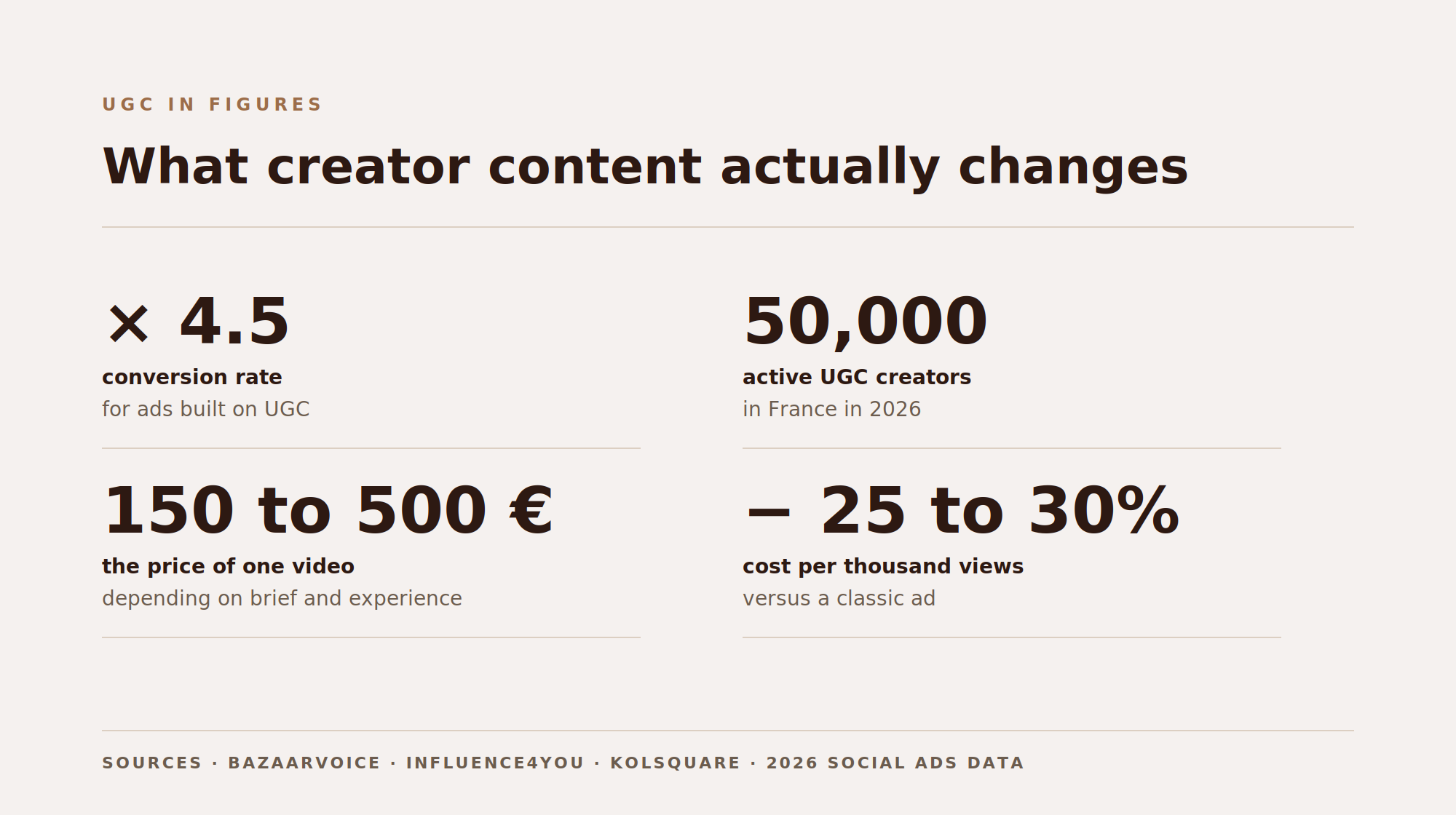
According to Bazaarvoice, ads built on UGC show a conversion rate 4.5 times higher than studio-produced creative. On TikTok, amplifying creator content through native formats delivers a cost per thousand views 25 to 30% lower than a classic ad, with higher perceived credibility.
The second factor is accessibility. France now counts more than 50,000 active UGC creators, a figure that has nearly doubled in a year. A video costs between 150 and 500 euros depending on the brief and the creator's experience, against the cost of an equivalent studio production.
The decisive argument for paid media: campaigns wear out. Creative has to be renewed constantly to avoid ad fatigue. UGC lets you produce ten variations where a classic production funds one.
UGC and influence: do not confuse them
This is the most common framing error, and an expensive one. Both levers involve creators, but you are not buying the same thing at all.
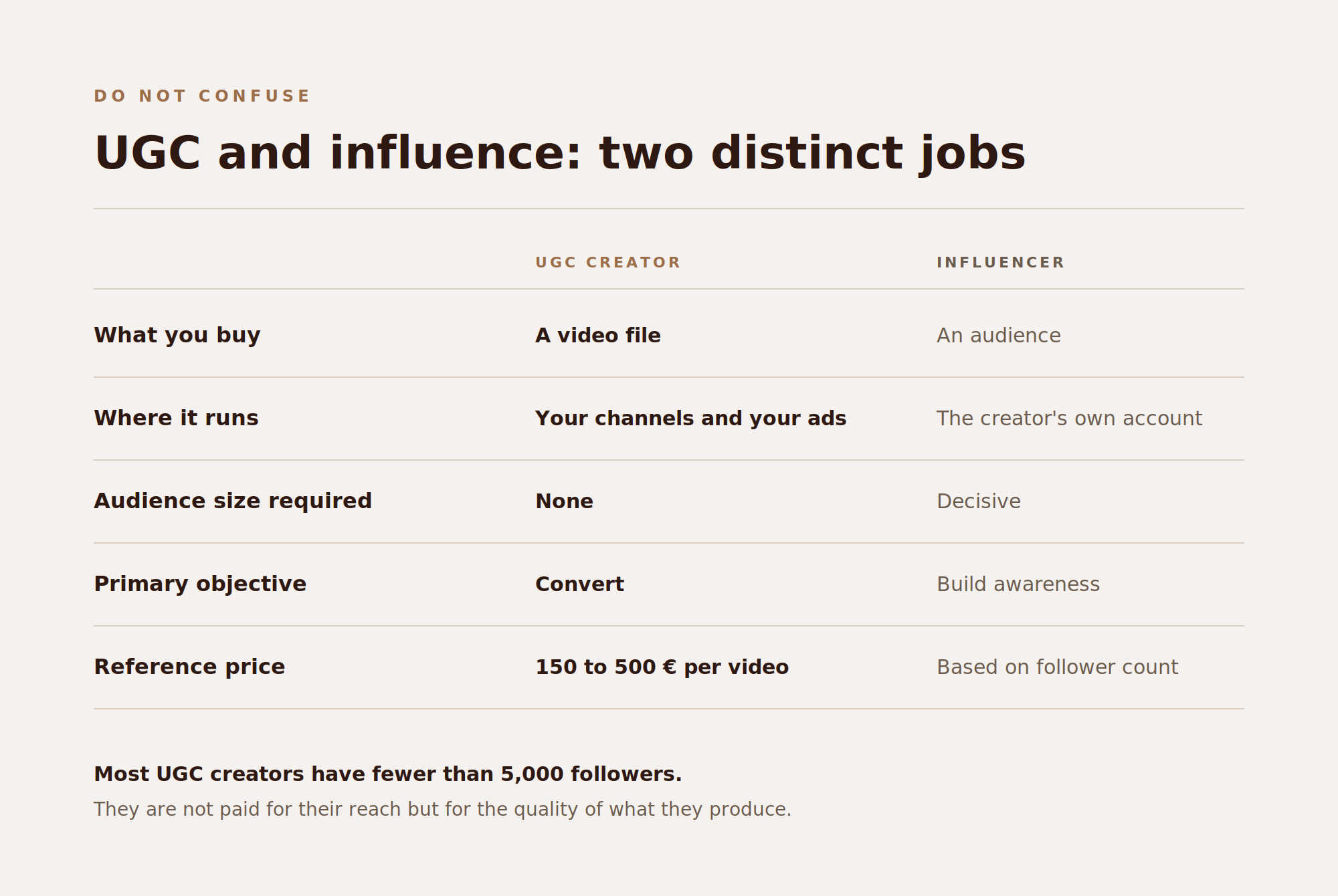
With an influencer, you buy access to their audience: the content is published on their account, and the fee depends on follower count. With a UGC creator, you buy a deliverable: they hand you a video file that you distribute yourself, on your channels or in paid ads. Their personal audience is irrelevant, which is why most UGC creators have fewer than 5,000 followers.
The practical consequence matters. You can work with an excellent UGC creator nobody has heard of, provided they film well, write strong hooks and deliver on time. For the full picture of the influence lever, see our influencer marketing guide.
The formats that work
Not all videos are equal. Five angles come up consistently in high-performing campaigns, and they should be specified explicitly in the brief.
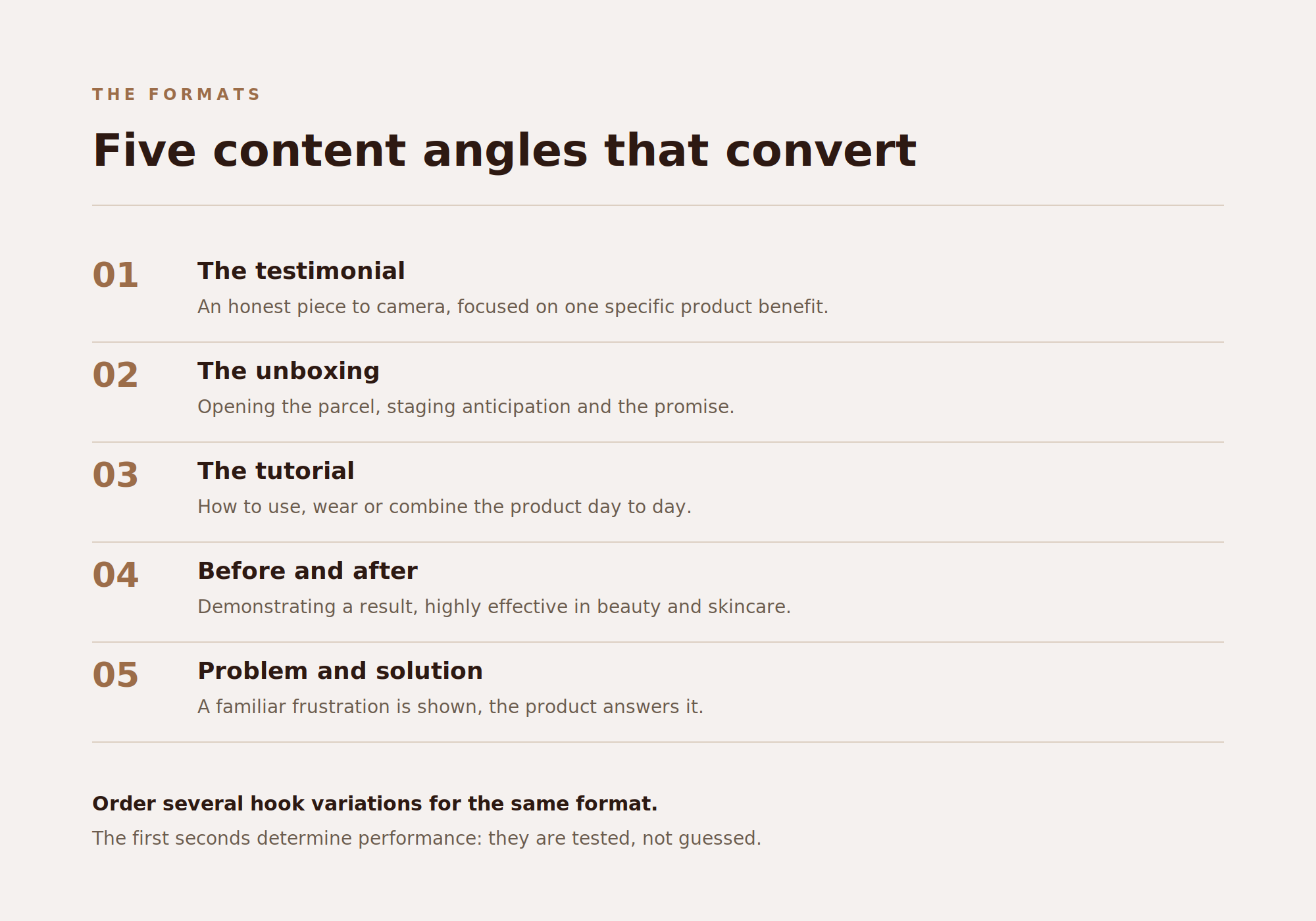
One technical point deserves emphasis: in these short formats, fifteen to thirty seconds, performance is decided in the first two seconds. That is why you should order several hook variations for the same content, so they can be tested in paid media. A video that fails with one hook can perform with another, with nothing else changed.
What to budget
The base rate for a video sits around 100 euros for a simple format, rising to 250 or 500 euros once scripting and genuine creative work are involved. An average of roughly 200 euros is a realistic benchmark for a standard video.
Two items are systematically added and often escape the initial budget. Usage rights first: creating the content and licensing it are two separate services. Running the video in paid advertising, over a long period or on additional channels, is billed on top. The media budget second, which has nothing to do with the creator's fee.
For a first batch, plan three to five videos rather than one: testing requires something to compare. Campaign budgets are detailed in our article on influencer campaign costs.
How to launch your first batch
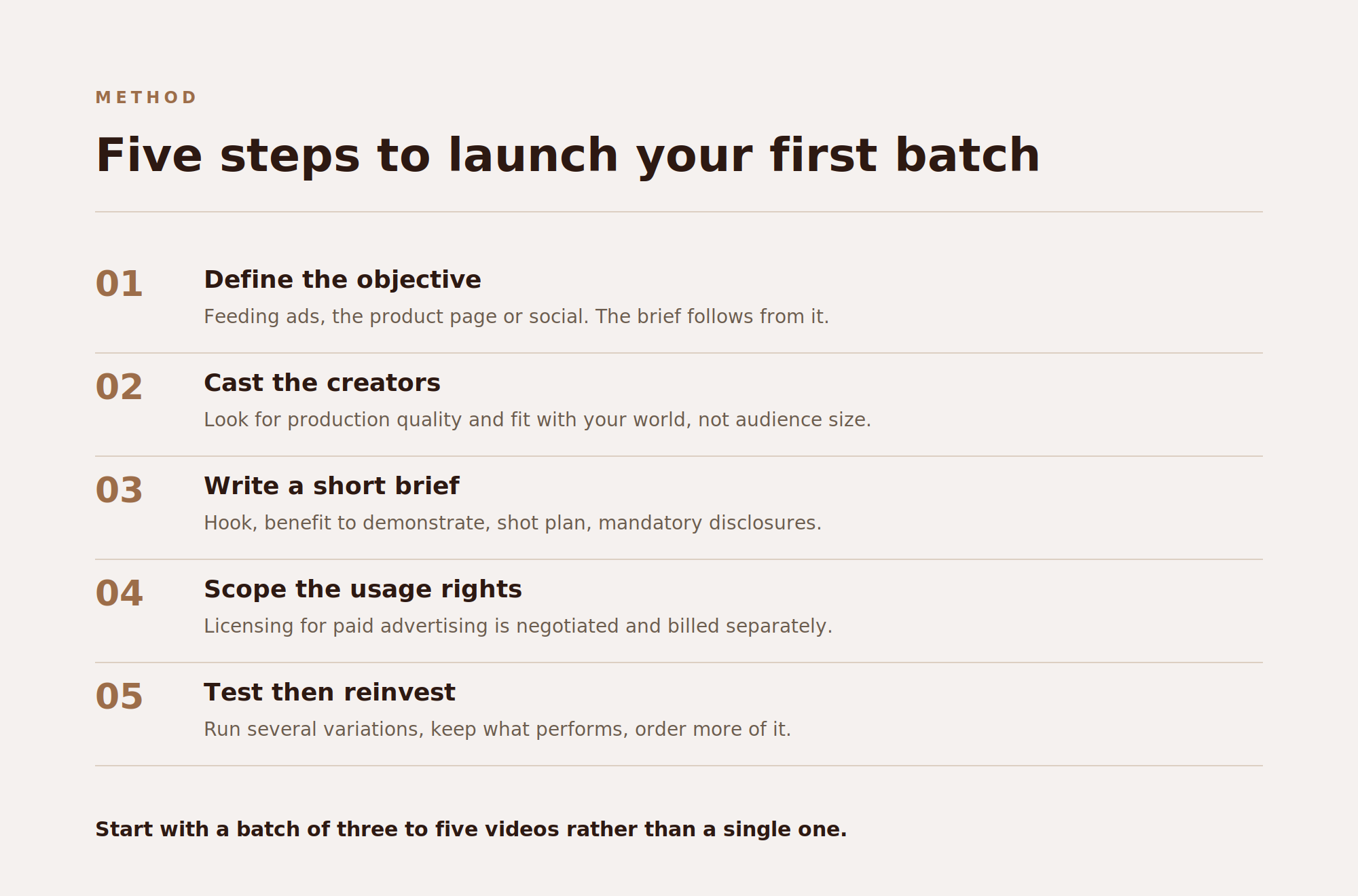
The most neglected step is the brief. A UGC creator is not a director: they expect clear direction. Specify the hook you want, the benefit to demonstrate, the shot plan, the delivery format and any mandatory disclosures. A well-built one-page brief beats three weeks of messages.
The most profitable step is the last one. Run several variations, identify what performs, then order more from the creators whose content worked. That is how you build a library of effective advertising creative, reusable season after season.
Mistakes to avoid
- Choosing a creator for their audience. In UGC, only production quality and fit with your world matter.
- Ordering a single video. With nothing to compare, you will not know whether the format or the hook was at fault.
- Forgetting usage rights. Running content in paid media without the licence exposes you needlessly.
- Over-briefing until the naturalness dies. Overly scripted content loses the authenticity that makes UGC perform in the first place.
- Confusing gifting with payment. Sending a product can start a relationship, but the moment you exploit the content in advertising, it is a professional service.
A regulatory reminder: in France, as soon as the total value of a collaboration reaches 1,000 euros excluding VAT within a calendar year with a single advertiser, gifted products included, a written contract is mandatory.
Frequently asked questions
What is the difference between UGC and influence?
With an influencer you buy an audience, and the content is published on their account. With a UGC creator you buy a file that you distribute yourself. Their follower count is irrelevant.
How much does a UGC video cost?
Between 150 and 500 euros depending on the brief and the creator's experience, averaging around 200 euros for a standard format. Usage rights for paid media are billed on top.
Do I need a large budget to start?
No. A first batch of three to five videos is a modest investment compared with a studio production, and is enough to test the channel.
Can UGC be used outside paid advertising?
Yes, on your social channels, product pages, newsletters or landing pages. Just check that the licence you negotiated covers those uses.
How do I recognise a good UGC creator?
By their portfolio: image and sound quality, hook writing, reliability on deadlines. Personal audience is not a relevant criterion.
Conclusion
UGC has taken hold because it solves two problems at once: advertising performance, with content that converts markedly better, and production volume, with a unit cost that allows creative to be renewed continuously. It still has to be framed properly, by clearly separating this lever from influence and budgeting usage rights from the start.
To find the creators that fit your brand, explore the Shaare directory and contact them directly, or hand us the production of your next batch.