

The French fashion market fell 1.9% in the first quarter of 2026. Yet some segments are growing 20% a year. The whole question is where to look.
Headlines about the sector's crisis hide a more nuanced reality. The market is not contracting uniformly: it is moving. Online sales grow while physical stores decline, second-hand grows three to five times faster than new, and consumption is not disappearing, it is changing channel and logic.
This article gathers the available data on the French fashion market in 2026, then draws concrete conclusions for brands. The aim is not to describe a decline, but to identify where growth still sits.
A market under pressure
Start with the uncomfortable numbers. According to the Institut Français de la Mode, sector revenue fell 1.9% by value in the first quarter of 2026 compared with the same period in 2025. March was particularly difficult, down 3.7%.
Several factors combined. An unfavourable calendar effect first, with one fewer Saturday in March 2026 than the previous year. A deteriorating macroeconomic backdrop next, marked by renewed inflation that led some consumers to postpone clothing purchases.
The most worrying point lies elsewhere: the gap with the pre-pandemic period is not closing. First-quarter 2026 revenue remains 13.6% below the same period in 2019. Six years on, the sector has not recovered its former level of activity.
The widening gap between channels
The average hides a clear split. Behind the overall decline sits a deep redistribution between distribution channels.
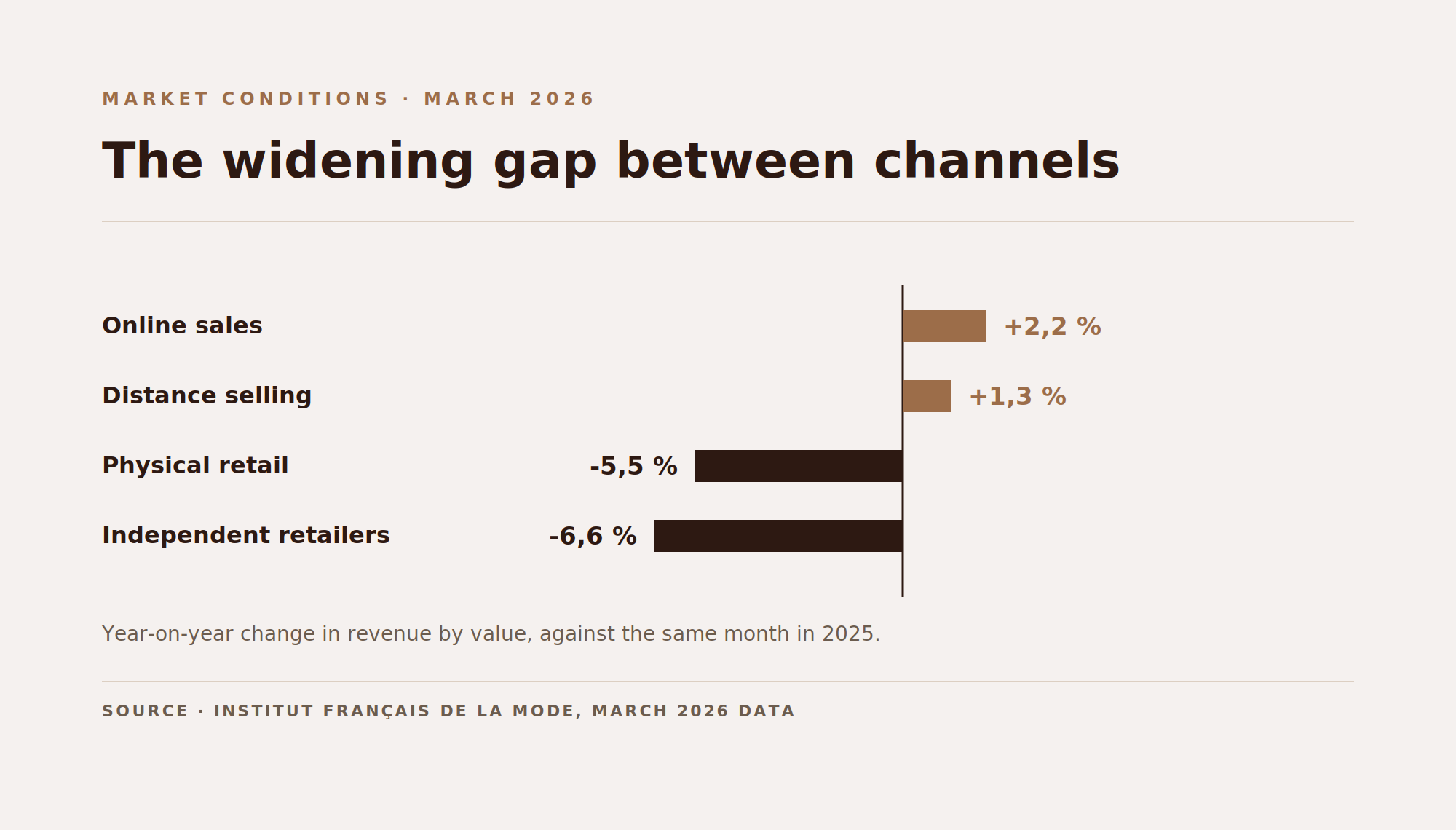
In March 2026, online sales rose 2.2% while physical retail fell 5.5%. The gap approaches eight points. Independent multi-brand retailers were hit hardest, with revenue down 6.6%.
This divergence is not cyclical, it is structural. It reflects a lasting shift of value towards digital channels, and explains why some traditional retailers struggle to recover despite strong collections.
E-commerce, the one engine still running
The contrast becomes striking when you widen the lens to online commerce as a whole.
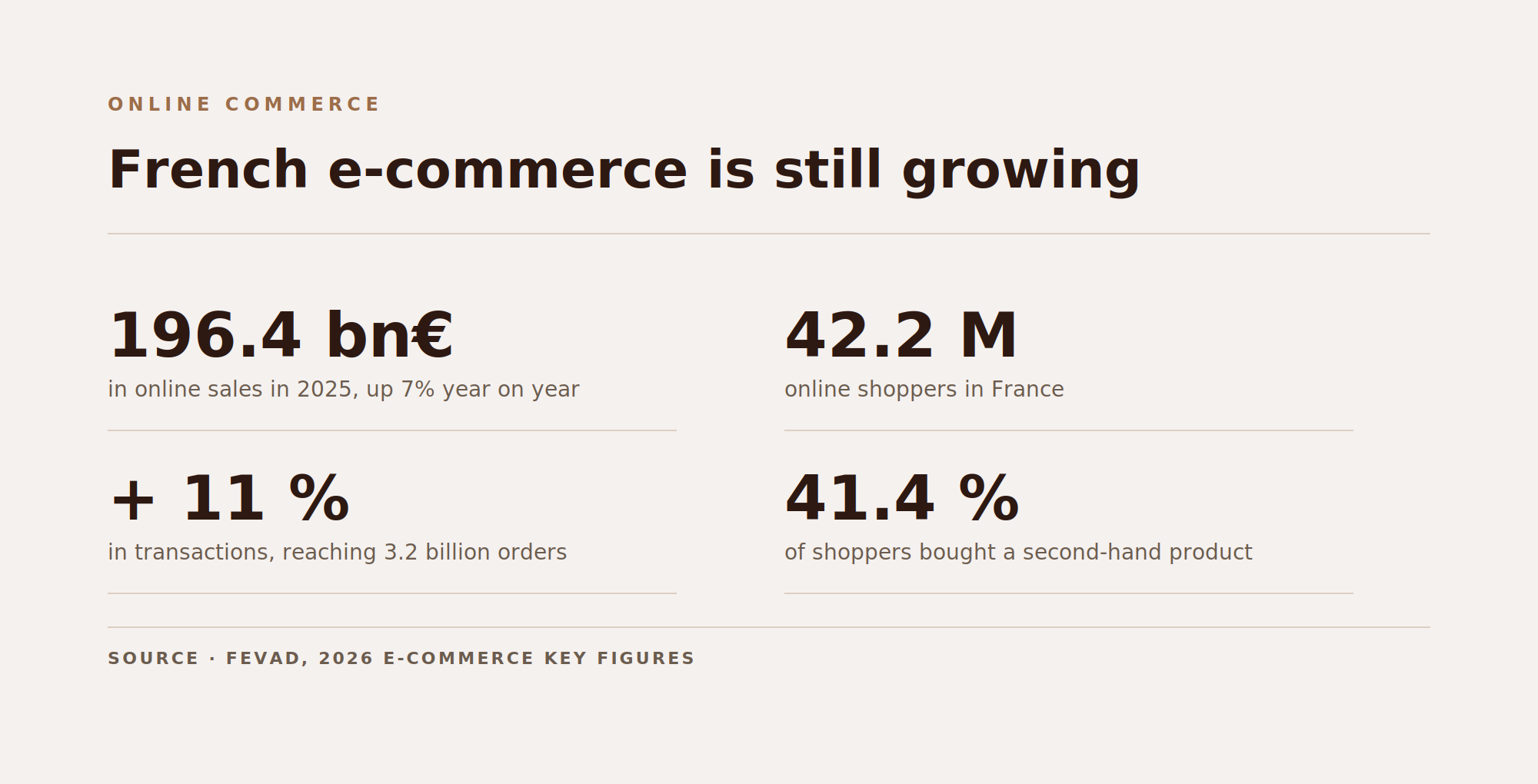
According to key figures published by Fevad, online sales of goods and services reached 196.4 billion euros in 2025, up 7% year on year. Transactions rose 11% to 3.2 billion orders, spread across 42.2 million online shoppers.
One detail deserves brands' attention: the average basket stands at 62 euros, and growth no longer comes from rising prices but from a rising number of orders. In other words, French consumers buy more often, in smaller amounts. This fragmentation changes the game, because it rewards frequency of contact with the brand rather than the exceptional basket.
Second-hand, the leading growth engine
This is the segment reshaping the sector's economics most deeply, and the one many brands still watch from a distance.
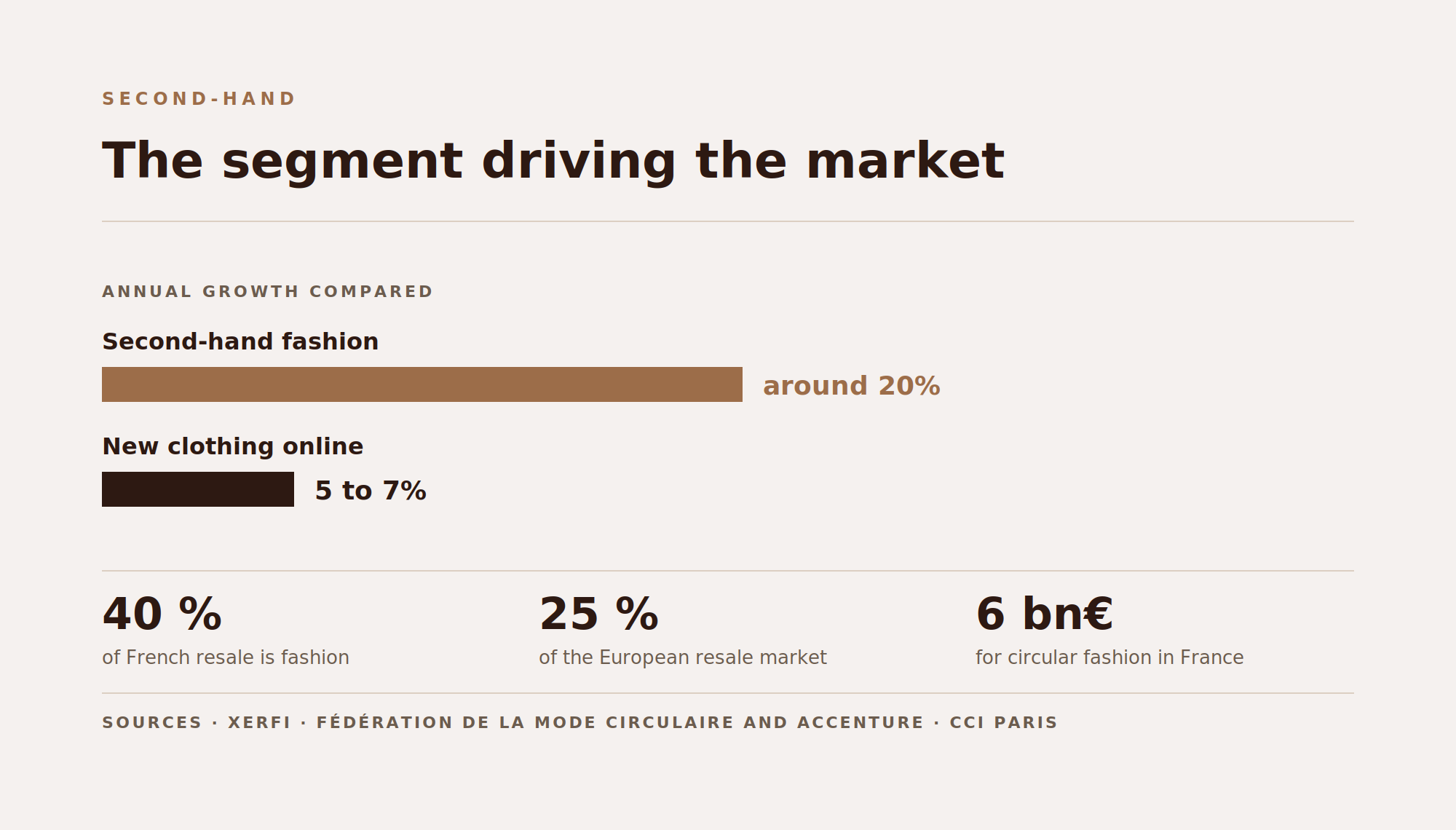
Fashion accounts for roughly 40% of the French second-hand market, making it the largest category ahead of electronics and furniture. Its annual growth sits close to 20%, while new clothing sold online grows 5 to 7%. France alone represents nearly a quarter of the European resale market.
The phenomenon has left the activist niche. Fevad reports that 41.4% of online shoppers bought at least one second-hand product in the past twelve months, and the buyer profile has broadened well beyond young urban consumers. New and used no longer stand in opposition: a significant share of consumers combines both.
A methodological note: estimates of the second-hand market size vary noticeably between sources, from 7 to 12 billion euros for fashion, depending on scope and on whether peer-to-peer transactions are counted. The growth trend, however, is not disputed.
Beyond resale, French circular fashion as a whole, covering rental, repair, reuse and upcycling, is valued at more than 6 billion euros by the Fédération de la Mode Circulaire, with annual growth close to 12% projected through to 2030.
What these figures mean for brands
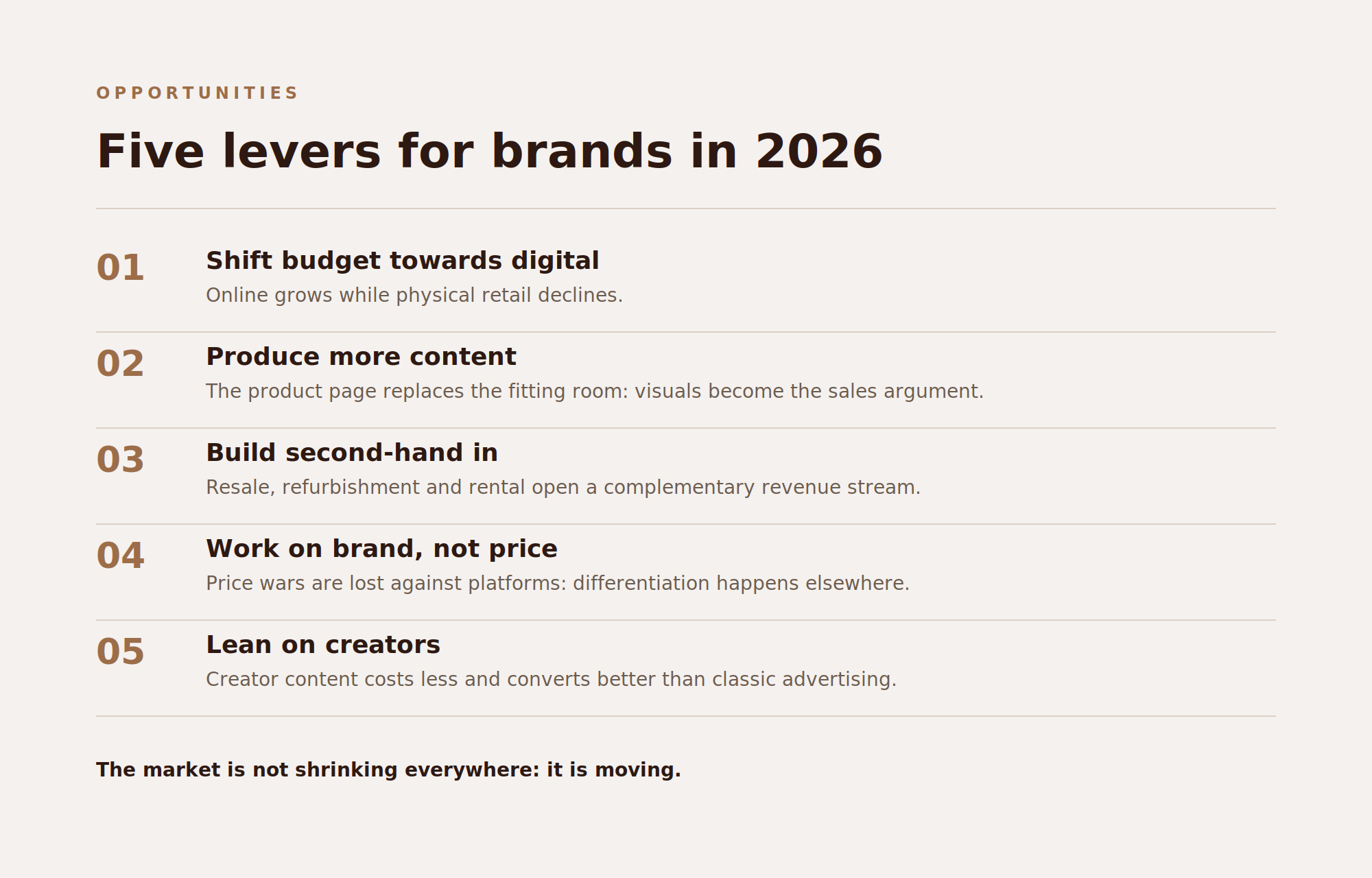
A market that moves is not a market that disappears. But your resources have to move at the same pace.
Visuals become the sales argument
When sales move online, the customer no longer tries on, touches or compares in store. They buy what they see. The quality of product visuals stops being an aesthetic question and becomes a direct driver of conversion. This also explains why content production keeps gaining ground in marketing budgets, a subject we cover in our guide to fashion content production.
Frequency matters more than basket size
With a stable average basket and more frequent purchases, the brand relationship plays out through repeated contact. That calls for a steady content flow rather than two large campaigns a year.
Differentiation no longer runs through price
Against international platforms and resale, the price battle is lost in advance for an independent brand. What remains defensible is the world you build, your singularity and perceived quality, all carried by imagery.
Creators cost less than advertising
With constrained budgets, creator-produced content offers a cost-to-performance ratio that is hard to match, which explains its rapid rise. We analyse this channel in our influencer marketing guide.
Second-hand is a revenue stream, not a threat
Buy-back, refurbishment and rental are now built into several retailers' models, with a double benefit: complementary revenue and a credible sustainability argument.
Frequently asked questions
Is the French fashion market in crisis?
The market is declining in value, down 1.9% in the first quarter of 2026, and remains more than 13% below its 2019 level. But the decline is very uneven across channels: online commerce grows while physical retail falls.
Which segments are still growing?
Online commerce, up 7% in 2025 across all sectors, and above all second-hand, whose annual growth in fashion sits close to 20%.
How large is second-hand within fashion?
Fashion makes up roughly 40% of the French second-hand market, its largest category. Value estimates vary depending on the scope used.
Why are independent retailers suffering most?
They combine exposure to the physical retail decline, limited capacity to invest in digital, and competitive pressure from platforms. Their revenue fell 6.6% in March 2026.
Where should a brand invest first?
In its online presence and the quality of its visual content, since that is now where conversion happens. Creator content also offers a strong cost-to-performance ratio.
Conclusion
The French fashion market in 2026 is not collapsing, it is reorganising. Value is moving from physical retail to digital, from new to used, from ownership to use. The brands losing ground are often those still allocating resources according to the geography of a market that no longer exists.
For brands able to shift their investment towards content, digital and circular models, conditions remain favourable. It does require producing enough images, often enough, with the right talent. Explore the Shaare directory to find the profiles that will let you keep that pace.