

A product page carrying four images or more converts 14% better than one carrying a single photo. Across a full catalogue, that gap changes a season.
Selling online, the customer does not touch the product, try it on, or compare it on a rail. They buy what they see. Which is why visuals are not an aesthetic question but a direct commercial lever, and why lookbook photography deserves as much attention as pricing or copy.
This guide covers what to produce in practice: how many images per reference, which ones, in what order, to which technical specifications, and how to prepare the day so the budget is not wasted.
Why visuals decide the sale
The data all points the same way. According to the Baymard Institute, shops offering four or more photos per product show a conversion rate 14% higher than those showing only one. More broadly, photography carries a major share of the online purchase decision, ahead of price and ahead of reviews.
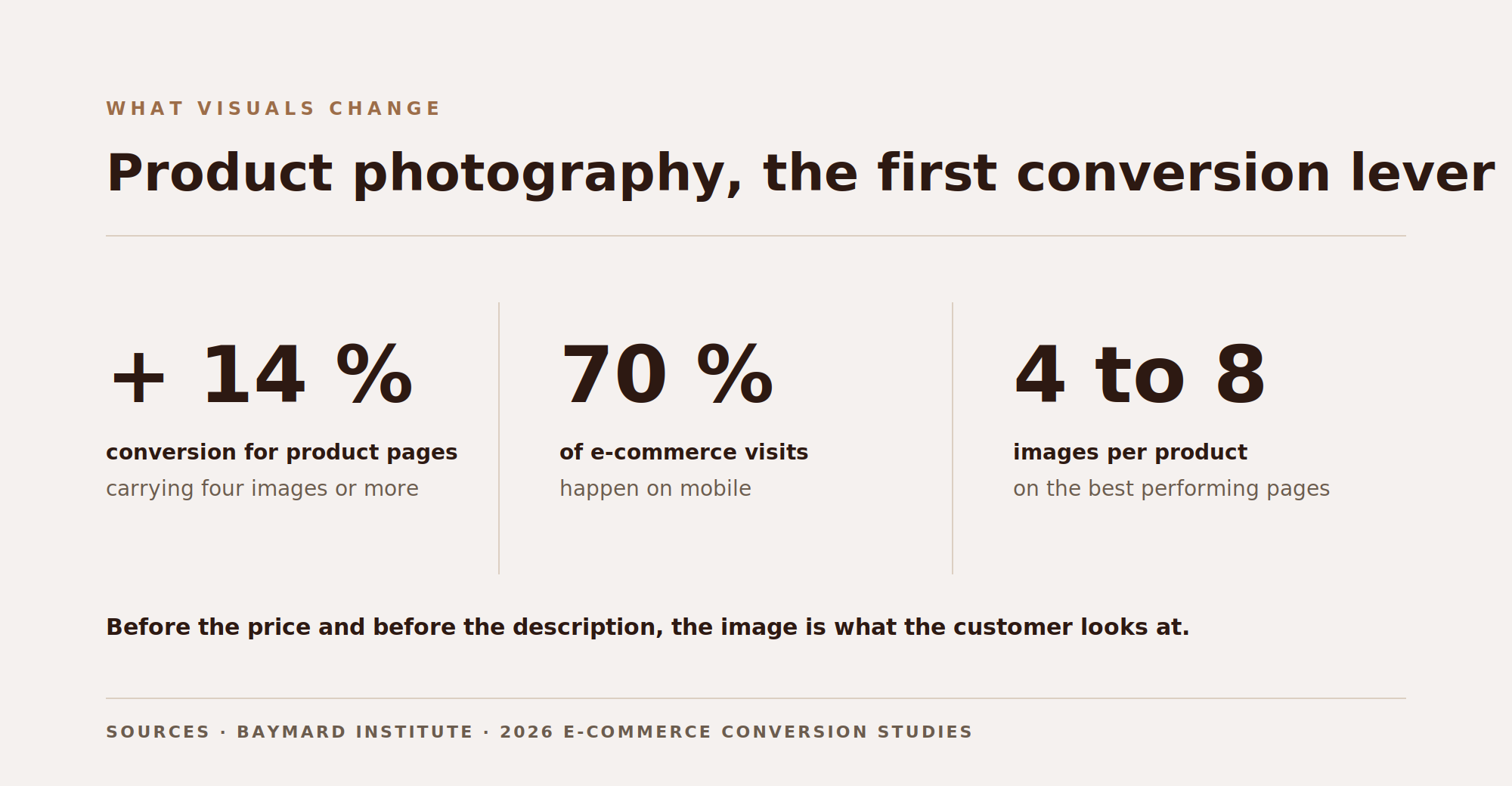
A second factor changes everything: seven in ten e-commerce visits now happen on mobile. On a six-inch screen, the image fills most of the page. It becomes the product page in itself, and flaws that passed on a desktop screen become disqualifying.
The calculation to run: if your product page converts at 1.5% and you move to four well-built visuals, a conversion gain in the region of 14% represents, across an active catalogue, considerably more than the cost of the shoot that produced it.
How many images per product, and which ones
The best performing pages carry between four and eight images. But the number matters less than the composition of the set: each visual should answer a question the buyer asks before checking out.
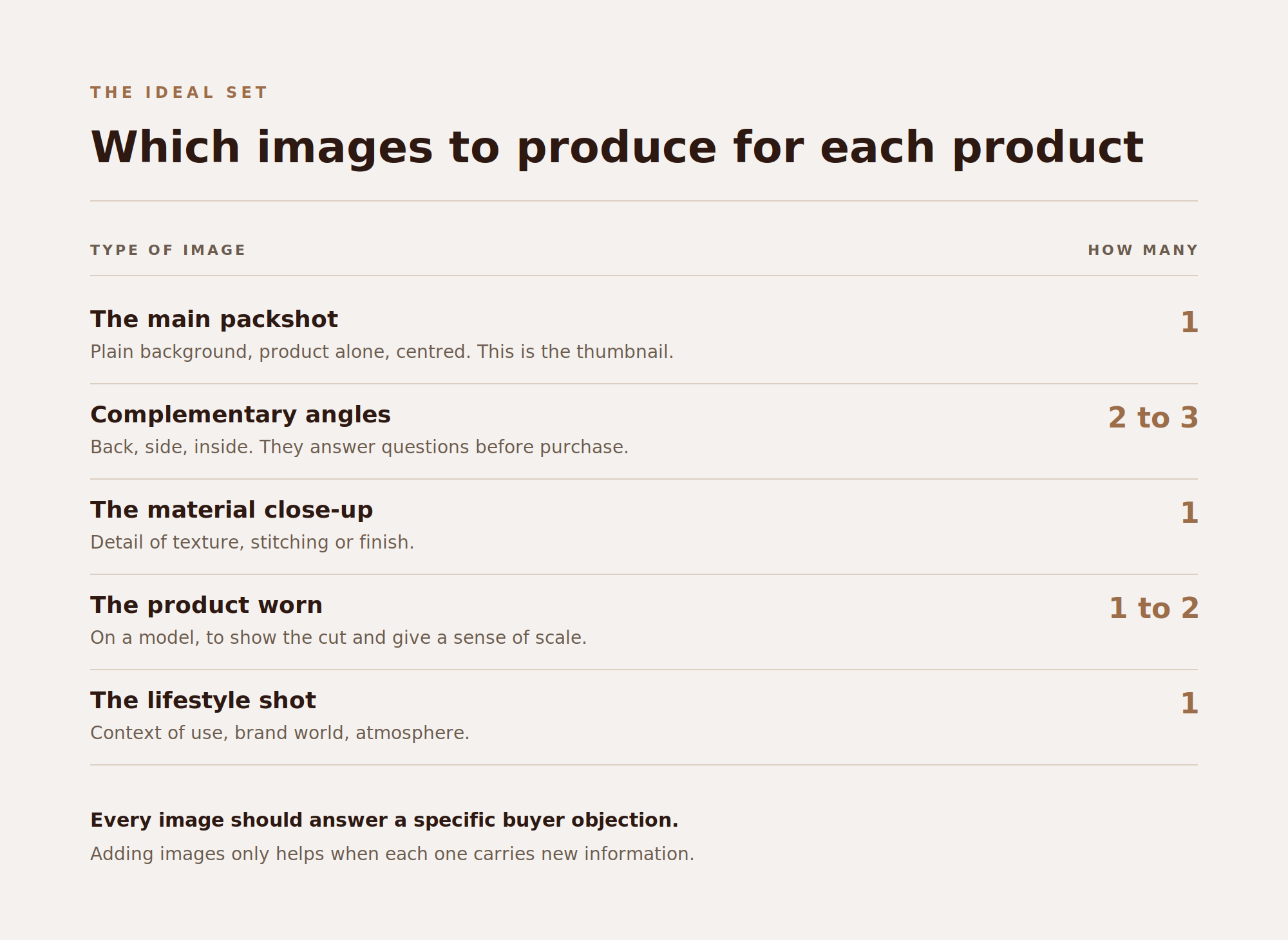
The main packshot serves as the thumbnail in the catalogue and in search results: it is what triggers the click. Complementary angles remove doubt about how the product is built. The material close-up replaces touch, which makes it the most underrated image in fashion. The product worn conveys cut and scale, decisive information for limiting returns. The lifestyle shot, finally, establishes the brand's world.
Adding images beyond eight generally achieves nothing, other than cluttering the page and slowing it down. The right instinct is to remove any visual that says nothing new.
Packshot or lookbook: two crafts, two budgets
Confusing these two formats is the leading cause of a failed shoot. They share neither objective, nor method, nor cost.
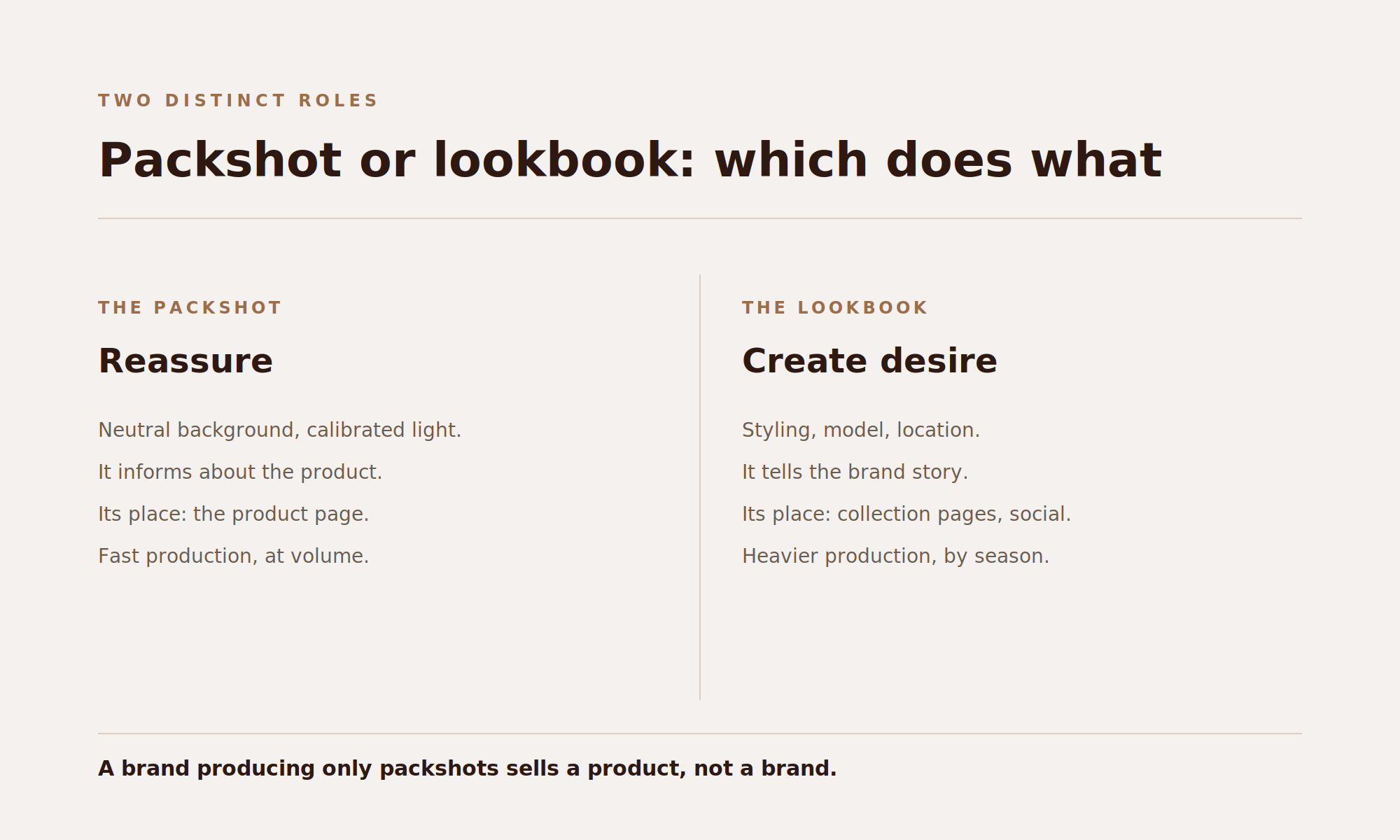
The packshot informs and reassures. It is produced at volume, at pace, under standardised conditions. The lookbook creates desire. It involves a model, a stylist, a make-up artist, sometimes a location, and is conceived by season. Merging the two in a single brief means paying lookbook rates for packshot output, or the reverse.
In practice, a fashion brand needs both. The packshot feeds the product page, the lookbook feeds collection pages, social media and advertising. Their respective price ranges are detailed in our article on fashion photoshoot costs.
The technical specifications to respect
A beautiful image delivered badly is unusable. These are the settings that determine whether your images can actually be exploited, in the catalogue and in search.
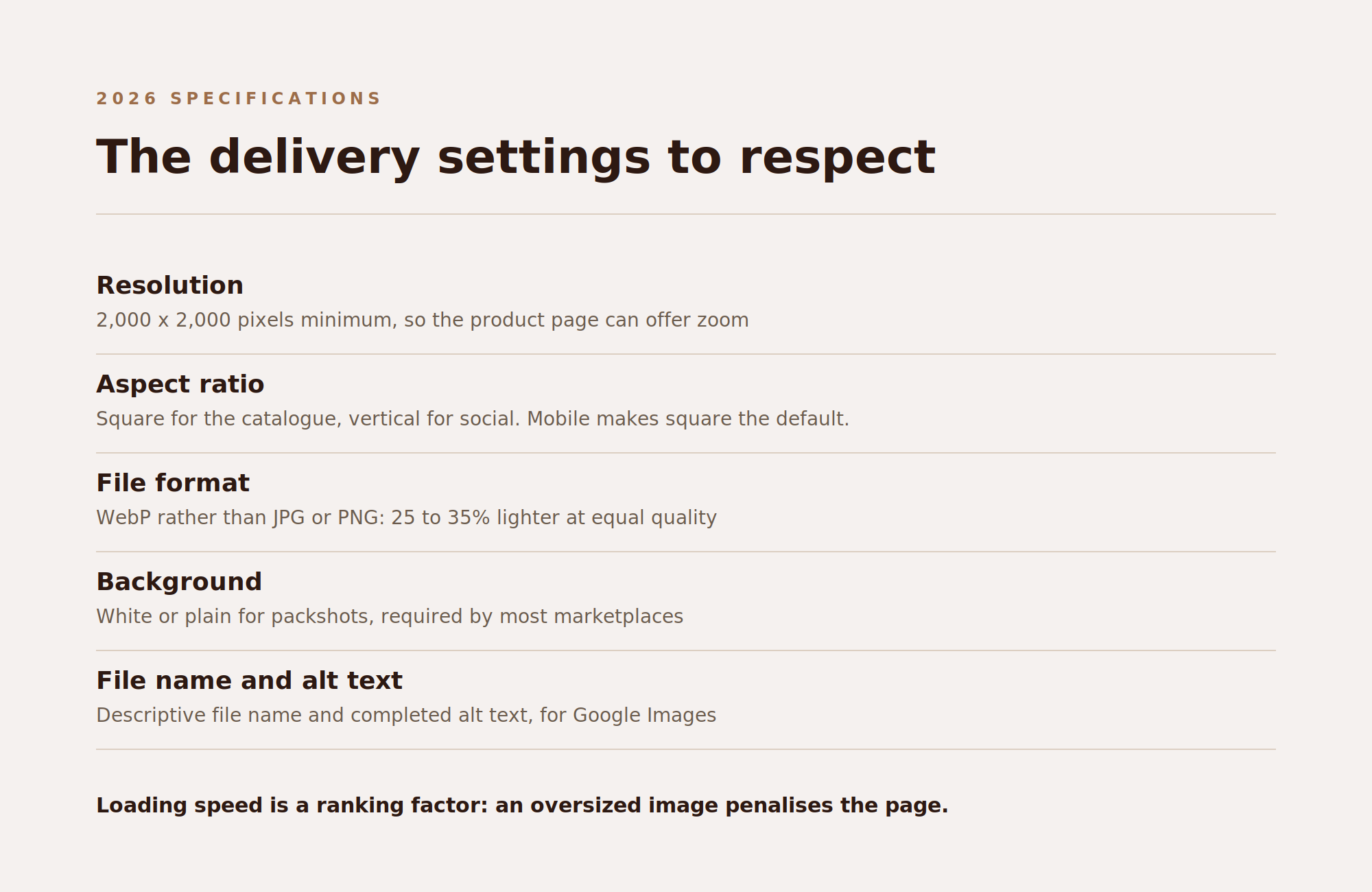
Two points deserve particular attention. File weight first: loading speed is a confirmed Google ranking factor, and images make up the heaviest part of it. Moving to WebP cuts file size by 25 to 35% at equal quality. Naming second: a descriptive file name and a completed alt tag improve your visibility in Google Images, a channel often overlooked in fashion.
Also check the requirements specific to each marketplace, which usually impose a white background and precise framing for the main image. Pass those constraints to the photographer at briefing stage: correcting them afterwards means a full reshoot.
Preparing the day so it is not wasted
A shoot budget is controlled before the day itself. A well prepared day produces roughly twice as many usable images as an improvised one, at the same cost.
- Prepare the products: steamed, labelled, in running order, in sizes matched to the chosen model.
- Frame the brief: visual references, list of deliverables per reference, technical constraints.
- Set a running order: grouping looks by set or by lighting avoids repeated adjustments.
- Cast in advance: models, make-up artists and stylists book up several weeks ahead during busy periods.
- Plan post-production: it often takes as long as the shoot itself and should be scheduled accordingly.
On that last point, our dedicated guide to briefing a shoot team details what to share in order to avoid costly back-and-forth.
The mistakes that cost the most
- A single image per product, depriving the buyer of any further information.
- Supplier photos, identical to those of dozens of competitors, with no possible differentiation.
- No worn photo, when fit is the leading cause of returns in fashion.
- Unoptimised visuals that slow the page down and penalise its ranking.
- Inconsistent results across references, for instance colour shifts between shoots, which blurs brand identity.
That last mistake argues for regular production rather than isolated, widely spaced shoots. It is also the main argument for a stable production partner, a subject we cover in our comparison of in-house versus outsourced content production.
Frequently asked questions
How many photos are needed per product?
Between four and eight on the best performing pages. The effective minimum is a main packshot, two to three angles, a material close-up and a worn shot.
What resolution for e-commerce visuals?
2,000 x 2,000 pixels minimum, so the product page can offer zoom. Square remains the catalogue standard, particularly on mobile.
Do I need a model for an e-commerce shoot?
For fashion, yes. The worn photo shows cut and gives scale, two pieces of information that noticeably reduce return rates.
What is the difference between a packshot and a lookbook?
The packshot informs and is produced at volume on a neutral background. The lookbook stages the product to build the brand's world. Both are complementary but differ in cost and method.
Can the visuals be reused on social media?
Yes, provided vertical formats are planned at shooting stage. Cropping a square image to vertical always cuts part of the product.
Conclusion
A successful lookbook photography shoot is not judged on the beauty of a single frame, but on whether the full set answers the buyer's objections. Four to eight images per reference, a clear distinction between packshot and lookbook, technical specifications respected and a day prepared in advance: those four elements are enough to turn a production budget into a conversion lever.
To build the team for your next shoot, whether photographer, model, make-up artist or stylist, explore the Shaare directory and contact the profiles that fit your world directly.