

Asked what holds their influencer campaigns back most, 77.8% of brands name the difficulty of measuring return on investment. Well ahead of budget, well ahead of casting.
The paradox is stark: 94% of brands that use influencer marketing judge it effective, but a large majority admit they cannot demonstrate it. So investment continues on conviction rather than measurement, which holds while budgets are rising and becomes untenable the moment trade-offs are needed.
This guide covers why influencer ROI resists measurement, which metrics to watch depending on the objective, how to build a calculation that holds up, and what to put in place before launch so the campaign is measurable at all.
Why influencer ROI resists measurement
Three structural reasons, and none of them is a flaw in method.
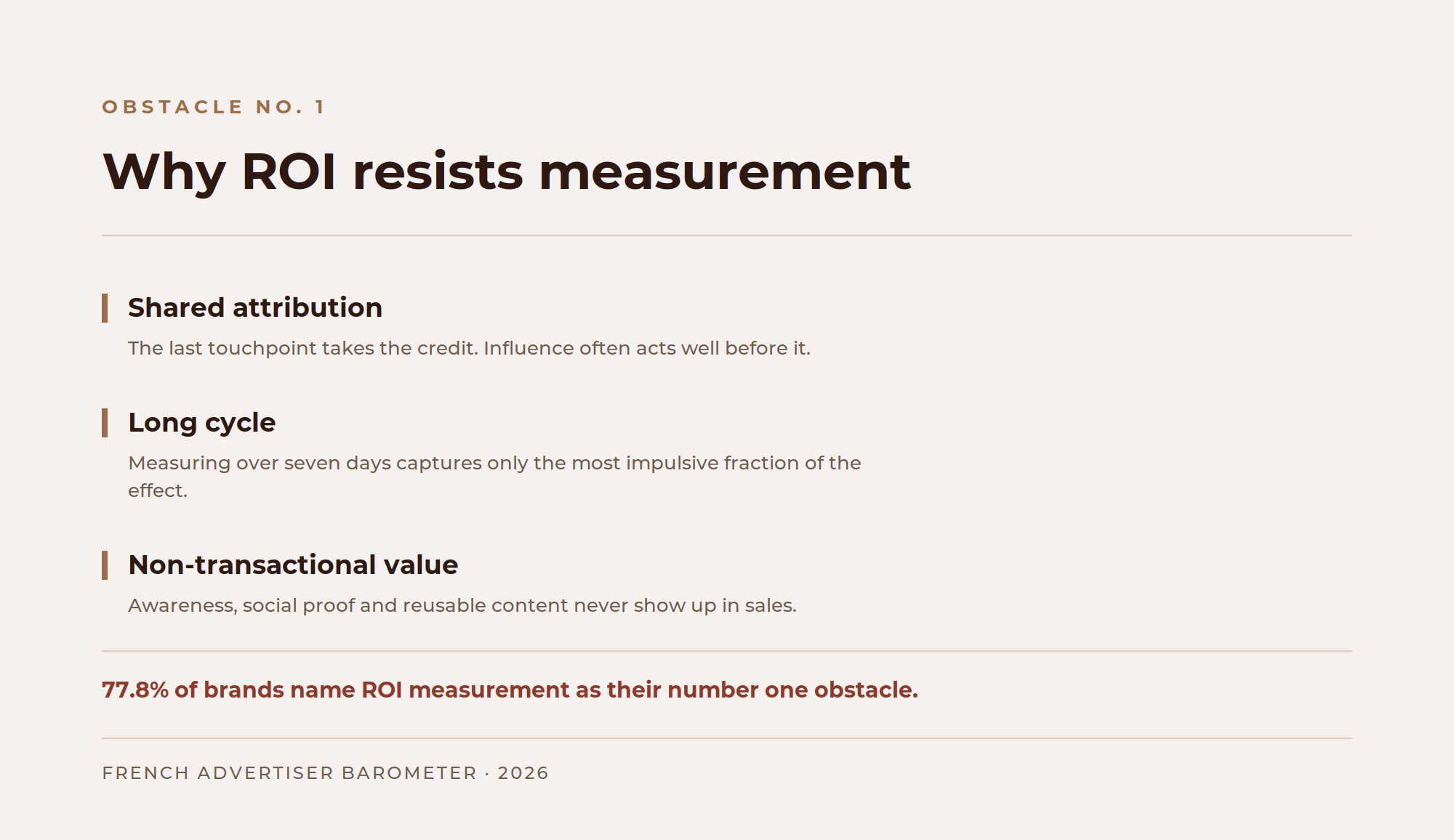
Attribution is shared. Someone sees creator content, does not act, comes back to the brand three weeks later through a search, then buys. Measurement tools credit the sale to the last touchpoint, meaning the search. Influence produced the effect, another line takes the credit.
The cycle is long. Unlike direct-response advertising, influencer marketing often works upstream of the decision. Measuring a campaign over the seven days after publication looks only at its most impulsive fraction.
Part of the value is not transactional. A campaign produces awareness, social proof and reusable content. All three have real economic value, and none shows up in a sales table.
Define the objective before the metric
The most common mistake is launching a campaign and then looking for something to measure. The reverse order is the only one that works: the objective decides the metric, and the metric decides what has to be installed before launch.
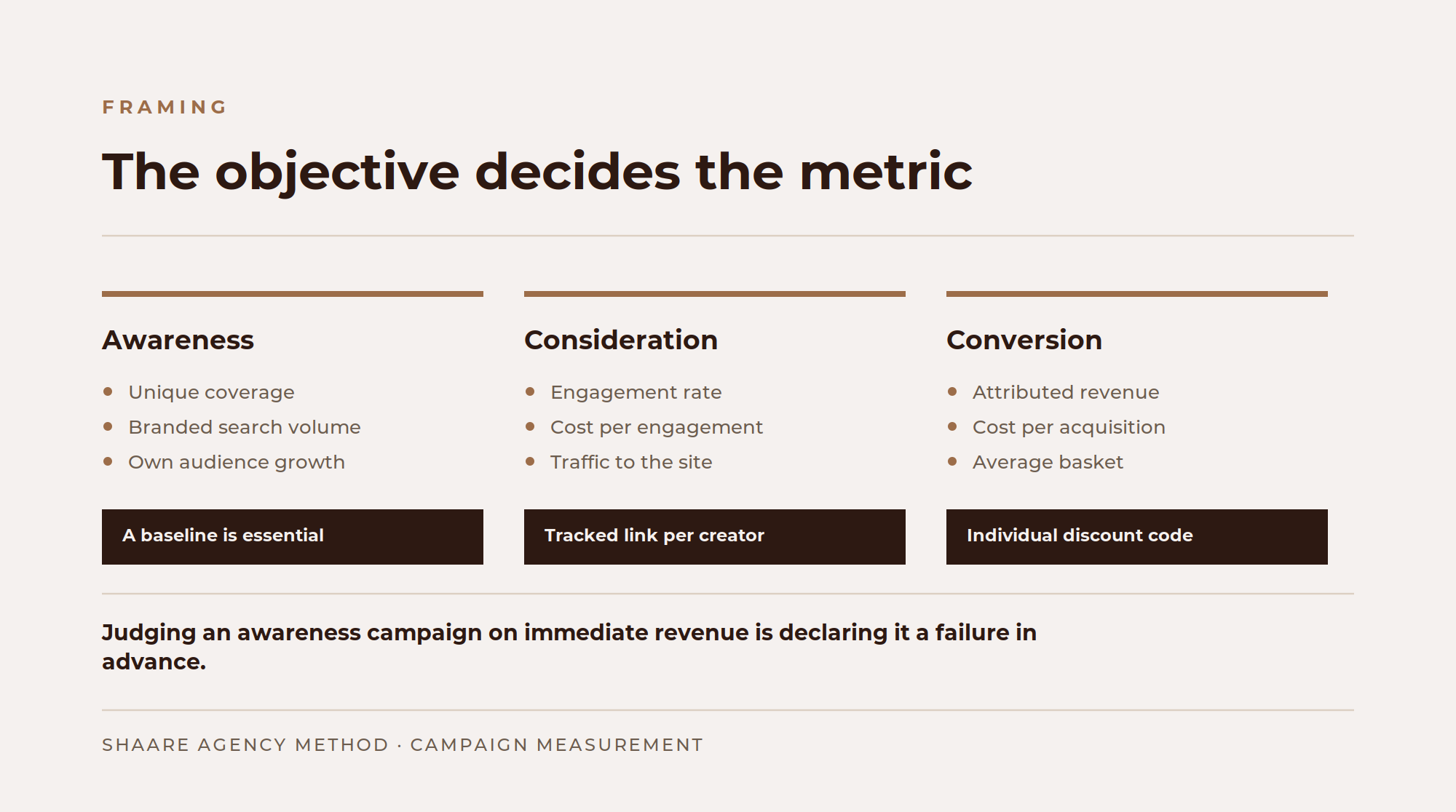
An awareness campaign judged on immediate revenue will be declared a failure. A conversion campaign judged on reach will be declared a success when it sold nothing. In both cases the metric was wrong from the start.
The five levels of measurement
A campaign is measured in successive layers, from the widest to the narrowest. Each level has its metric and its limits.
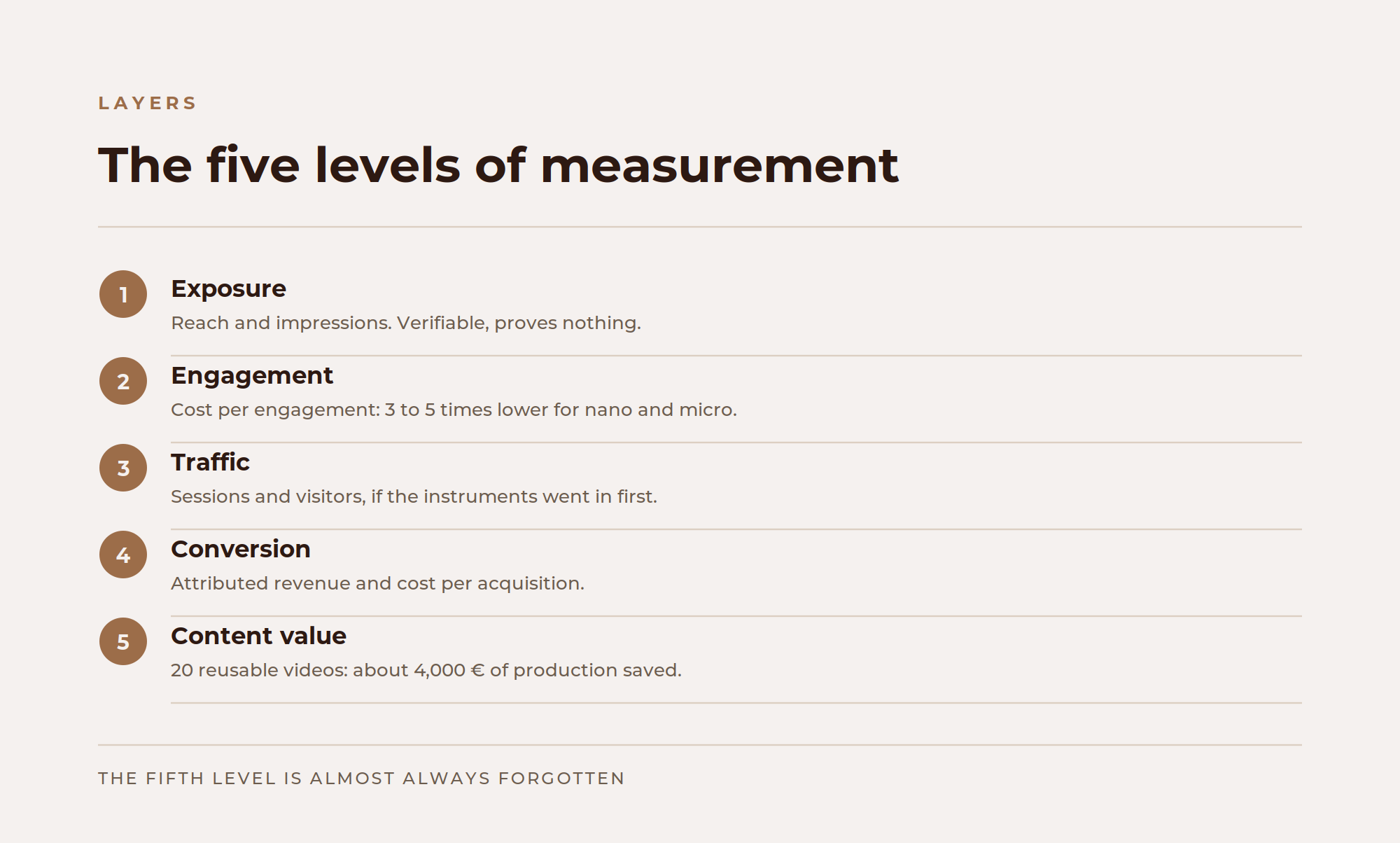
Exposure
Reach, impressions, unique coverage. Useful to confirm the campaign was actually seen, but not enough to conclude anything. Reach can be bought; it proves nothing.
Engagement
The engagement rate, and above all the cost per engagement, which is worked out simply: the fee divided by the follower count multiplied by the engagement rate. At a given budget this is the most revealing metric, because it neutralises the effect of size. On the French market, cost per engagement for nano and micro profiles averages three to five times lower than for macro.
Traffic
Sessions, new visitors, page views. Measurable only if you put the instruments in place before launch: a tracked link per creator, a dedicated landing page, or an individual discount code.
Conversion
Attributed revenue, cost per acquisition, average basket for buyers who came from the campaign. It is the most scrutinised level and the most fragile, for the attribution reasons above.
The value of the content produced
This is the level that gets forgotten every time, and often the one that tips the calculation. A campaign generating twenty reusable videos saves you an equivalent production. At an average of 200 euros a video on the market, that is 4,000 euros of production saved, provided you negotiated the usage rights upfront.
Building a calculation that holds up
ROI is classically calculated by relating net gain to the amount invested. Applied to influencer marketing, the exercise calls for two precautions.
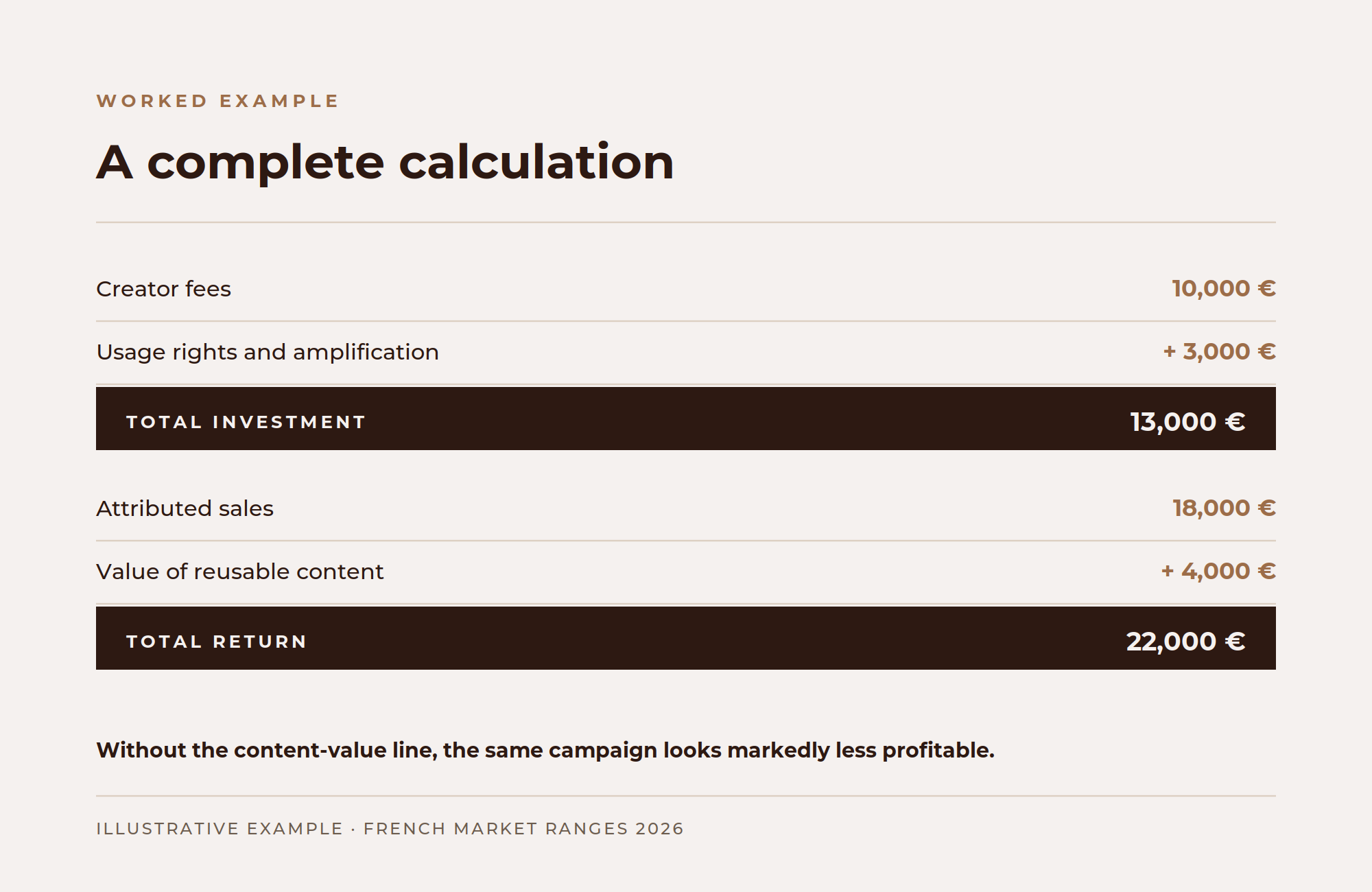
First precaution, count the whole investment. Creator fees are never the final figure: usage rights are billed separately, and media amplification generally accounts for 10 to 30% of the total budget. A campaign budgeted at 10,000 euros in fees actually costs 12,000 to 14,000 euros once those lines are included.
Second precaution, count the whole return. On top of attributed sales sits the production value saved on reusable content. That line is missing from most campaign reviews, and it sometimes represents a third of the total return.
One metric to handle with suspicion: Earned Media Value, which converts reach into an equivalent advertising budget. It is flattering by construction, it depends entirely on CPM assumptions chosen by whoever calculates it, and it corresponds to no money actually received. Useful for comparing two campaigns with each other, unusable for justifying a budget.
What to install before launch
None of these calculations can be done retroactively. Four mechanisms go in before the first post, and take under an hour.
- A unique discount code per creator. The most reliable instrument, because it depends on no tracking tool. Its only bias is that it understates the campaign, since some buyers never use the code.
- An individual tracked link. Distinct UTM parameters per creator and per format, so you can separate what came from a story and what came from a post.
- A baseline. Record your traffic, sales and follower count over the preceding four weeks. Without that reference point you will not know what the campaign actually added.
- A measurement window set in advance. Thirty days after the last post is a reasonable benchmark for most fashion campaigns.
Creator selection weighs at least as much as the instrumentation. On that point, our micro versus macro influencer comparison details the gaps in engagement and cost per interaction across tiers.
The most common measurement traps
- Judging over seven days. A short window captures only impulse buying and systematically undervalues consideration campaigns.
- Stopping at vanity metrics. Reach and view counts say nothing about the quality of the audience reached.
- Crediting the last click. It is the default model in most tools, and the one that penalises influencer marketing most.
- Comparing tiers without normalising. One macro and ten micro at equal budget only compare on cost per engagement.
- Forgetting the content value. Without usage rights negotiated upfront, that value is lost, and with it part of the return.
To frame the budget before going further, our guide to influencer campaign costs gives the ranges by tier and the lines brands discover too late.
Frequently asked questions
What is a good ROI for an influencer campaign?
There is no universal threshold, because the calculation depends on the objective and the scope you choose. The useful benchmark is comparative: measure your cost per acquisition on the campaign and set it against your other channels.
Over what period should a campaign be measured?
Thirty days after the last post for most fashion campaigns. A seven-day window captures only impulse buying.
Are discount codes reliable?
They are the most robust instrument, but they understate the campaign since some buyers never use them. Cross-check with a tracked link.
Should Earned Media Value be taken into account?
For comparing two campaigns with each other, possibly. For justifying a budget to a finance director, no: it corresponds to no money actually received.
How do you measure an awareness campaign?
Through unique coverage, movement in branded search volume and growth of your own audience, all compared against a baseline recorded before launch.
Conclusion
Measuring an influencer campaign is not a tooling problem, it is a sequencing problem. The objective is set before the casting, the instruments go in before the posts, and the calculation counts content value as well as attributed sales. All three are decided upfront, and none can be recovered afterwards.
To build your creator panel, browse the Shaare directory and contact them directly, or hand us the full management of your campaign, from framing to measurement.