

A failed shoot is not decided on the day. It is decided in the days before, when the brief goes out. Or when it does not.
Most brands prepare a production carefully: they pick the studio, approve the pieces, book the team. Then they turn up in the morning with a moodboard and an idea in their head, counting on the day to do the rest. That is where the gap opens between what was planned and what comes out.
Briefing a shoot team is not a creative exercise, it is an exercise in precision. This guide covers what each role needs to receive, what a workable brief must contain, and how to build a running order that holds.
What a vague brief really costs
Take a standard lookbook day. The shoot is billed at 1,500 euros, the photo assistant 120 euros, the stylist 380 euros, the make-up artist 290 euros. Add studio rental and the model's fee, and the day passes 3,000 euros excluding tax.
If the images are not usable, that sum is not what you lose, you lose more. Four people's availability has to be realigned, which rarely takes less than three weeks, and the collection launch slips by the same amount.
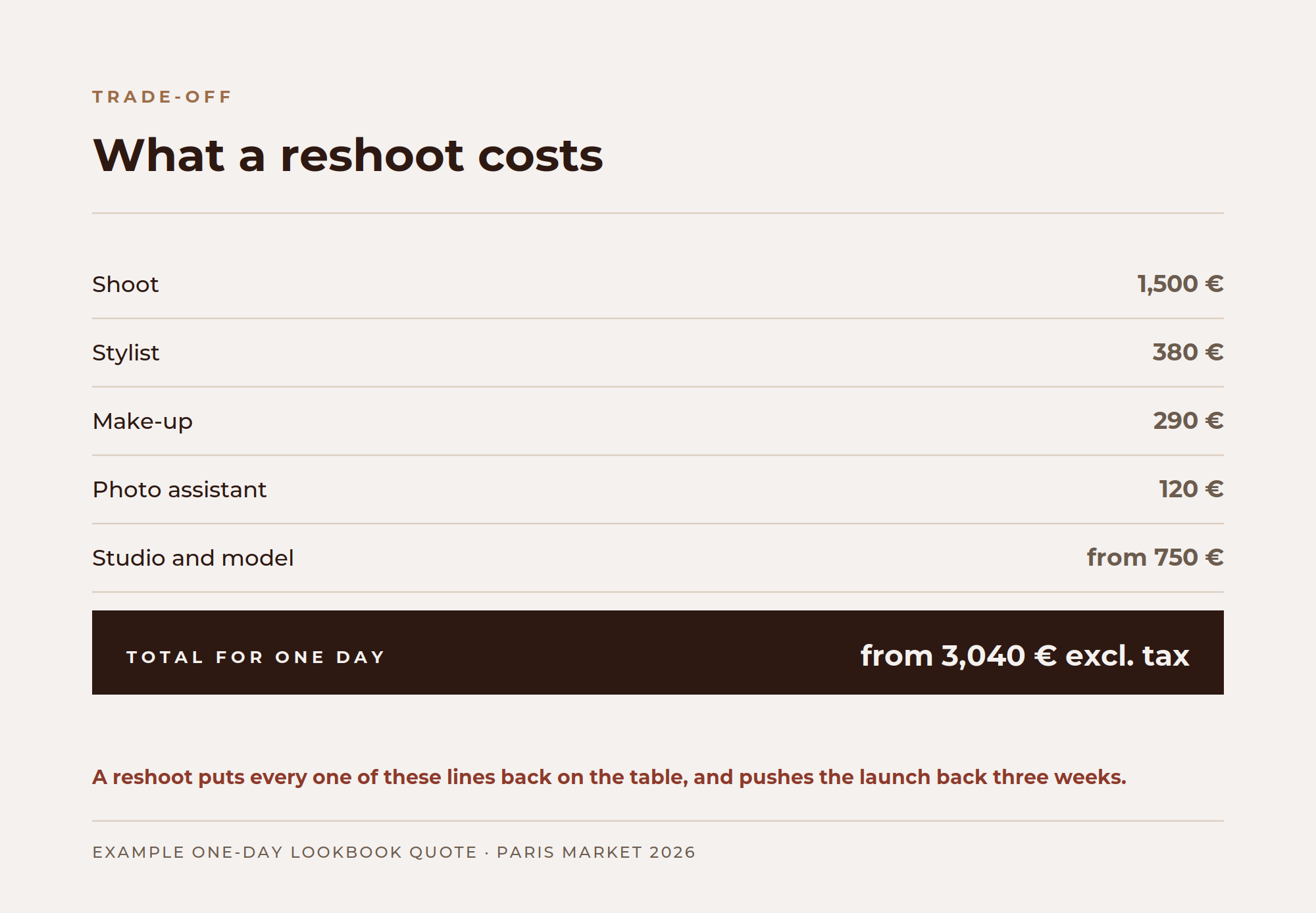
This is why the brief is the best investment in a production: it takes an hour to write and it protects several thousand euros. How a budget is built is set out in our guide to fashion photoshoot costs.
Each role needs different information
The most common mistake is sending the same document to everyone. A single six-page brief, where each person has to hunt for the two paragraphs that concern them, always produces the same result: nobody reads it all the way through.
The photographer
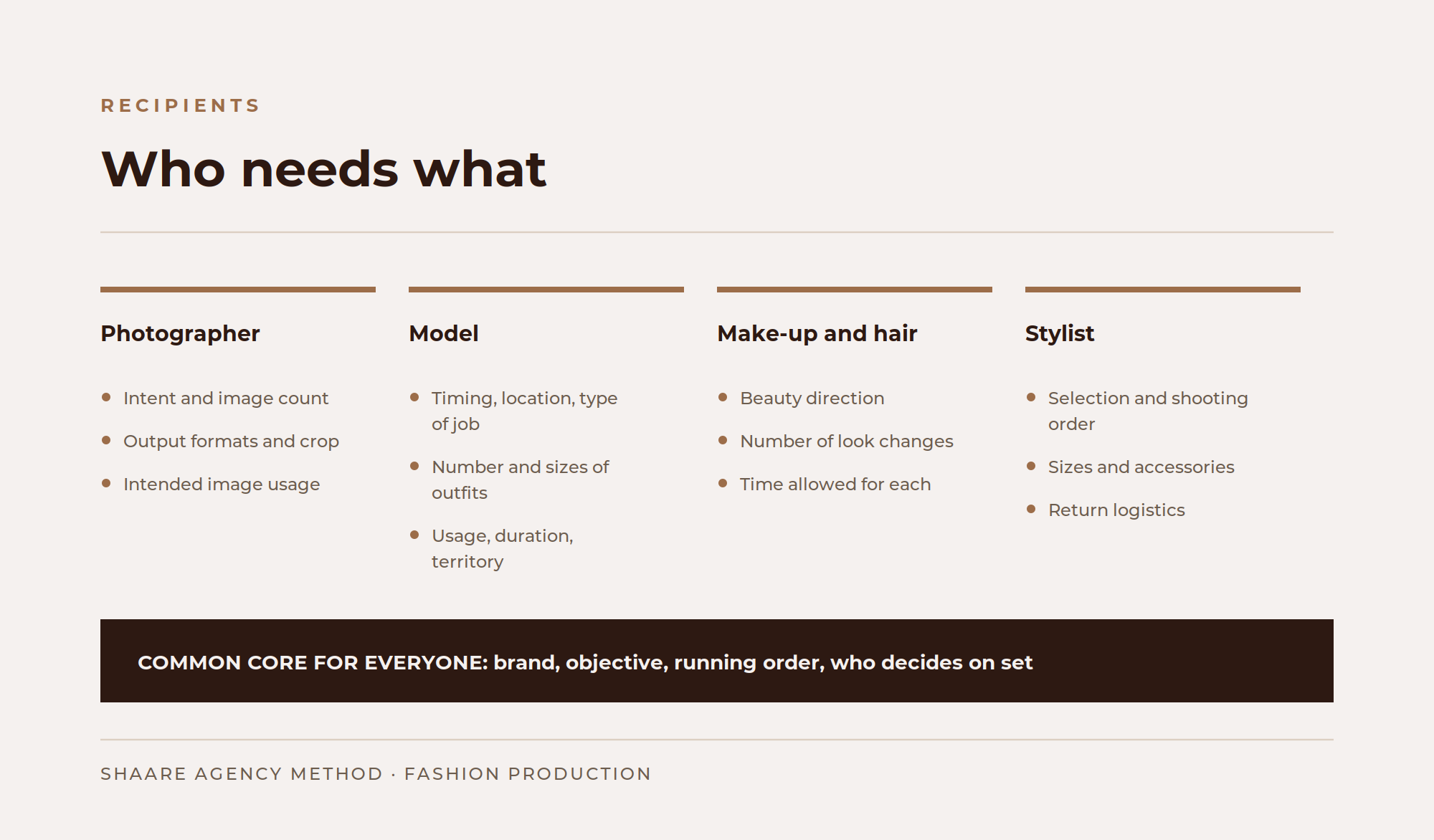
They need the intent, not just the shot list. Specify how many images you expect and of what kind, the output formats and their constraints, particularly the ratio and crop zone if the images are headed for a product page, and the intended usage. An image meant for outdoor advertising is not framed like a packshot.
The model
Dates, call and wrap times, exact address, type of assignment, number of outfits, and above all the image usage with its duration and territory. That last point drives the fee as much as the day itself. Include the sizes of the pieces too, so nobody discovers an impossible fitting in the morning.
Make-up and hair
A clear beauty direction, the number of look changes planned and the time allowed for each. A full change takes twenty to forty minutes: if your running order has six of them, that is more than two hours of floor time. Specify the rendering constraints as well, since make-up designed for flash falls flat in natural light.
The stylist
The collection or the selected pieces, the order you want them shot in, the sizes available, the accessories to work in, and the return logistics. This is the role where improvising costs the most time on set.
The anatomy of a brief that works
A workable brief fits on two pages and answers seven questions. Below that, something is missing. Above it, it will not be read.
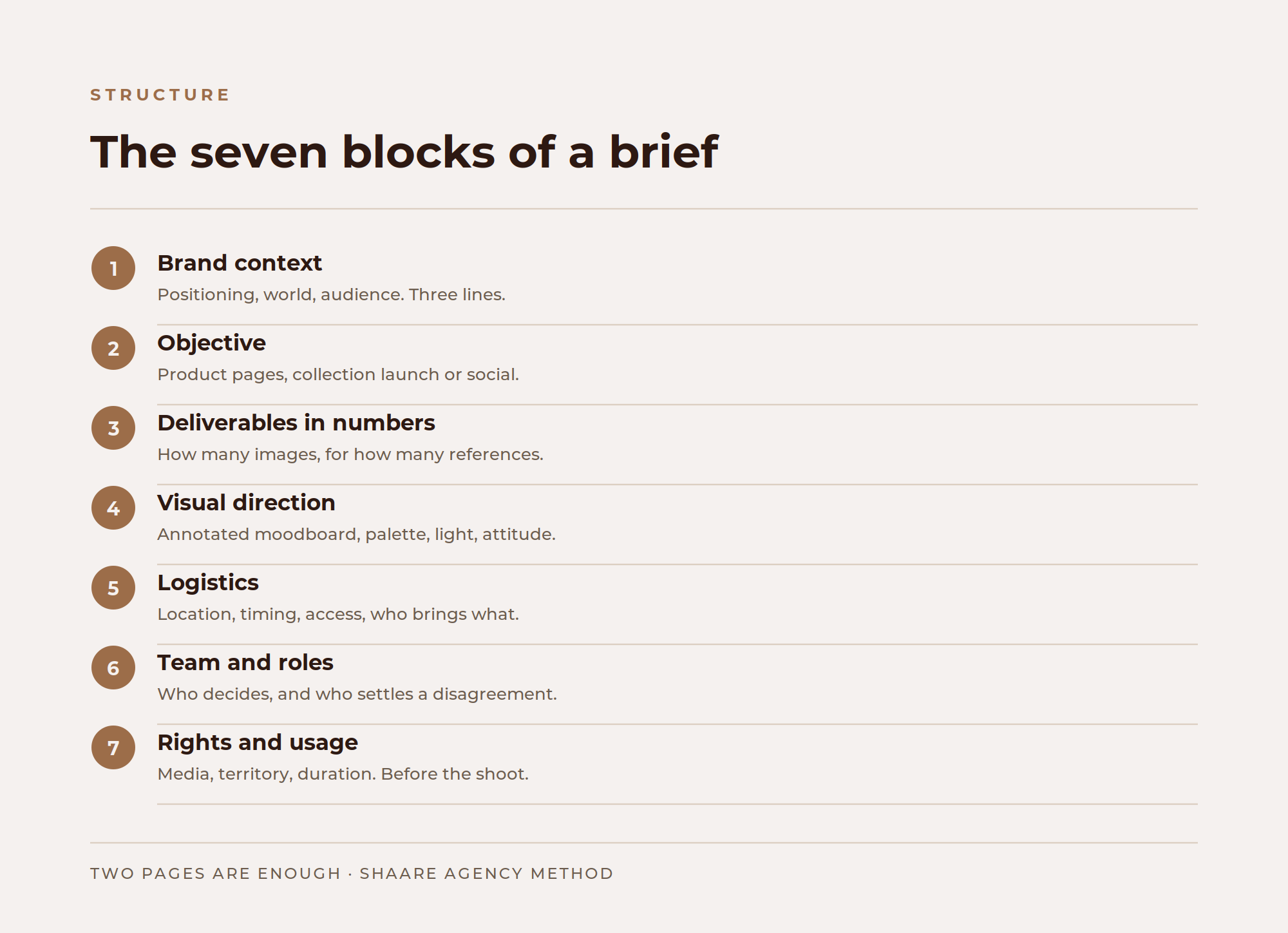
- Brand context: positioning, world, who you are talking to. Three lines are enough, but they steer every decision taken on set.
- The objective: feeding product pages, launching a collection, supplying social content. None of the three needs the same framing or the same volume.
- Deliverables in numbers: how many images, for how many references, in which formats. Without a number, nobody can commit to anything.
- Visual direction: annotated moodboard, palette, type of light, the attitude you are after.
- Logistics: location, timing, access, who brings what, who is present.
- Team and roles: who decides what, and who settles a disagreement.
- Rights and usage: media, territory, duration. Written before the shoot, never after.
The moodboard, useful but not enough
A moodboard shows a direction, it does not transmit one. Three traps come up every time.
References the budget cannot deliver. A campaign image shot with a team of fifteen and three days of location scouting does not get reproduced in one studio day. If the reference stands for intent rather than a model to copy, say so explicitly.
References that do not say what to take from them. This is the most frequent flaw. For each image, state what you are taking: the light, the framing, the model's attitude, the colour treatment. Without that, every member of the team reads something different into it.
Incompatible directions. A moodboard mixing hard contrasted light with a soft natural rendering asks the team to choose in your place, on the day, under pressure.
The rule that changes everything: for every visual reference, write one sentence saying what you are taking from it. Five annotated images beat twenty silent ones.
Building the running order
The brief says what you want to obtain, the running order says how the day is organised to get there. Both are needed.
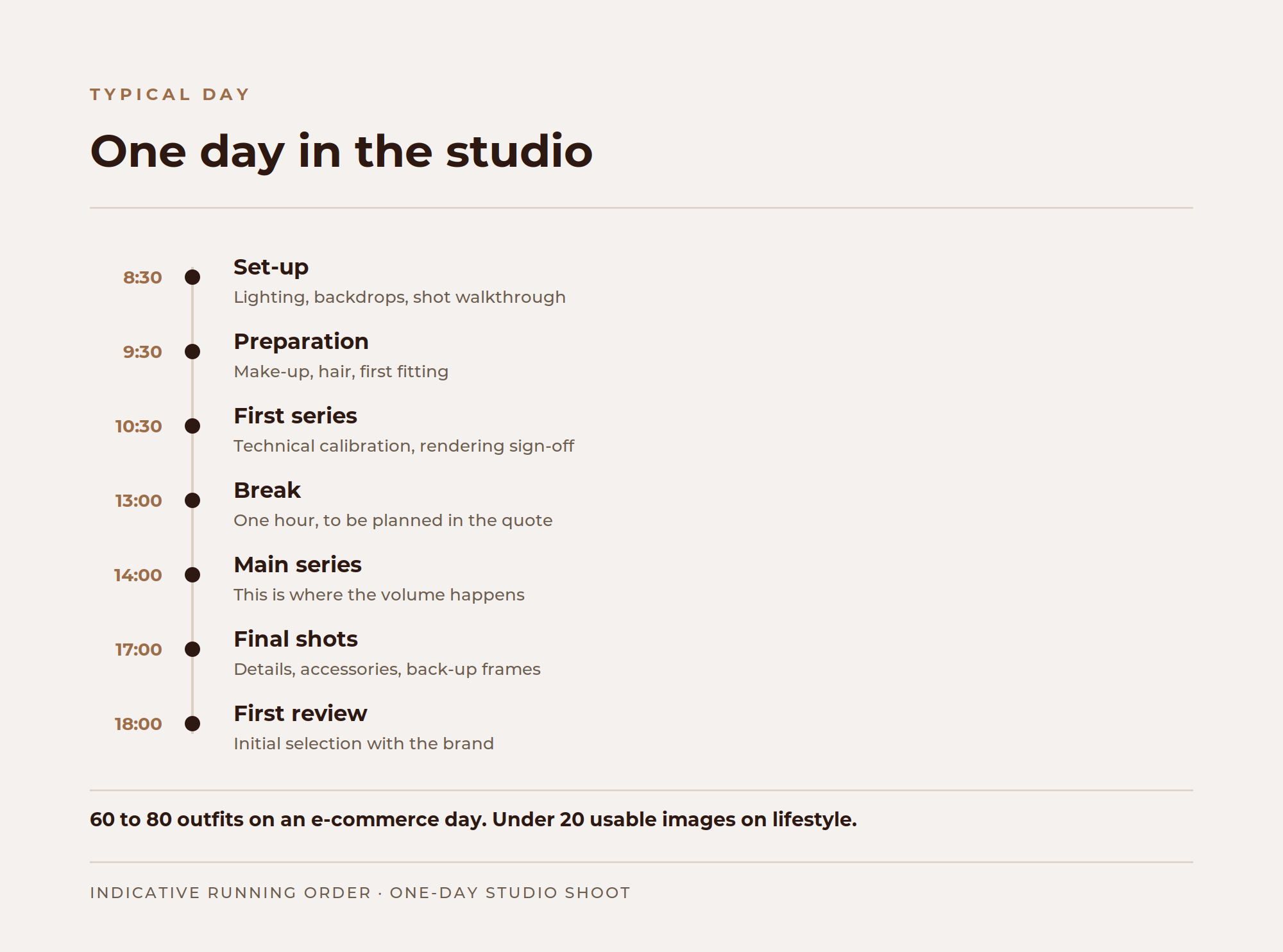
Two volume benchmarks help with calibration. On an e-commerce shoot in a studio, a full day covers sixty to eighty outfits with an experienced team. On lifestyle, with changes of light, set and posture, the volume often drops below twenty genuinely usable images.
Always build in a margin: set-up takes longer than planned, the first series serves as a calibration run, and the last hour of a shoot day is rarely the most productive. A running order calculated to the minute turns into an afternoon of catching up.
Who coordinates the day?
This is the question nobody settles, and it always gets paid for. If no one is appointed, coordination falls by default to the photographer, who ends up arbitrating outfits, managing the pace and deciding when a series is done. That is not their job, and it shows in the images.
Two options hold up. Either the brand appoints someone present all day, with a mandate to decide. Or coordination is handed to a provider, which becomes worthwhile as soon as the team passes three people or the number of references gets high.
To build that team, our fashion casting guide covers rates, booking lead times and what to settle before contacting talent.
The mistakes that cost the most
- Sending the brief the night before. Talent who discover the project in the morning have prepared nothing. Allow three to five days minimum.
- Not putting numbers on deliverables. "A nice series" is not an objective, and leaves nobody able to tell when the day has succeeded.
- Leaving image usage for later. Negotiating after the fact is always done from a weak position.
- Confusing moodboard and brief. Images with no written intent produce as many readings as there are people on set.
- Appointing nobody to decide. A day without an arbiter produces compromises, rarely a point of view.
Frequently asked questions
How far in advance should the brief go out?
Three to five days minimum, a week if the team is more than three people. Make-up artists and stylists need that time to prepare their kit and their selection.
Do you need a different brief for each role?
A common core is enough, with one section per role. A single undifferentiated document never gets read in full.
How many images can you produce in a day?
Sixty to eighty outfits on an e-commerce studio shoot with an experienced team. Considerably fewer on lifestyle, where every change of set and light costs time.
Who provides the clothes and accessories?
The brand, unless explicitly agreed otherwise. The stylist completes the selection, they do not build your wardrobe for you.
Do you need to be there on the day?
Someone on the brand side must be able to decide in real time. If that is not you, appoint the person and say so in the brief.
Conclusion
A good brief does not constrain the team's creativity, it saves them from guessing. Writing down what you expect, what you are taking from your references and who decides in case of doubt takes an hour. It is the one line in a production with a guaranteed return.
To build your team, browse the Shaare directory and contact photographers, models and make-up artists directly, or hand us the production end to end.