
Choosing a production agency is not about comparing three quotes and picking the cheapest. It is about checking that what is priced actually matches what you will receive.
Two quotes can show the same figure and cover very different work: one includes the full team, coordination, retouching and usage rights, the other prices the shoot day alone and bills the rest as it goes. The gap usually surfaces too late.
This guide covers what a fashion production agency actually does, the options available in Paris, the six criteria that make the difference, and how to read a quote to spot the grey areas before signing.
Agency, freelance, studio, collective: who does what
The word agency covers several different realities, and the confusion is expensive at the moment of choosing.
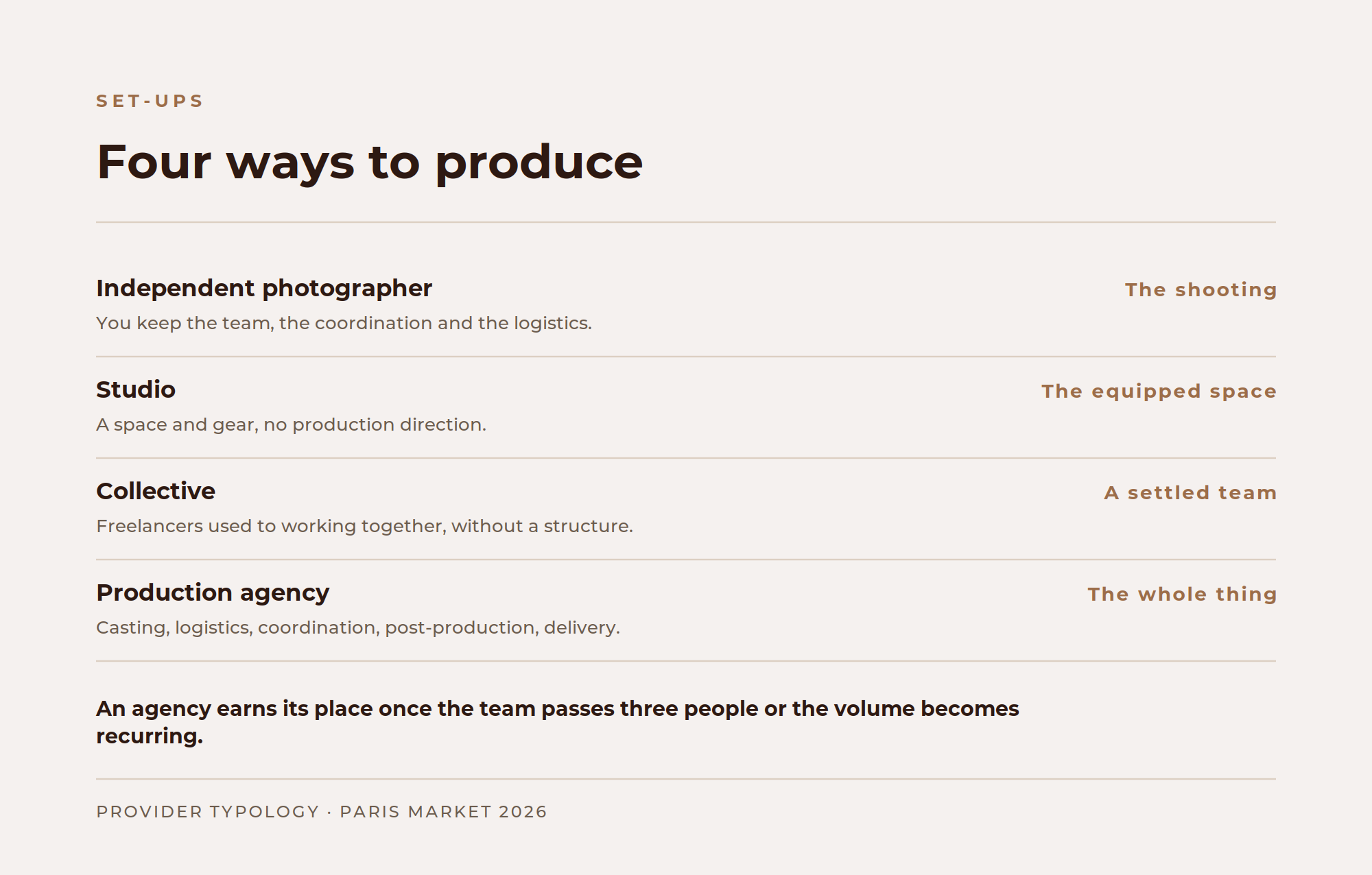
The independent photographer sells a shooting service. They may recommend a make-up artist or a stylist, but assembling the team, coordination and logistics stay with you.
The studio rents out an equipped space. Some offer associated services, but their business is the space, not production direction.
The collective brings together several freelancers who work together regularly. You get a coherent team without an agency's overhead, at the cost of a contact who is sometimes less available upfront.
The production agency takes on the whole thing: casting the team, logistics, coordination on the day, post-production, delivery. You get a single point of contact and a commitment on the result, not just on the day.
When you do not need an agency
Worth saying plainly, because nobody does: in a fair number of cases an agency adds nothing you could not do yourself.
If your production fits in one day, you have fewer than twenty references to cover, your brief is clear and you have already worked with a photographer who knows your world, you do not need a middleman. Contact the profiles directly, coordinate yourself, and keep the agency margin in your production budget.
Three situations, however, flip the calculation.
- The team goes past three people. Aligning availability, briefing everyone and arbitrating on the day becomes a full-time job.
- The volume is large or recurring. Past several dozen references, or with a production every month, coordination becomes the critical line.
- You have no one in-house to decide. If nobody on your side can settle a question on set, that role has to be given to someone, and it will not be the photographer.
For the first category, our fashion casting guide covers rates, lead times and how to contact talent directly.
The six criteria that matter
Once you have established that you need an agency, the comparison comes down to six points. The first three are about competence, the last three about transparency.

Fashion specialisation
A generalist provider knows how to run a shoot. They do not necessarily know how a garment is framed for a product page, how a fabric behaves under hard light, or how to fit sixty outfits into one day. Ask for productions comparable to yours, not a general portfolio.
The ability to supply the full team
An agency that imposes its photographer but leaves you to find the make-up artist and the model only takes half the load off you. Check that it covers the five roles a production needs, and that it can match the level of the profiles to your budget rather than applying one fixed grid.
Coordination on the day
Ask explicitly who will be there, and with what mandate. An agency that sends the team with no lead hands you back the very problem you were trying to delegate. This takes one question to check and it often separates two otherwise identical quotes.
The billing model
Per day, per image or fixed fee. All three are legitimate, but they do not put the risk in the same place, and that is exactly what to look at.
The rights included
A quote that specifies neither media, nor territory, nor duration of use is an incomplete quote. Renegotiating afterwards is always done from a weak position, and the gap can come to several times the initial figure.
The delivery process
How many images delivered, in which formats, by when, and with how many rounds of retouching included. "Retouching included" with no number means nothing and reliably produces a disagreement.
Comparing the billing models
This is the least understood point, and the one where brands most often make the wrong trade-off.
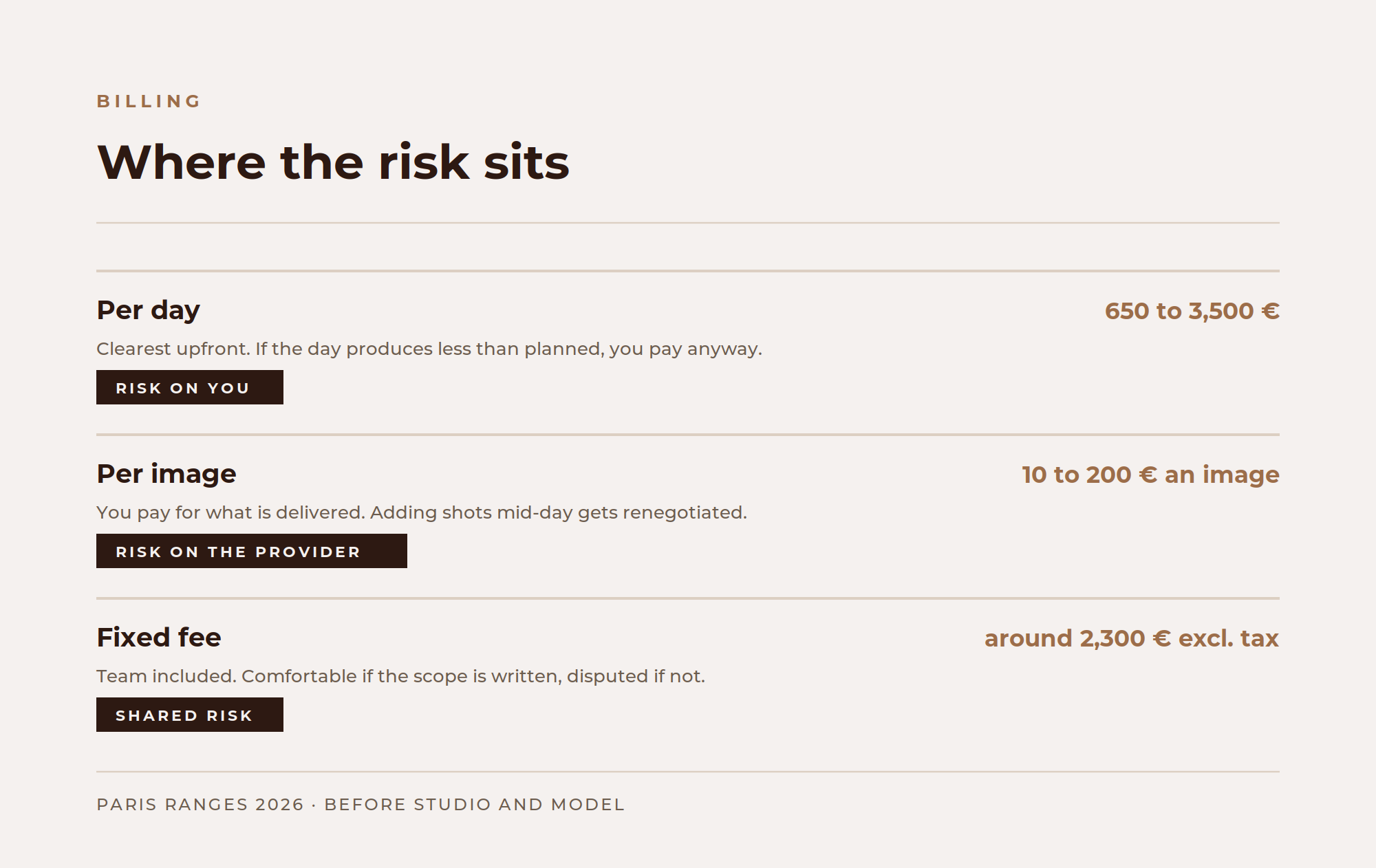
Day rates are the clearest upfront. On the Paris market, an e-commerce day runs between 650 and 1,700 euros for the shooting alone, a collection lookbook between 700 and 3,500 euros. The risk sits with you: if the day produces less than planned, you pay all the same.
Per-image pricing reverses the logic. Expect 10 to 40 euros for a standard packshot, up to 200 euros for an elaborate lifestyle image. Fifty images at 40 euros comes to 2,000 euros. The risk moves to the provider, but you lose flexibility: adding shots during the day gets renegotiated.
A fixed fee covers everything, team included. A full quote for a lookbook day with stylist, make-up artist and assistant lands around 2,300 euros excluding tax, before studio and model. It is the most comfortable model, provided the scope is written precisely. Without that, it is the one most prone to disputes.
How a budget is built line by line is set out in our guide to fashion photoshoot costs.
Reading a production quote
A workable quote shows six distinct lines. If one is missing, that is not a simplification, it is an imprecision you will pay for.
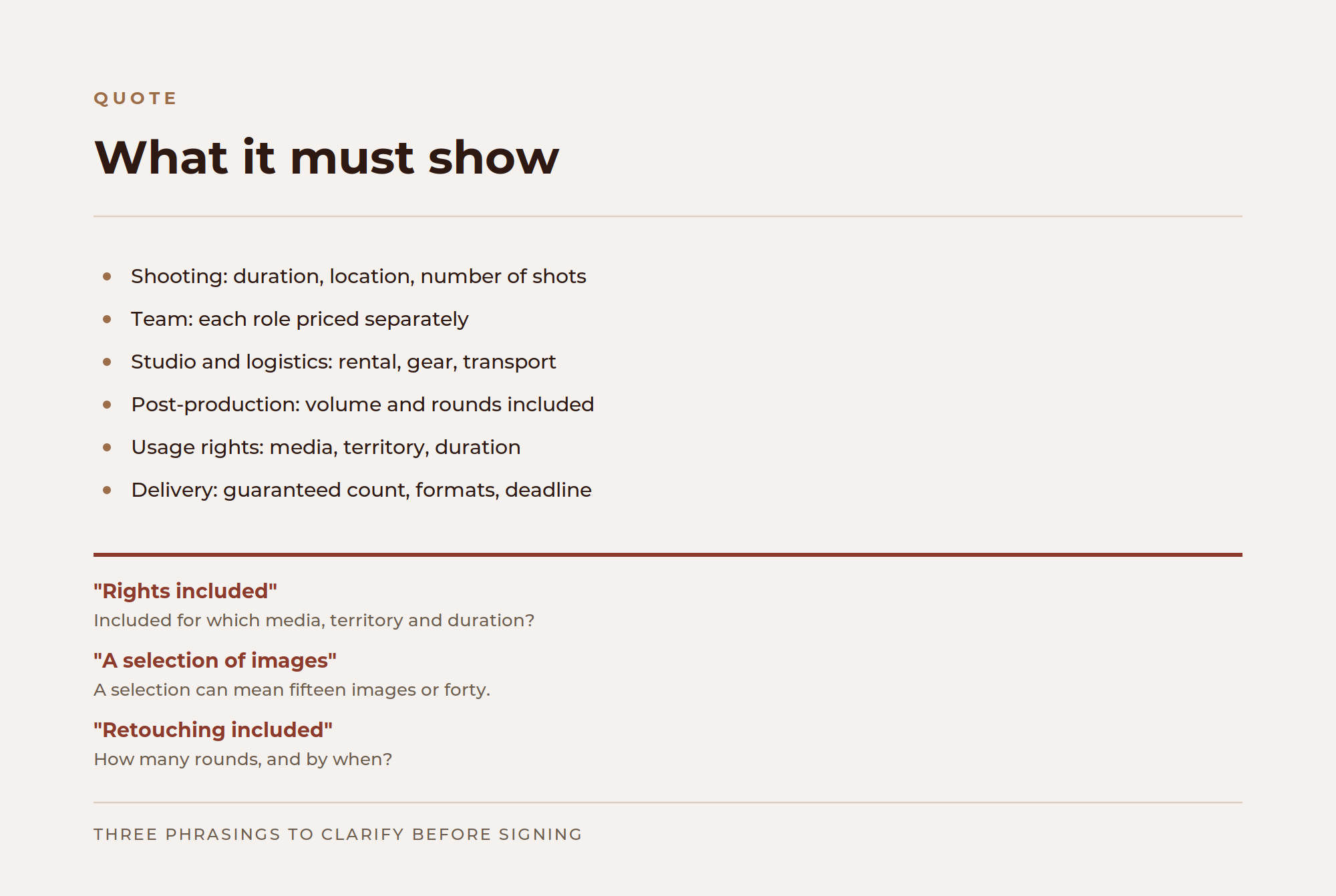
Three phrasings should always prompt you to ask for something in writing.
"Usage rights included" with nothing further. Included for which media, which territory, which duration? One year of web use in France and an unlimited worldwide licence are not the same price, and the ratio between them can reach a factor of six.
"A selection of images delivered" with no number. A selection can mean fifteen images or forty. Have the guaranteed minimum written down.
"Retouching included" with no quantity or deadline. Specify the number of rounds and the turnaround at each stage, or delivery stretches out over weeks.
The simplest test: ask the provider what happens if the day runs late and the planned volume is not reached. Their answer tells you more about how they work than their portfolio does.
Questions to ask before signing
- Who will physically be there on the day, and who settles a disagreement?
- Has the proposed photographer produced this type of image before, and for which brands?
- How many images are guaranteed at delivery, and by when?
- Which media, territory and duration do the included rights cover?
- What happens if the images do not work, and who bears the cost of a reshoot?
- Who provides the studio, the accessories and the logistics for the pieces?
Frequently asked questions
How much does a production agency cost in Paris?
A quote is built line by line rather than as a single rate. Expect 650 to 1,700 euros for an e-commerce day covering the shooting alone, and around 2,300 euros excluding tax for a lookbook day with the team, before studio and model.
Should you choose an agency that specialises in fashion?
For images meant to sell, yes. The framing, fabric and volume constraints are specific, and a generalist provider discovers them on your production.
What is the difference between an agency and a collective?
A collective brings together freelancers used to working with each other, without a production structure. An agency adds coordination, a commitment on the result and a single point of contact.
Can a production quote be negotiated?
On scope rather than on price. Cutting the number of images, tightening the usage rights or removing a service brings the figure down without degrading what remains.
How far ahead should you book?
Four to six weeks for a production with a team, more in September and October, when every brand is producing its collection visuals.
Conclusion
The right agency is not the cheapest, nor the most prestigious: it is the one whose quote describes precisely what you will receive, and which answers the question of who decides on set without dodging it. Both can be checked before signing, in a few questions.
If you would rather keep control, browse the Shaare directory and build your team directly. If you want to delegate the whole thing, hand us your production, from brief to delivery.