
A post from a nano creator costs 50 €. The same post from a celebrity runs past 10,000 €. Between the two, everything depends on what you are actually buying.
This is the question that stalls most brands before they start. Rates are not public, the spread is enormous, and the averages floating around are too vague to build a budget on. Some brands overpay for lack of benchmarks, others give up believing the channel is out of reach.
This article gives concrete ranges for the French market in 2026, tier by tier, then breaks down the costs brands discover too late: usage rights, exclusivity, amplification. You will know what to budget, and where the value actually sits.
Base rates, tier by tier
Creator fees are the largest single line in any campaign. The ranges below apply to one Instagram post in France, excluding usage rights and exclusivity.
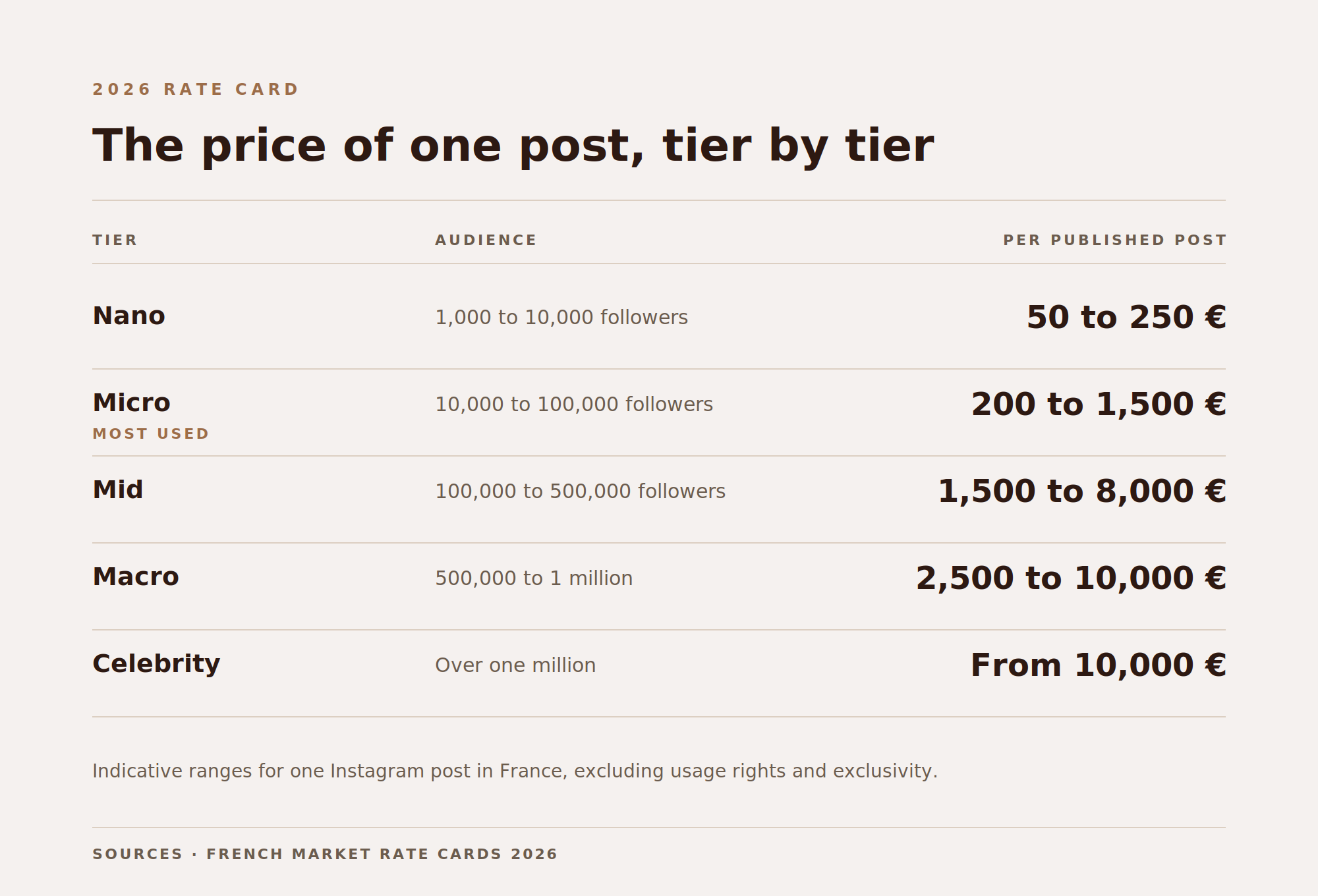
Two creators with identical follower counts can charge three times apart. That is not arbitrary: a highly specialised profile with strong engagement and polished production justifies the top of its range. Conversely, a wide but passive audience is objectively worth less than it asks.
What moves the price
The tier rate is only a starting point. Four variables then build the actual quote, and they are what blows a budget when nobody anticipates them.
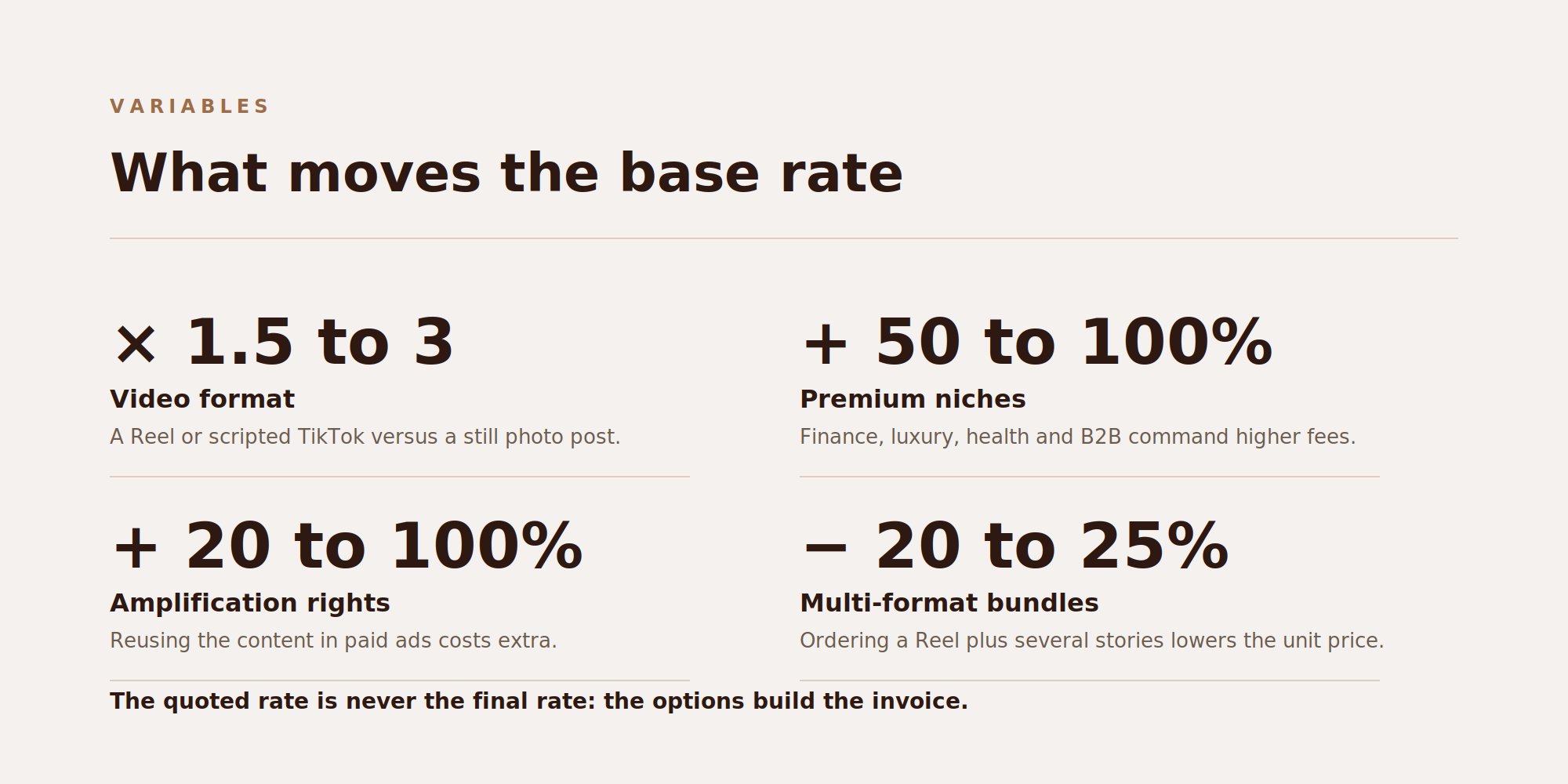
Format weighs heavily: a scripted video negotiates at one and a half to three times the price of a still photo post, while a story sits below. Premium sectors such as finance, luxury and health carry a surcharge. Amplification rights, meaning the ability to reuse the content in paid advertising, can double the fee. Conversely, ordering a bundle combining a Reel and several stories brings the unit price down.
The line everyone forgets: paid amplification. Reusing creator content in advertising, through Spark Ads or Partnership Ads, is a separate media budget, typically 10 to 30% of the total. It does not come out of creator fees.
What budget for a full campaign?
Adding up unit rates does not make a budget. A campaign involves a panel of creators, several formats, coordination and measurement. Here are three investment levels observed on the market.
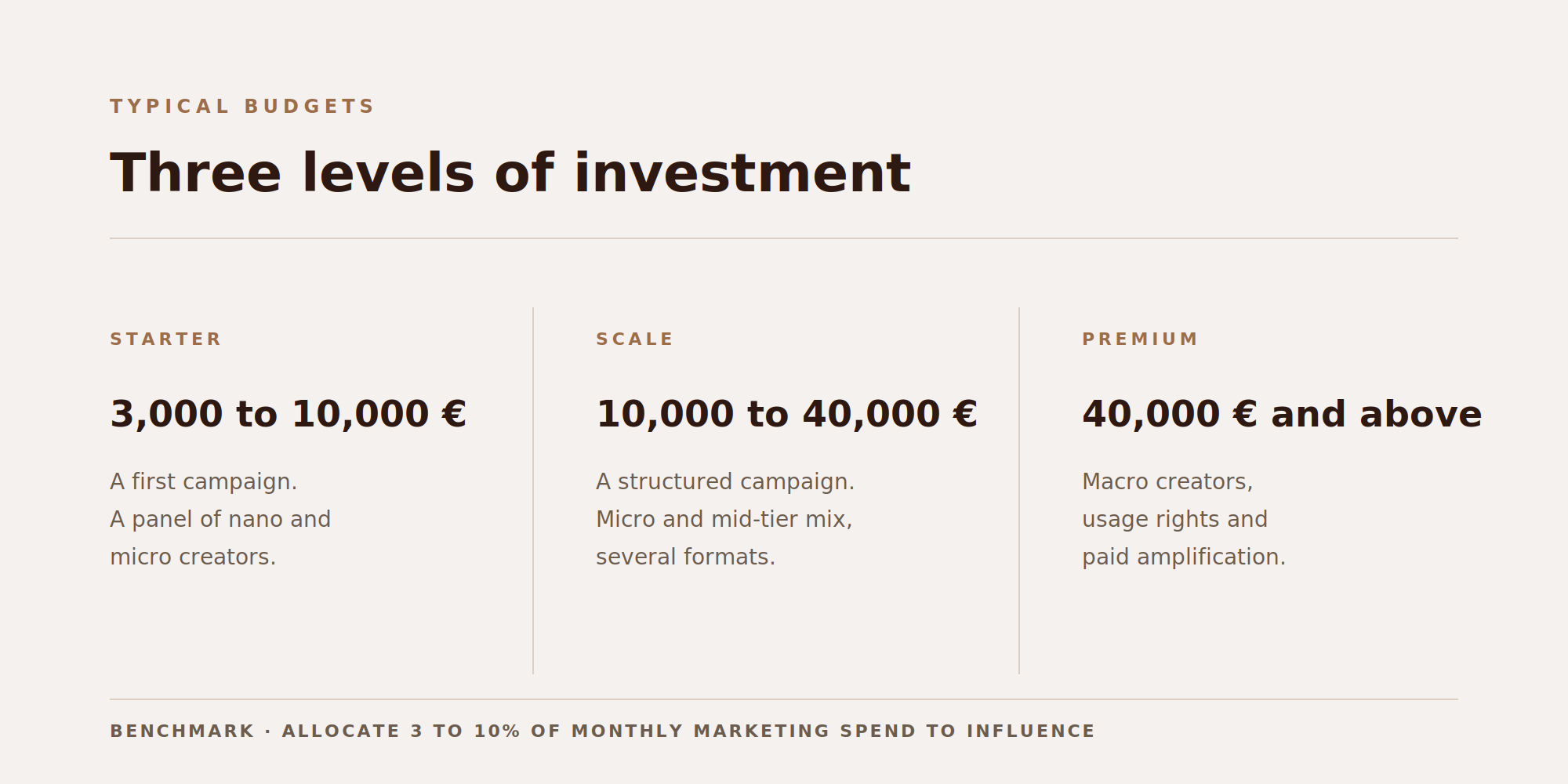
For a first campaign, a credible test starts around 10,000 to 15,000 €, with targeted seeding or a panel of micro creators. Some providers offer starter packages from 3,000 € with a tighter panel. Below that threshold, the budget is better directed towards creator content production, where entry costs are lower.
A useful benchmark for internal discussion: many brands allocate between 3 and 10% of their monthly marketing budget to influencer marketing. Across Europe, median annual spend reaches 175,000 €, which gives the order of magnitude for established brands.
One macro or ten micro? The trade-off that changes everything
This is the single most structuring decision in your budget, and the one brands most often get wrong by favouring apparent fame.
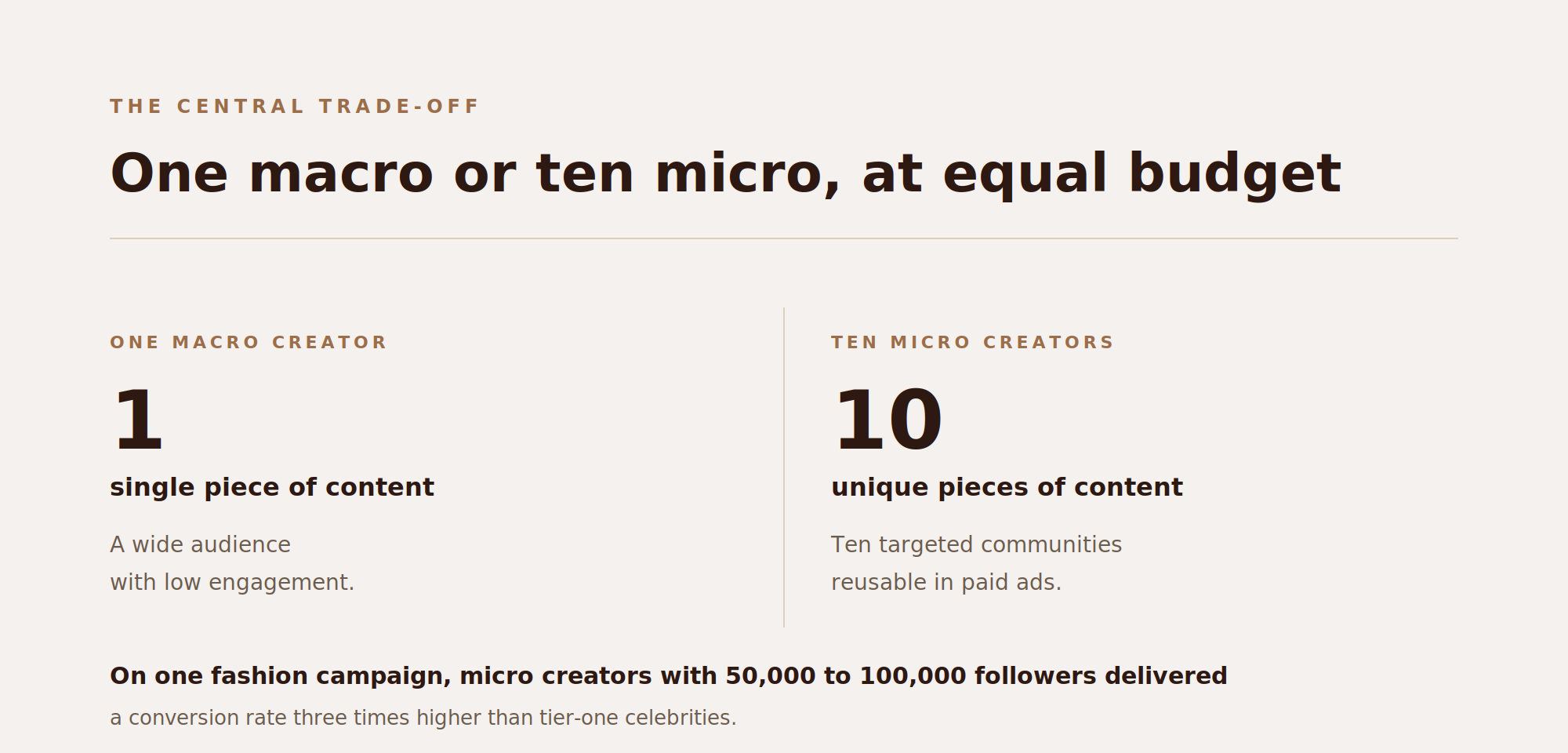
At equal spend, ten micro creators produce ten distinct pieces of content, reach ten targeted communities, and hand you material that can be reused in paid advertising. A macro creator produces one piece, for a wider but proportionally less engaged audience. Cost per engagement for nano and micro profiles is on average three to five times lower than for macro.
Field results confirm the gap. On one international fashion collaboration, micro influencers with 50,000 to 100,000 followers delivered a conversion rate three times higher than tier-one celebrities. Big names still make sense for an awareness push, far less for a conversion campaign. We break this trade-off down in our micro versus macro influencer comparison.
The costs brands discover too late
Four items routinely escape the initial budget and inflate the final invoice.
- Usage rights: distributing the content beyond the creator's own account, on your site or in advertising, is priced separately and negotiated by duration.
- Exclusivity: asking a creator not to work with a competitor for ninety days carries a fee, and one that has risen since last year.
- Media amplification: 10 to 30% of the total budget, to plan from the outset if you intend to push content as paid ads.
- Coordination: sourcing, audience verification, contracting, approval and reporting represent real working time, whether handled in-house or delegated.
A legal requirement: since 1 January 2026, French decree n°2025-1137 requires a written contract for any commercial collaboration whose total value reaches or exceeds 1,000 € excl. VAT within a calendar year, per advertiser. The threshold covers fees paid, but also gifted products, trips and any benefit in kind.
How to invest without overpaying
A handful of habits noticeably improve the return on any given budget.
- Start from the objective, not the rate. An awareness campaign favours reach and the number of profiles. A conversion campaign concentrates budget on highly engaged creators with proper tracking.
- Check the audience before negotiating. Location, age bracket, past partnerships and fake followers are all easy to verify, and doing so avoids paying for reach that does not exist.
- Negotiate duration rather than price. Creators often lower their unit rate for a multi-post commitment or a long-term partnership, which performs better anyway.
- Scope rights to actual usage. Buying broad by default is expensive for nothing.
- Measure from the very first campaign. A promo code or trackable link per creator tells you who delivered, and therefore where to reinvest.
On that last point the data is encouraging: influencer marketing is estimated to return close to six euros for every euro invested, with a better ratio on nano and micro campaigns where entry costs are lower. Provided, of course, that you measured it. For the full picture of the channel, see our influencer marketing guide.
Frequently asked questions
How much does a post from a micro influencer cost?
Between 200 and 1,500 € for an Instagram post in France, excluding usage rights. The top of the range corresponds to highly specialised profiles with strong engagement.
What is the minimum budget to get started?
A credible test starts around 10,000 to 15,000 €. Starter packages exist from 3,000 € with a tighter panel of nano and micro creators.
Is paid amplification included?
No. It is a separate media budget, in the range of 10 to 30% of the total, to plan alongside creator fees rather than within them.
Can I pay in products rather than cash?
It is possible with nano and micro creators, though less reliable on output and timing. Note that benefits in kind count towards the 1,000 € excl. VAT annual legal threshold in France.
Are rates negotiable?
Yes, particularly on multi-post commitments or long-term partnerships. Bundling several formats usually secures a discount on the unit price.
Conclusion
In 2026 there is no longer an average price for influencer marketing, only a cost that matches an objective. A 200 € story from a nano creator can outperform an 8,000 € post from a macro profile when the brief is aligned and the audience is qualified. Remember three things: the headline rate is never the final rate, rights and amplification must be budgeted from the start, and returns depend far more on casting relevance than on audience size.
To find the creators that match your brand and your budget, explore the Shaare directory and contact them directly, with no intermediary and no commission.