

Most content calendars die after six weeks. Not for lack of ideas, but because they were built from a publishing rhythm instead of being built from a stock of content.
A calendar that holds does not start with "three posts a week". It starts with an inventory: what do you need, on which channels, and where will each piece come from. The rhythm follows, and it holds because it is covered.
This guide covers how to start from the need rather than the rhythm, the three sources of content and their respective economics, how to build a quarter, and what makes a calendar survive its third month.
Start from the need, not the rhythm
The first exercise is listing what your channels actually consume over a quarter.
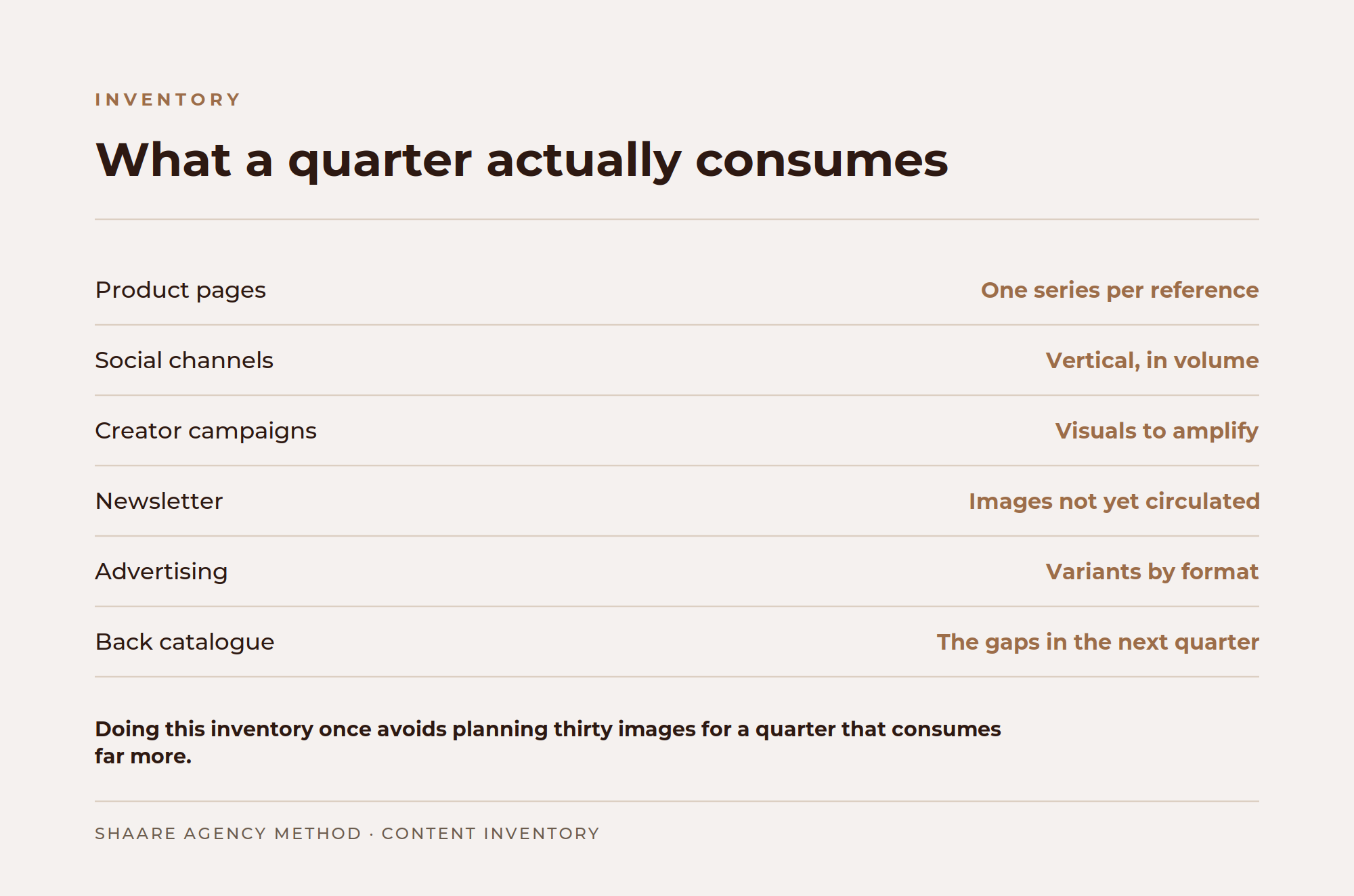
Product pages need a full series per reference. A page with four or more images converts markedly better than one with a single image, and that need cannot be compressed. Social consumes vertical formats, in volume. Creator campaigns need visuals to amplify. The newsletter needs images that have not already circulated everywhere.
Doing this inventory once avoids the structural mistake: planning a thirty-image shoot for a quarter that consumes a hundred and twenty, then filling the gap with increasingly tired repeats.
Three sources, three economics
A calendar that holds mixes all three. Relying on only one is what makes it fall over.
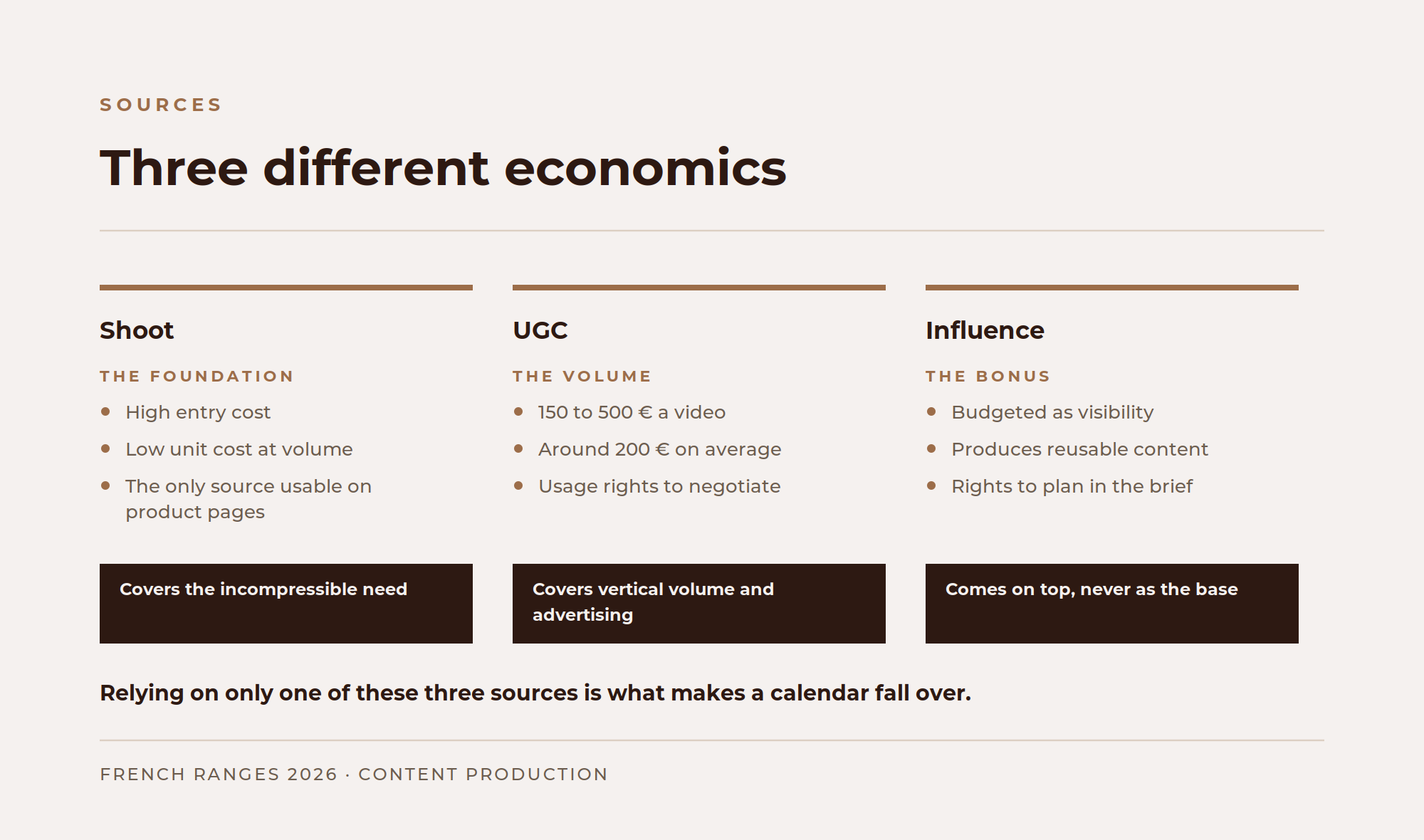
The shoot has a high entry cost and a low unit cost as soon as volume follows. It produces the most controlled material and the only kind usable on product pages. It is the foundation, and it is planned in grouped days.
UGC has a low entry cost and a moderate unit cost: between 150 and 500 euros a video depending on the brief, averaging around 200 euros. It produces authentic volume, ideal for vertical formats and advertising, provided usage rights have been negotiated.
Influence is not budgeted as a content source, but it produces content. A campaign generating twenty reusable pieces saves an equivalent production, again provided rights were planned from the start.
The rule that follows: the shoot covers the incompressible need, UGC covers volume, influence adds the bonus. Reversing that order produces a calendar that depends on the goodwill of creators.
Building a quarter
The quarter is the right unit. A month is too short to amortise a production day, a year is too long to stay accurate.
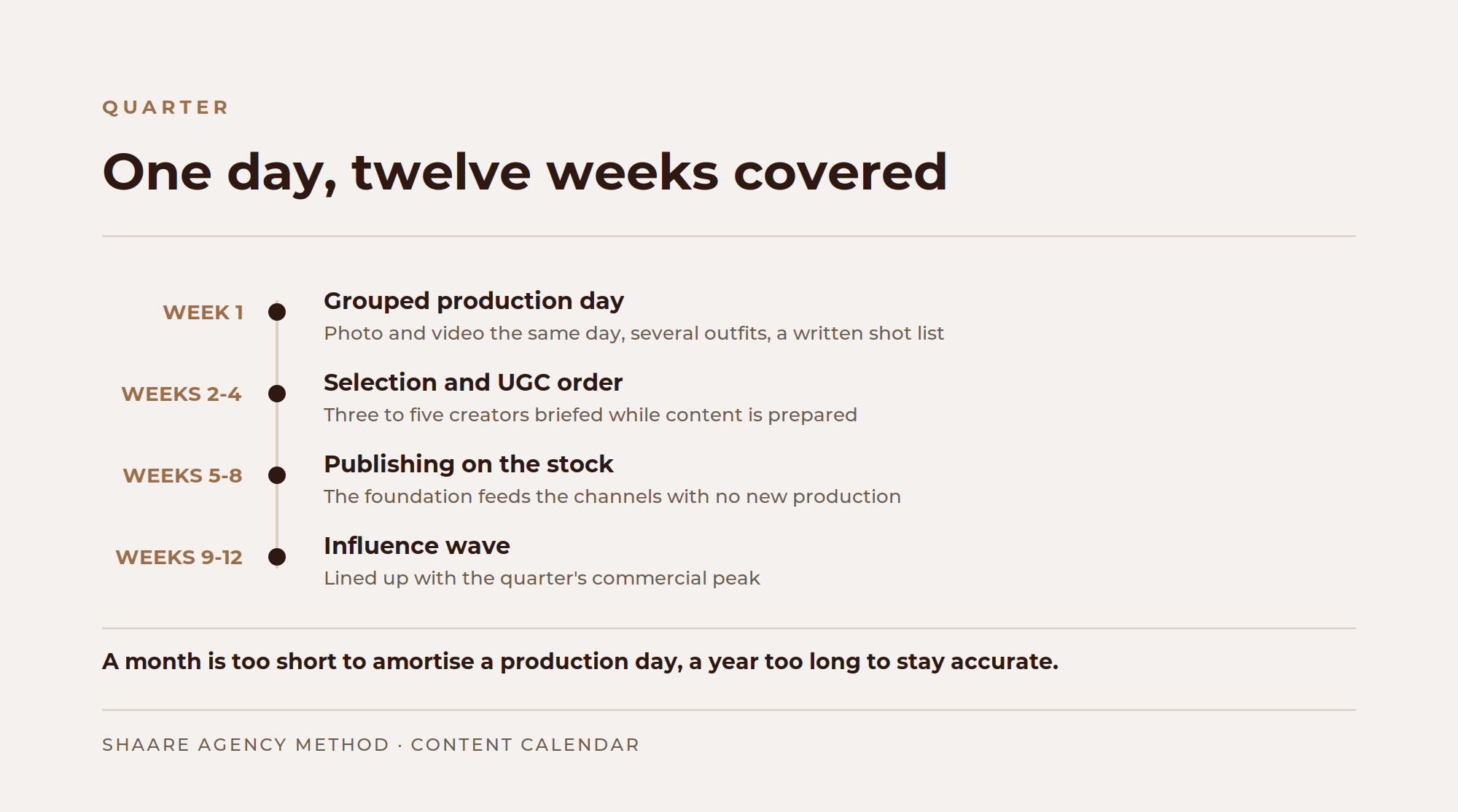
In week 1, the grouped production day: photo and video the same day, several outfits, several simple settings, a written shot list. It produces the quarter's foundation.
In weeks 2 to 4, selecting and preparing the content, while the UGC order goes out to three to five creators.
In weeks 5 to 12, publishing draws on the stock, and the influence wave lines up with the quarter's commercial peak.
How to build the brief for that grouped day is covered in our guide to briefing a shoot team, and framing vertical formats in our brand video guide.
The rule of three uses
A piece of content has to serve three times, otherwise its unit cost stays prohibitive.
The publishing use. The use planned at the time of production.
The recycling use. The same image recropped for another format, another platform, another message. A lookbook image becomes a product page, then a newsletter visual, then an ad.
The archive use. One quarter's content feeds the gaps in the next. That is what lets you hold through periods with no production planned.
This rule has a practical consequence: name and file your assets at delivery. A library nobody can search is a library that serves once.
What makes a calendar hold
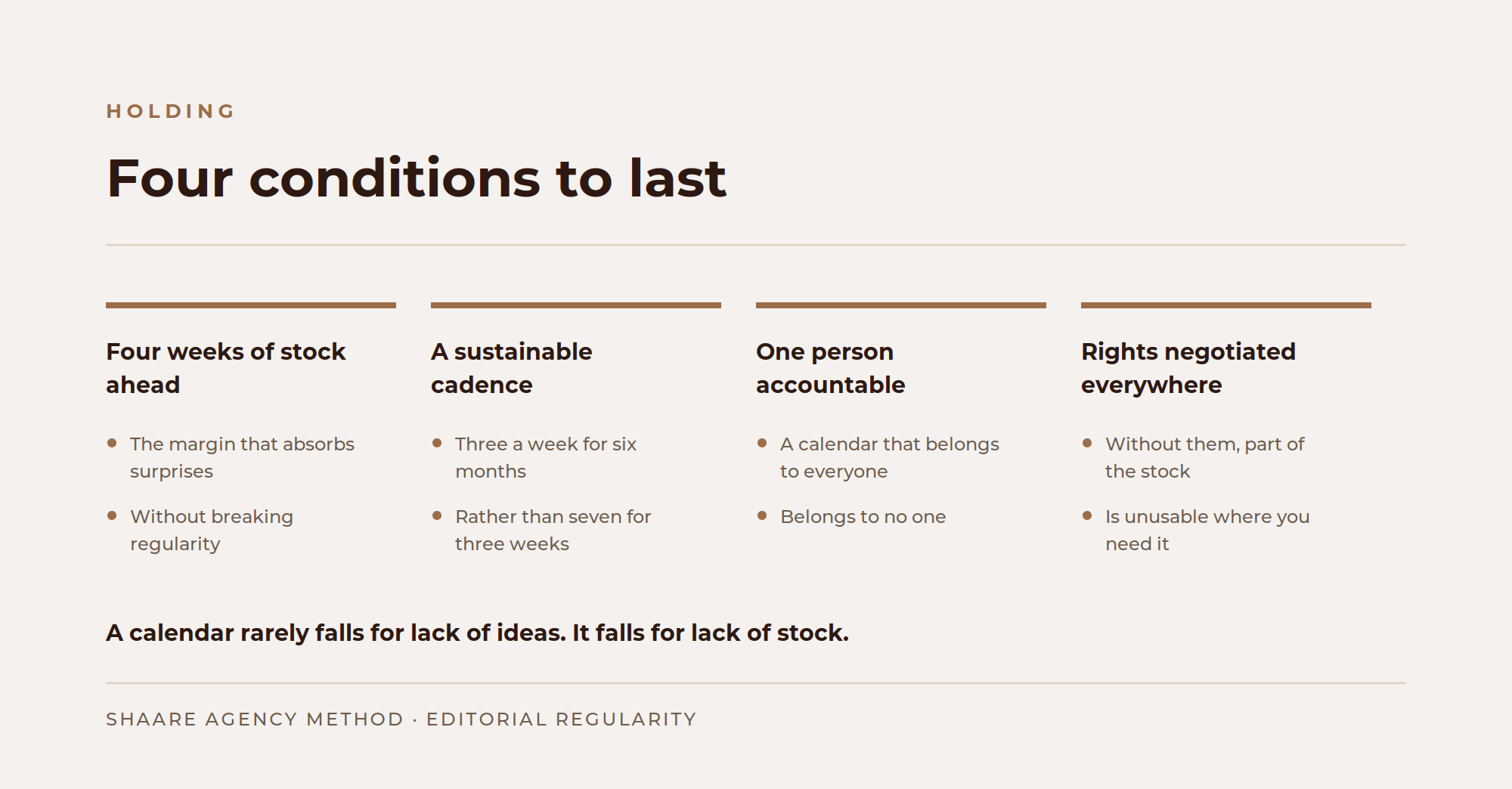
- Four weeks of stock ahead. That is the margin that absorbs the unexpected without breaking regularity.
- A sustainable cadence rather than an ambitious one. Three posts a week held for six months beats seven held for three weeks.
- One person accountable. A calendar that belongs to everyone belongs to no one.
- Usage rights negotiated everywhere. Without them, part of your library is unusable exactly where you would need it.
The most common mistakes
- Starting from the publishing rhythm. The need is calculated first, the rhythm follows from it.
- Betting everything on one source. Shooting alone costs too much at volume, UGC alone does not cover product pages.
- Producing without filing. Content you cannot find serves once.
- Forgetting rights on creator content. They determine recycling, and so the real unit cost.
- Publishing the whole stock immediately. Regularity is built on being ahead, not on inspiration.
Frequently asked questions
How much content should you plan per quarter?
It depends on your channels. Do the inventory: product page series, vertical volume, campaign and newsletter visuals. The total usually comes as a surprise.
What publishing cadence should you hold?
The one your stock covers. Three posts a week held for six months beats an unsustainable rhythm abandoned in the second month.
Do you need a shoot every quarter?
One grouped day per quarter is the most common rhythm for a brand publishing regularly. It produces the foundation, UGC fills the volume.
Can everything be done with UGC?
No. Product pages need a level of control UGC does not give. UGC does cover vertical volume and advertising very well.
How do you avoid the repetition effect?
By recropping and recontextualising rather than reposting identically, and by keeping part of the stock for the gaps in the next quarter.
Conclusion
A content calendar holds when it starts from the real need, mixes the three sources according to their economics, and keeps four weeks of stock ahead. Rhythm is not a decision you take at the outset, it is a consequence of the stock you have managed to build.
To build the team for your production days, browse the Shaare directory and contact photographers, videographers and creators directly, or hand us the production of your calendar.