Launching a beauty brand in France is nothing like launching a fashion brand. The difference comes down to one word: compliance. Six regulatory obligations have to be met before the first sale, and none of them is optional.
That is why so many beauty projects stall between formulation and market. The product exists, the brand world is built, and then there are six to twelve months of procedures nobody had costed.
This guide covers the state of the French market, the obligations to meet before your first sale, what actually changes compared with a fashion launch, the realistic timeline, and where to differentiate once compliance turns out to be only a floor.
The French beauty market
France remains the world's leading cosmetics exporter, but 2025 marked an inflection that needs reading correctly.

According to figures published by FEBEA, the sector represents 35.6 billion euros in total revenue, of which 22.4 billion comes from exports, and accounts for 15% of the world market. The fabric of the industry is mostly small and mid-sized companies, which make up 64% of the sector, with 18% micro-enterprises. In other words, this market is not reserved for large groups.
The 2025 inflection deserves attention. Over the first ten months, exports fell by 1.16%, to 18.75 billion euros. That is the first decline in at least twenty years outside the Covid period. The cause is single and identified: US tariffs, which cut sales to the United States by 18%, while China grew 2% and the European Union 4%.
Two lessons for a brand starting out. The European market is holding, and that is your natural ground. But imports are up 6%, driven by Chinese platforms and K-Beauty: incoming competition is intensifying on entry-level segments.
The six obligations before your first sale
They follow from European regulation 1223/2009 and apply in full, including to a brand selling only online and in small batches.

1. Appoint a responsible person
A natural or legal person established in the European Union guarantees the compliance of every product. Their name and address must appear on the labelling. They carry the regulatory liability, not the manufacturer.
2. Have the product's safety assessed
Article 15 of the regulation requires a toxicological assessment of every formulation, carried out by a qualified assessor. Some substances are restricted or banned, and colourants, preservatives and UV filters must appear on the authorised lists.
3. Compile the product information file
The PIF brings together the formula, safety data, evidence for the claims made and manufacturing details. It must be kept available to the control authorities and retained for ten years after the last placing on the market.
4. Notify through the CPNP portal
European notification, provided for in article 13, is mandatory before placing a product on the market. It is free and covers composition, labelling and the responsible person's details. Products containing nanomaterials must be notified six months before going on sale.
5. Meet labelling requirements
INCI ingredient list, precautions for use, batch number, minimum durability date or period after opening, name and address of the responsible person. This is where first production runs most often fall short.
6. Apply good manufacturing practice
Standard NF EN ISO 22716 governs manufacturing and packaging. If you work with a contract manufacturer, check its certification: that is a selection criterion, not an administrative detail.
One obligation that often gets forgotten: beyond the European regulation, manufacturing and packaging sites must declare their opening, any changes and the end of their activity to the DGCCRF, under the public health code.
What changes compared with a fashion launch
The two sectors share a great deal: positioning, identity, content, distribution. They diverge completely on going to market.

In fashion, you can produce a small run and sell within weeks. In beauty, several unavoidable months pass between a validated formula and the first legal sale.
The corollary is more encouraging than it sounds: once crossed, that barrier also protects your brand. It removes part of the opportunistic competition and makes a product that works harder to copy quickly. For everything the two sectors have in common, our guide to launching a fashion brand still holds on positioning, budget and the order of steps.
The realistic timeline
Counting on six months is optimistic. Nine to twelve months is the range observed for a first range.
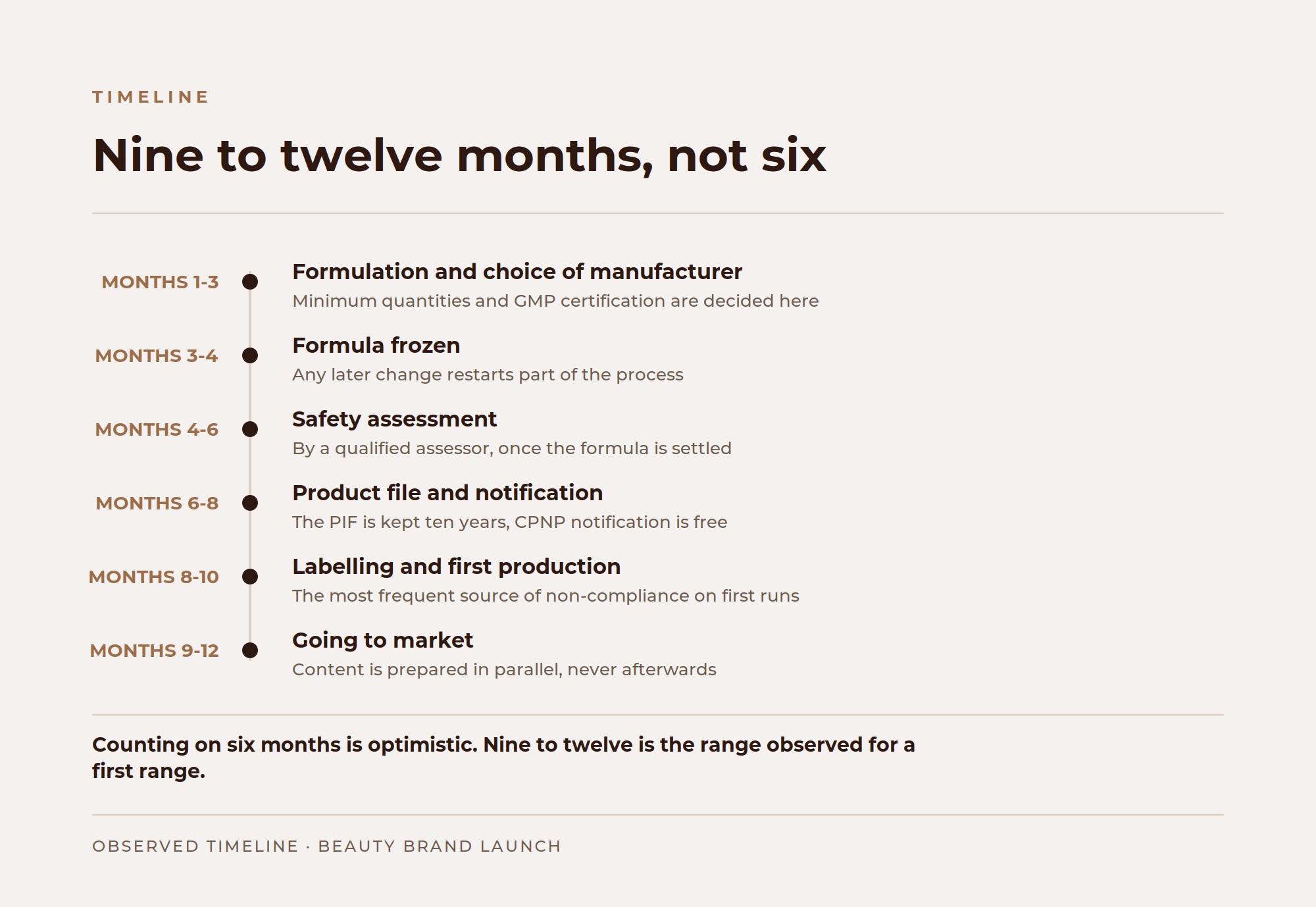
Two milestones govern everything else. The choice of contract manufacturer determines minimum quantities, GMP certification and part of the schedule. The safety assessment can only begin once the formula is frozen, and any change to the formula restarts part of the process. That is why back-and-forth on formulation costs so much time.
Plan content in parallel rather than afterwards. Product visuals, copy and the site can be built during the regulatory phase, which avoids ending up with a compliant product and nothing to sell it with.
Differentiating when compliance is only a floor
Every brand on the market is compliant. Compliance sells nothing, it grants permission to sell.
Three lines of differentiation work in this market. Proof, meaning claims backed by testing rather than by adjectives, given that any claim has to be substantiated in the PIF anyway. Formulation, when it answers a poorly covered need rather than adding one more variation. And the brand world, which remains the most accessible lever and the one where content weighs most.
On that last point, beauty has a specific trait: demonstration counts as much as image. Content showing application, texture and result converts better than a bottle shot, which makes video formats and creator content particularly well suited. How to frame that lever is covered in our UGC strategy guide.
The mistakes that cost most
- Producing before freezing the formula. Any change restarts the safety assessment and pushes back the launch.
- Underestimating labelling. It is the most frequent source of non-compliance on first production runs.
- Choosing a contract manufacturer on price alone. Certification and minimum quantities weigh more heavily on viability.
- Claiming what you cannot prove. Every claim must be substantiated in the product file.
- Waiting for compliance before producing content. The two workstreams run in parallel.
Frequently asked questions
Can you sell a cosmetic made at home?
The same obligations apply, including good manufacturing practice and the safety assessment. Scale of production changes nothing in the regulatory framework.
How long before the first sale?
Nine to twelve months for a first range, counting formulation, safety assessment, product file and notification.
Do you need to be established in France?
The responsible person must be established in the European Union. A brand based outside the EU therefore has to appoint one, as in textiles.
Is CPNP notification paid?
No, it is free. The real cost of the file lies in the safety assessment and in compiling the PIF.
What should you check with a contract manufacturer?
ISO 22716 certification, minimum order quantities, their ability to support the regulatory file and their real production lead times.
Conclusion
Launching a beauty brand in France means treating compliance as a workstream in its own right, run alongside the brand rather than after it. The six obligations are known, the timeline is predictable, and the barrier they create then protects those who have crossed it.
For the content that will sell your products, browse the Shaare directory and contact photographers, make-up artists and creators directly, or hand us your production.