
Price is the worst criterion for choosing a fashion photographer. Two photographers on the same day rate will produce incomparable results if one works hard light and the other diffused daylight, and your brand needs the opposite.
A photographer is not an interchangeable supplier. They bring a point of view, and that point of view has to serve your world rather than theirs. It is the only variable that really counts, and it can be checked before you sign.
This guide covers how to match a photographer's profile to the type of production, what to look for in a portfolio, the questions that reveal real experience, how to frame a paid test, and what is actually negotiable.
Three types of production, three profiles
The first filter is the type of production, not the general quality of the work.
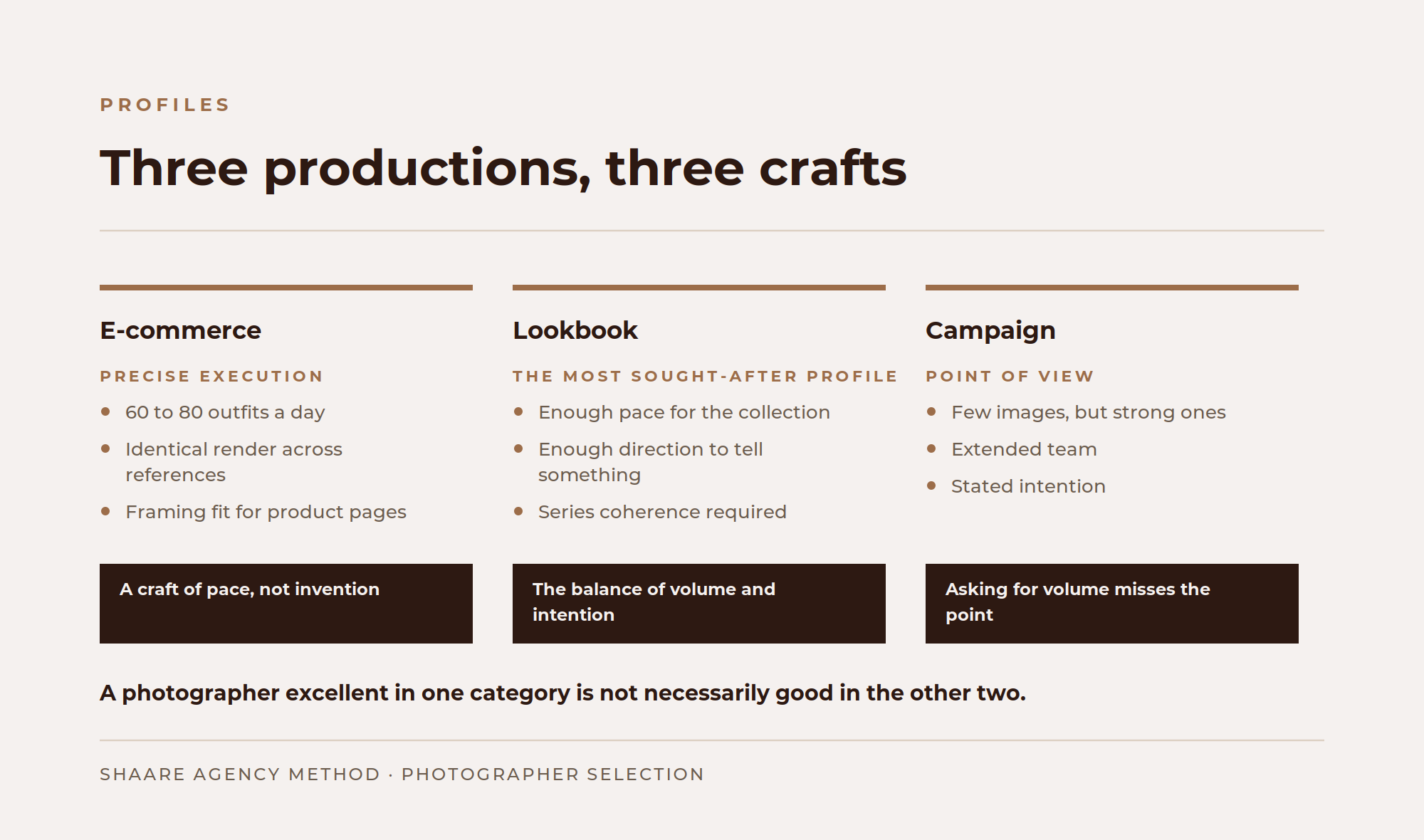
E-commerce demands consistency and pace: sixty to eighty outfits in a day, an identical render from one reference to the next, framing compatible with automatic cropping on product pages. It is a craft of precise execution, not invention.
The lookbook demands balance: enough pace to cover the collection, enough direction for the images to tell something. It is the most common and the most sought-after profile.
The campaign demands a point of view. The photographer brings a strong intention, works with an extended team, and produces few images but strong ones. Asking them for volume misses the point.
A photographer who is excellent in one category is not necessarily good in the other two. Ask for productions comparable to yours, not a general portfolio.
Reading a portfolio
The mistake is judging on the best images. They tell you what the photographer can do in ideal conditions, not what they will produce for you.
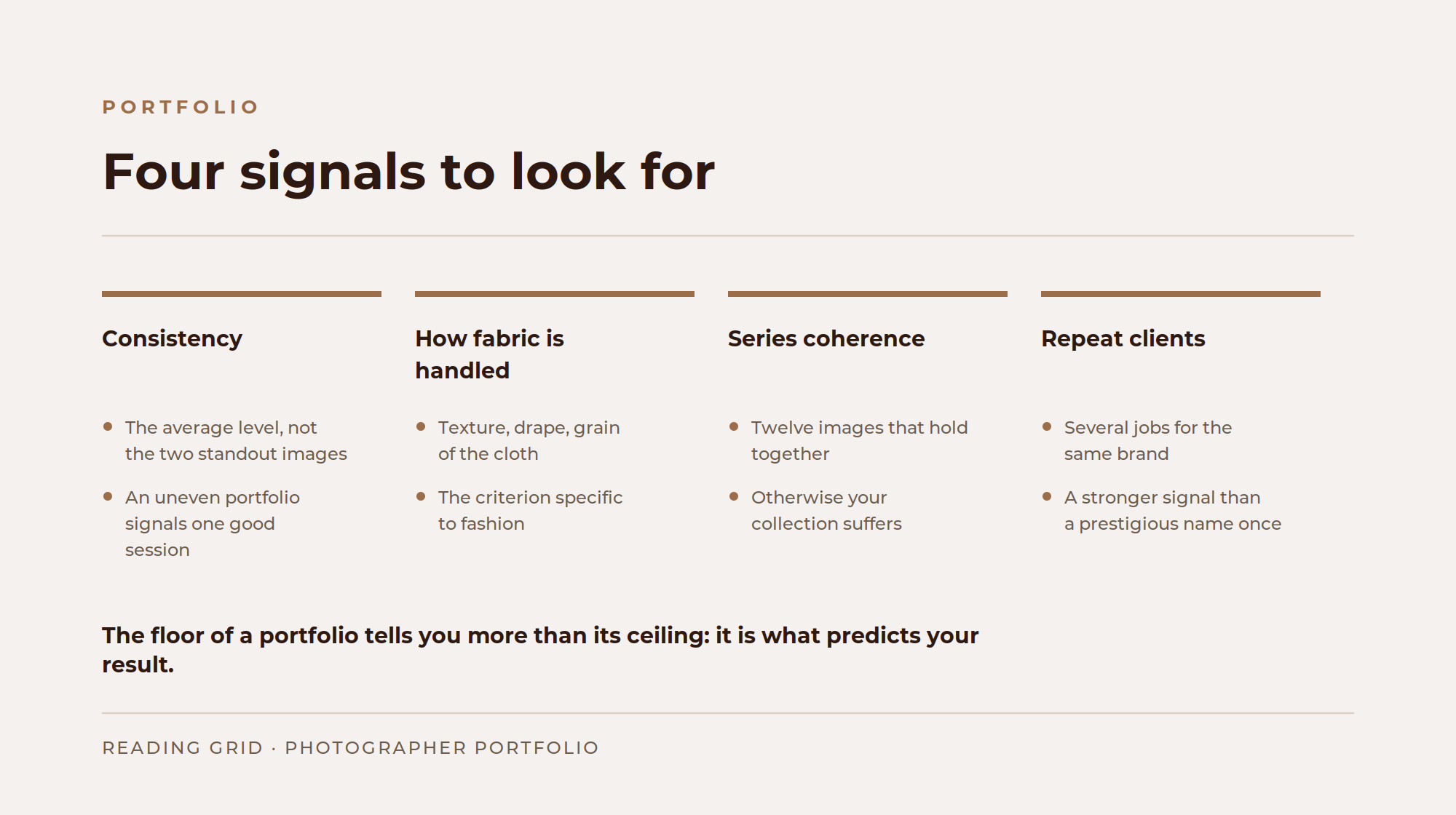
Consistency. Look at the average level, not the two images that stand out. A very uneven portfolio often signals one good session rather than a steady standard.
How fabric is handled. This is the criterion specific to fashion. A piece has to read: texture, drape, the grain of the cloth. A photographer who lights faces well but flattens fabric is not the right fit.
The coherence of a series. A series of twelve images has to hold together. If every image seems to come from a different world, your collection's coherence will suffer.
Repeat clients. A photographer who works several times for the same brands is a stronger reliability signal than a portfolio of prestigious names seen once.
The questions that reveal real experience
Four questions are enough to tell a seasoned professional from a good portfolio.
- "How do you organise a day of sixty outfits?" The answer immediately reveals whether they are used to volume or improvising it.
- "What do you do if a piece does not hang well on the model?" A professional describes on-set solutions. A beginner says you will see on the day.
- "How do you deliver, and in what timeframe?" Number of guaranteed images, formats, retouching rounds included.
- "What rights are included in your rate?" A photographer who cannot answer precisely will expose you to a renegotiation.
Framing a test
For a collaboration meant to last, a test is a reasonable investment. It still has to be informative.
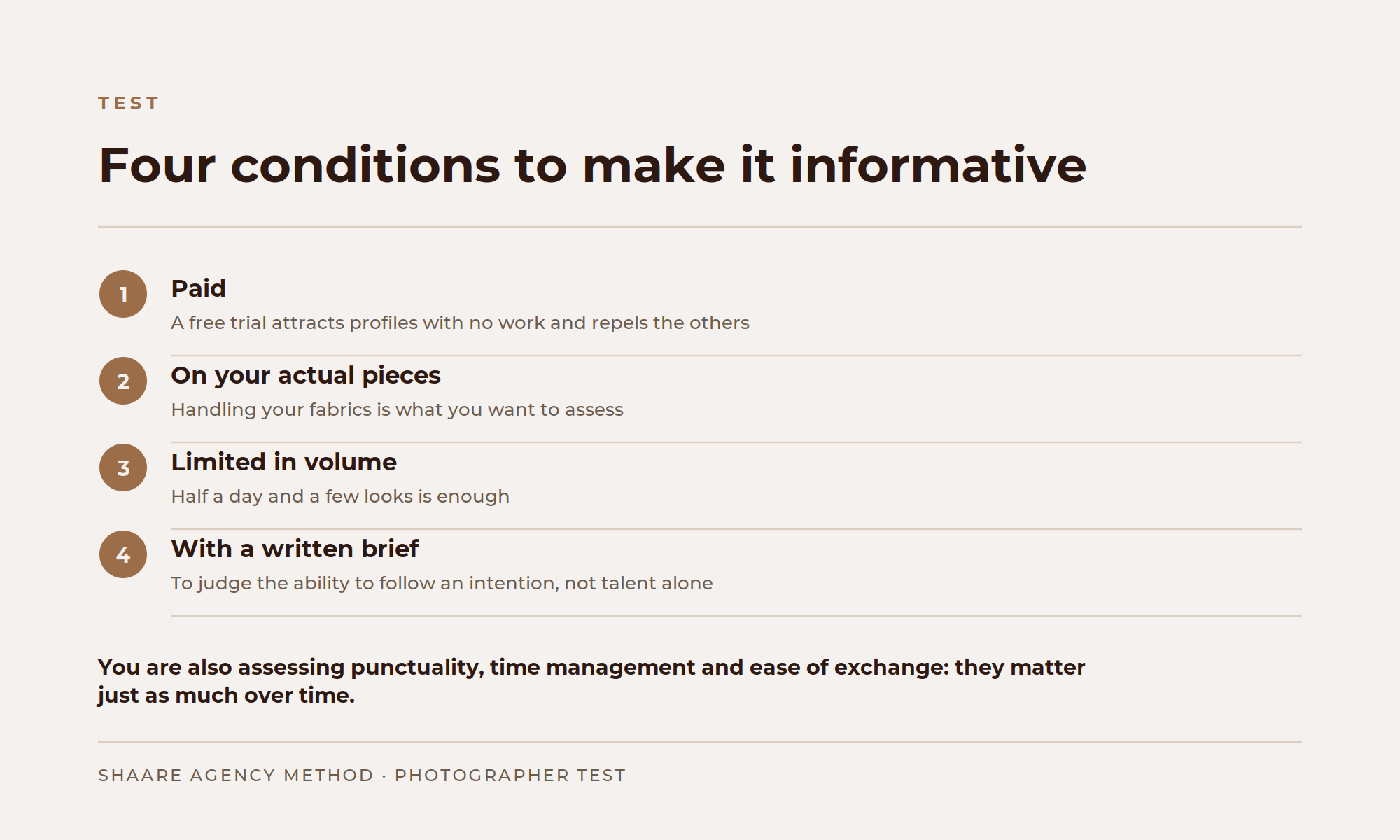
A useful test is paid, because a free trial attracts the profiles with no work and repels the ones who have plenty. It uses your actual pieces, not a free subject, because handling your fabrics is precisely what you want to assess. It is limited in volume: half a day and a few looks is enough. And it comes with a written brief, so you are judging the ability to follow an intention rather than talent alone.
What you then assess is not only the images. Punctuality, time management, the ability to propose and ease of exchange matter just as much over the long run. The frame of a workable brief is covered in our guide to briefing a shoot team.
What is negotiable, and what is not
Negotiation is about scope, rarely about the day rate.

Negotiable: the number of images delivered, the extent of usage rights, the volume of retouching included, the duration of the shoot, and a volume rate if you plan several days across the year.
Not negotiable: the time needed to work properly, and the usage rights you have not bought. A photographer who agrees to deliver sixty retouched images in half a day is mostly agreeing to work badly.
Price ranges by type of shoot are in our guide to fashion photoshoot costs.
The most common mistakes
- Choosing on day rate. Two identical rates can cover very different scopes.
- Judging on the best images. It is the floor of the portfolio that predicts your result.
- Asking for a free test. You rule out the photographers who are working and attract the ones who are looking.
- Ignoring the type of production. A campaign photographer is not an e-commerce photographer.
- Changing every season. A brand's visual coherence comes largely from a recurring eye.
Frequently asked questions
How do you know if a photographer suits your brand?
By looking at productions comparable to yours, how fabric is handled, and the coherence of a whole series rather than isolated images.
Should a test be paid?
Yes. A free test rules out photographers who already have work, which is exactly the group you are looking for.
Can an e-commerce photographer shoot a campaign?
Sometimes, but these are two different crafts. Ask for examples in the format you want, not an extrapolation.
What happens if the images are not right?
That should be set out in the quote: number of guaranteed images, retouching rounds included, and who covers a reshoot if one is needed.
Should you always work with the same photographer?
Over time, largely yes. Visual coherence is one of the least expensive brand awareness levers there is.
Conclusion
Choosing a fashion photographer comes down to three checks: productions comparable to yours, a portfolio judged on its average level, and a paid test on your actual pieces. Price is discussed afterwards, on scope rather than on the day.
To contact fashion photographers in Paris and across France directly, browse the Shaare directory, with no intermediary and no commission, or hand us your production.