
Vertical video has become the default format for brand discovery. It is also the format where fashion brands spend the most for the weakest return, because they carry photography's rules across to it.
A Reel is not an animated lookbook. It follows a logic of retention, not composition: what counts is what happens in the first two seconds, and what makes someone want to watch the third.
This guide covers the formats that work for a fashion brand, how to produce in batches rather than one at a time, what a video costs by production route, and how to weigh Instagram against TikTok.
What video produces that photography cannot
Three things, and none of them is aesthetic.

Drape and fabric. A piece in motion answers the question every online buyer asks and no photograph settles: how does it actually hang.
Scale. Seeing a piece worn, walking, in context, gives a sense of size and volume that a packshot does not.
Distribution. Vertical formats are the ones platforms push to audiences who do not follow you. It is the only format still doing discovery work at no media cost.
The formats that work in fashion
Four formats cover most of a brand's needs, and none requires heavy production.
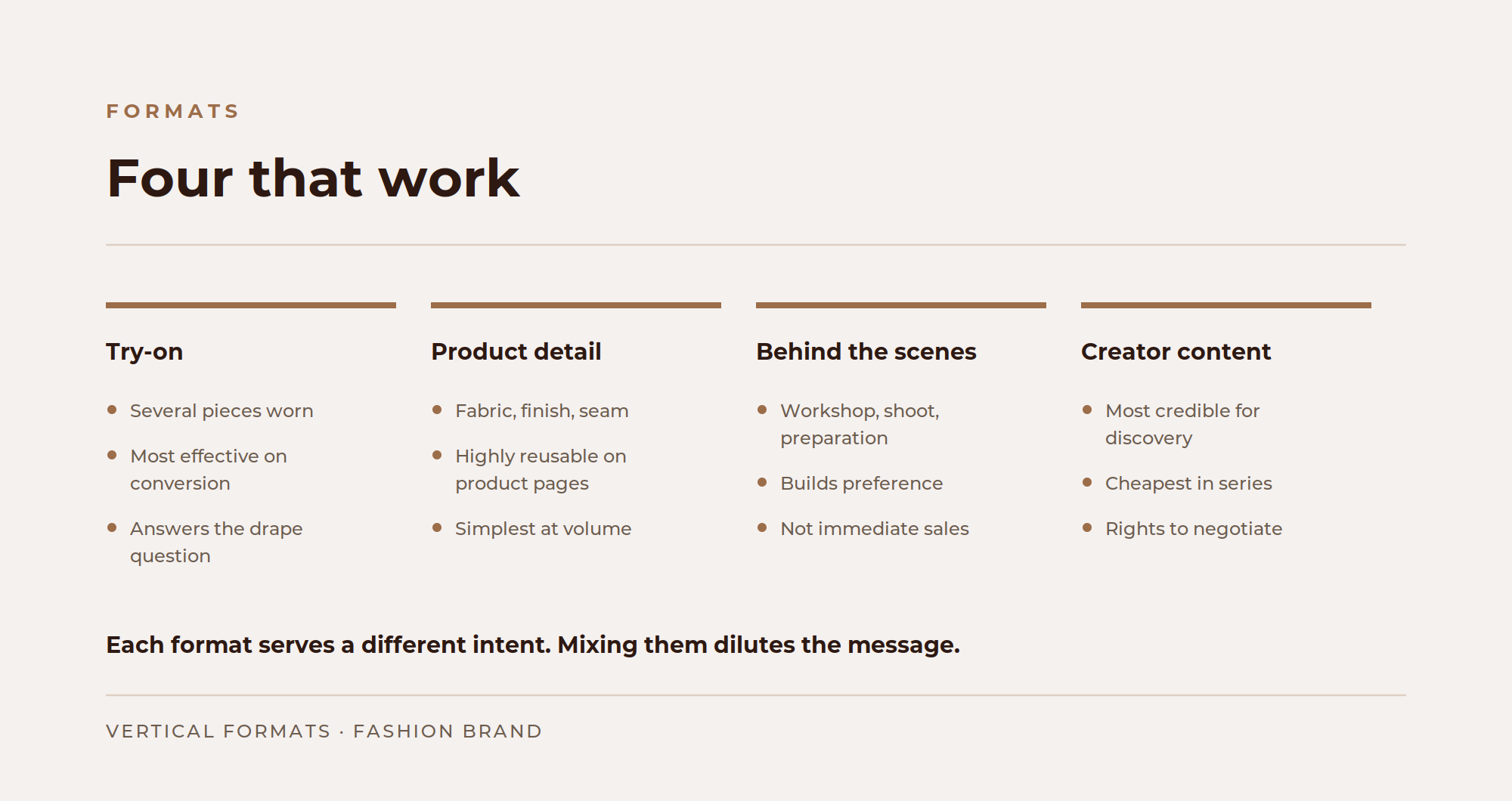
The try-on shows several pieces worn in succession. It is the most effective format on conversion, because it answers the drape question directly.
The product detail isolates a fabric, a finish, a seam. Short, highly reusable on product pages, and the simplest to produce in volume.
Behind the scenes shows the workshop, the shoot, the preparation. This is the format that builds brand preference rather than immediate sales.
Creator content remains the most credible format for discovery, and the cheapest to produce in series. How to frame its production is covered in our UGC strategy guide.
Produce in batches, not one at a time
This is what separates brands that keep the rhythm from those that give up after three weeks.
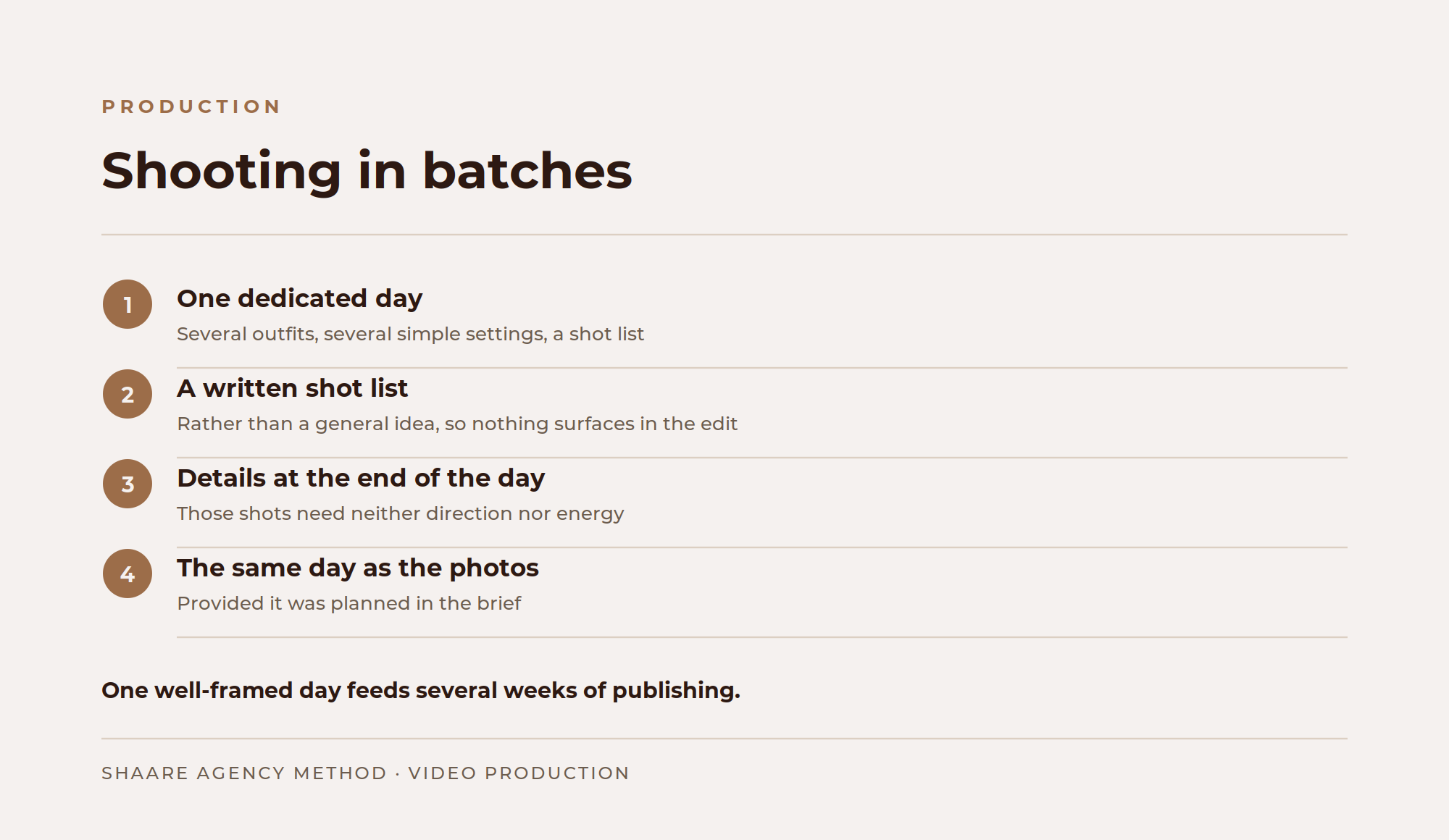
The principle: shoot in batches. A dedicated day, with several outfits, several simple settings and a shot list defined in advance, produces enough to feed several weeks. The alternative, filming a video when it occurs to you, costs proportionally far more in time and produces an irregularity that penalises distribution.
Two habits make batch shooting possible. Prepare a shot list rather than a general idea, so you do not discover in the edit that a cutaway is missing. And shoot the detail shots at the end of the day, when the team is tired but those shots need neither direction nor energy.
This batching logic connects to the photo shoot: the same day can produce both, provided it was planned in the brief. The method is in our guide to briefing a shoot team.
What it costs
Three production routes, three very different economies.
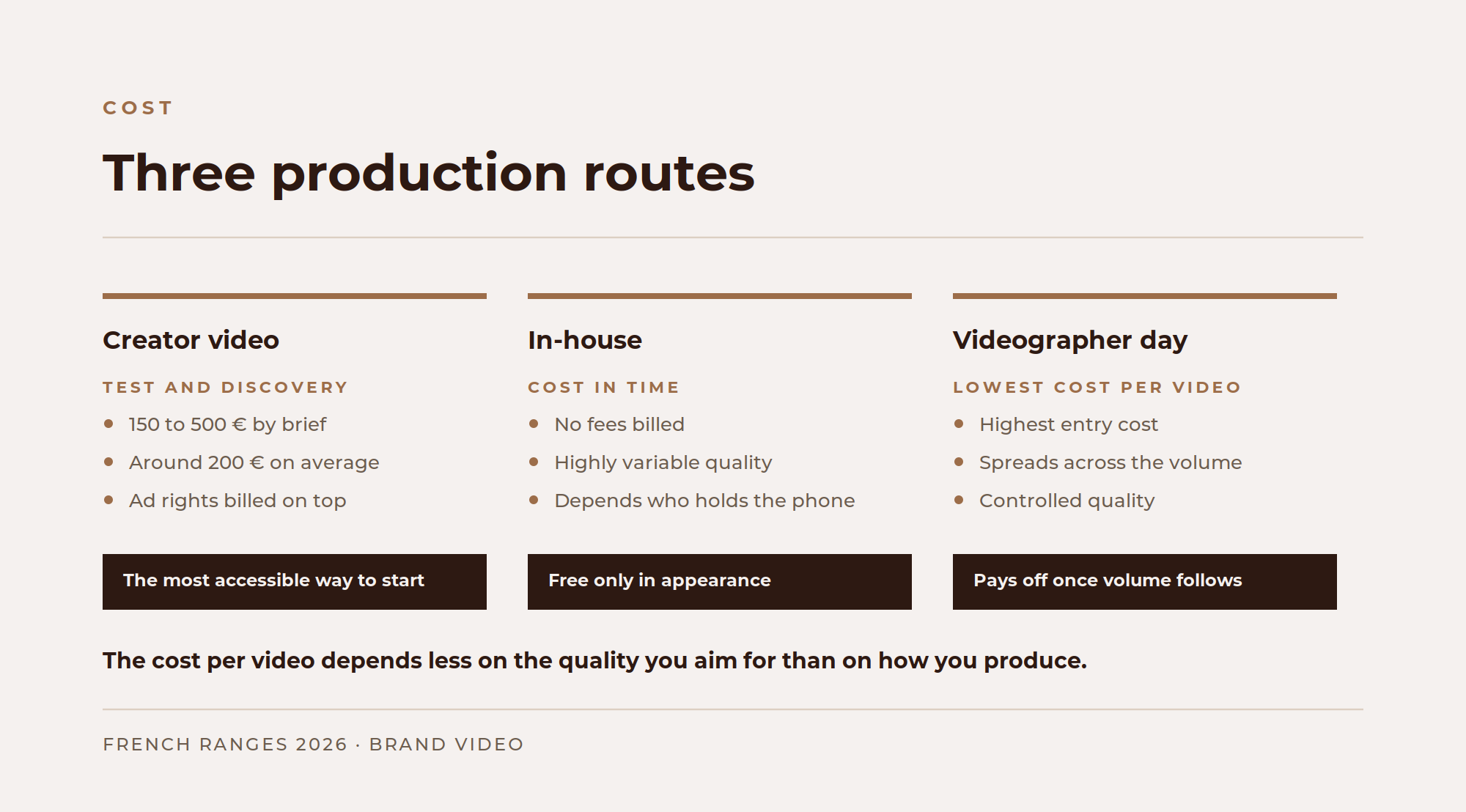
Creator video runs between 150 and 500 euros depending on brief and experience, averaging around 200 euros for a standard format. Advertising usage rights are billed on top and negotiated separately.
In-house production costs nothing in fees but costs time, and produces quality that varies a lot with whoever holds the phone.
A shooting day with a videographer has the highest entry cost but the lowest cost per video once volume follows, since the day spreads across everything produced.
The most common trade-off: for a brand starting out, a panel of creators producing three to five videos costs less than a shooting day and lets you test several angles before investing in controlled production.
Instagram or TikTok
The question matters less than people think, because the format is the same and the marginal cost of posting to both is nil.
What changes is the register. TikTok tolerates and rewards rougher, faster, more spoken production. Instagram remains more sensitive to visual composure, which suits a brand building a world. A fashion brand generally benefits from posting to both, adapting the edit rather than reshooting.
The point to watch is elsewhere: posting the same content without adapting the opening frame and the on-screen text performs badly on both platforms.
The mistakes that cost most
- Carrying photography's rules across. A static, composed frame does not hold attention in vertical.
- Polishing the ending rather than the opening. Everything is decided in the first two seconds.
- Shooting one at a time. Cost per video jumps and regularity becomes impossible to hold.
- Forgetting usage rights on creator content, which rules out reusing it in advertising or on product pages.
- Neglecting sound. A large share of views happen with sound on, and a poor track sends people to the next video.
Frequently asked questions
How much does a brand video cost?
Between 150 and 500 euros with a creator, averaging around 200 euros for a standard format. A shooting day with a videographer has a higher entry cost but a lower cost per video if volume follows.
How many videos a month?
Regularity counts more than volume. Four a month held for six months beats twenty in three weeks and then nothing.
Videographer or creator?
A creator for discovery and testing angles, a videographer for controlled content destined for product pages and advertising. The two complement each other.
Can you post the same content to Instagram and TikTok?
Yes, adapting the opening frame and the on-screen text. Posting strictly identical content performs badly on both.
Do you need usage rights on a creator video?
Yes if you intend to reuse it in advertising, on your site or on product pages. They are negotiated upfront and billed separately from the creation.
Conclusion
Vertical video is not an animated version of your photographs, it is a format with its own logic: the first two seconds decide, production happens in batches rather than one at a time, and usage rights are negotiated before filming. Those three decisions are enough to turn the format from a cost into an asset.
To find videographers and creators, browse the Shaare directory and contact them directly, or hand us the production of your video content.