
Finding a model, a photographer or a make-up artist for a fashion shoot is not the hard part. The hard part is knowing what it costs, how far ahead to book, and what needs to be settled before the shoot day.
Most brands come to casting late, once the collection is ready and the dates are set. That is when the trouble starts: the good profiles are already booked, rates get negotiated under pressure, and image rights are sorted out afterwards, usually badly.
This guide covers what you need to know before contacting fashion talent in France: pay ranges by role and experience level, realistic booking lead times, what a brief must contain to get a reply, and how to frame image usage. The Shaare Agency directory then lets you contact profiles directly, with no middleman and no commission.
What fashion talent costs in Paris in 2026
First thing to understand: there is no single rate per role. Pay depends on experience, on the type of production, and on how the images will be used. Here are the orders of magnitude on the Paris market.

Models
For a photo shoot, on a four-hour half day:
- Beginner: 250 to 400 euros
- Intermediate, two to four years of experience: 400 to 600 euros
- Experienced, five years or more with a solid book: 600 to 900 euros
E-commerce follows a different, more standardised logic: expect 350 to 600 euros for a full eight-hour day covering sixty to eighty outfits. Runway is the widest-ranging format, from unpaid work in exchange for exposure up to several thousand euros for an established profile.
Photographers
Rates are built per assignment, not per hour:
- E-commerce day: 650 to 1,700 euros
- Collection lookbook: 700 to 3,500 euros
- Full campaign: from 3,000 euros, with no real ceiling
The breakdown by assignment and by city is in our fashion photographer price list.
Make-up, hair and styling
These roles are more stable: around 250 euros a day for a make-up artist, 330 euros for a stylist, 100 to 150 euros for a photo assistant. They are systematically underestimated in initial budgets even though they directly shape the final result.
The line everyone forgets: studio rental. An equipped studio in Paris starts around 200 to 250 euros excluding tax for a half day, lighting and backdrops included. Outside Paris, expect roughly 30% less.
To build a full budget rather than an isolated rate, our guide to fashion photoshoot costs breaks it down line by line.
When to book
Lead time is the variable brands underestimate most, because it costs nothing until you run into it.
For an e-commerce shoot with a small team, two to three weeks is usually enough. For a lookbook with a model, make-up and styling, expect four to six weeks: you have to align three to five people's availability on a single day. For a campaign or a runway show, two to three months is not excessive.
These lead times stretch noticeably in two periods: September and October, when every brand is producing its collection visuals, and Paris fashion week, when the most sought-after profiles are either unavailable or charging peak rates. If your production falls in those windows, double your lead time.
What a brief must contain to get a reply
Talent receive vague enquiries constantly. The ones that get a fast reply all share one trait: they let the reader say yes or no without having to ask three questions first.
Six elements are enough:
- The nature of the project: e-commerce, lookbook, campaign, runway, social content.
- Dates and duration, precisely. "Sometime in November" does not let anyone block a diary.
- The location: studio, outdoors, which city.
- How the images will be used: media, territory, duration. This drives the rate as much as the shoot itself.
- The budget, even as a range. A brief with no budget reads as a request for a free quote and goes to the bottom of the pile.
- A visual reference: two or three images are enough to convey the direction.
Three things, conversely, get a brief declined every time: no budget, exposure offered in place of payment, and image usage left deliberately vague.
Reading a book: the signals that matter
A portfolio's aesthetic is quick to judge, but it says little about how reliable the profile is. Three signals are more useful.
Consistency of level. A book where two images stand well above the rest usually reflects one good session with a strong photographer rather than a steady level. Look at the floor, not the ceiling.
Range of contexts. A model who only appears in one type of framing or lighting has not yet worked under varied production conditions.
Recency. A portfolio whose most recent images are two years old raises a simple question: what has happened since?
Image rights, the line nobody plans for
This is the subject that turns a controlled budget into a bad surprise, and it is settled before the shoot, never after.
The fee covers the work. Image usage is negotiated separately, on three parameters: permitted media, territory and duration. The same shoot billed at 1,500 euros as a base, for one year of web use in France, commonly negotiates around 3,750 euros for two years across Europe on all media, and can reach 9,000 euros for an unlimited worldwide exclusive assignment.

Three points to put in writing before the day: the list of media, the licence duration, and whether it is exclusive. A verbal agreement on this always ends up costing more than the time it would have taken to write it down.
The applicable framework depends on the talent's status and on the nature of the assignment. For a major campaign or a long-term commitment, have the document reviewed by a lawyer: it is a modest investment against the risk.
Where to find these profiles
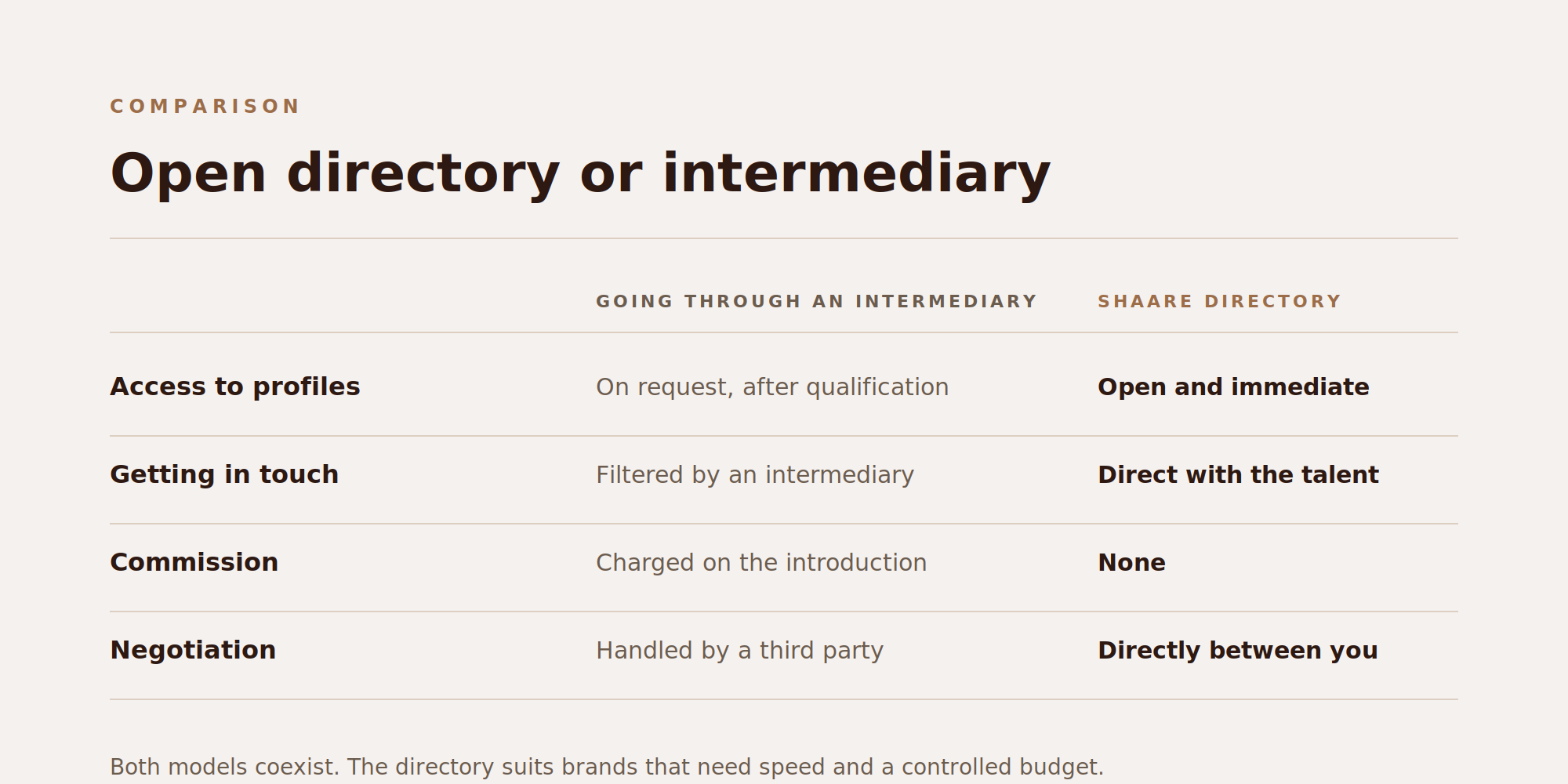
Three routes coexist, and they do not answer the same need.
Representation agencies provide curation, support and administrative handling. That is the right choice for a high-stakes campaign, or when you have no visibility on the market. The cost of that support shows up in the final invoice.
Social media lets you spot profiles, but not whether they are available, at what rate, or whether they work professionally. The time spent filtering is the real cost of this route.
Direct-access directories answer a specific need: moving fast when you know what you are looking for, while keeping control of the budget and the negotiation.
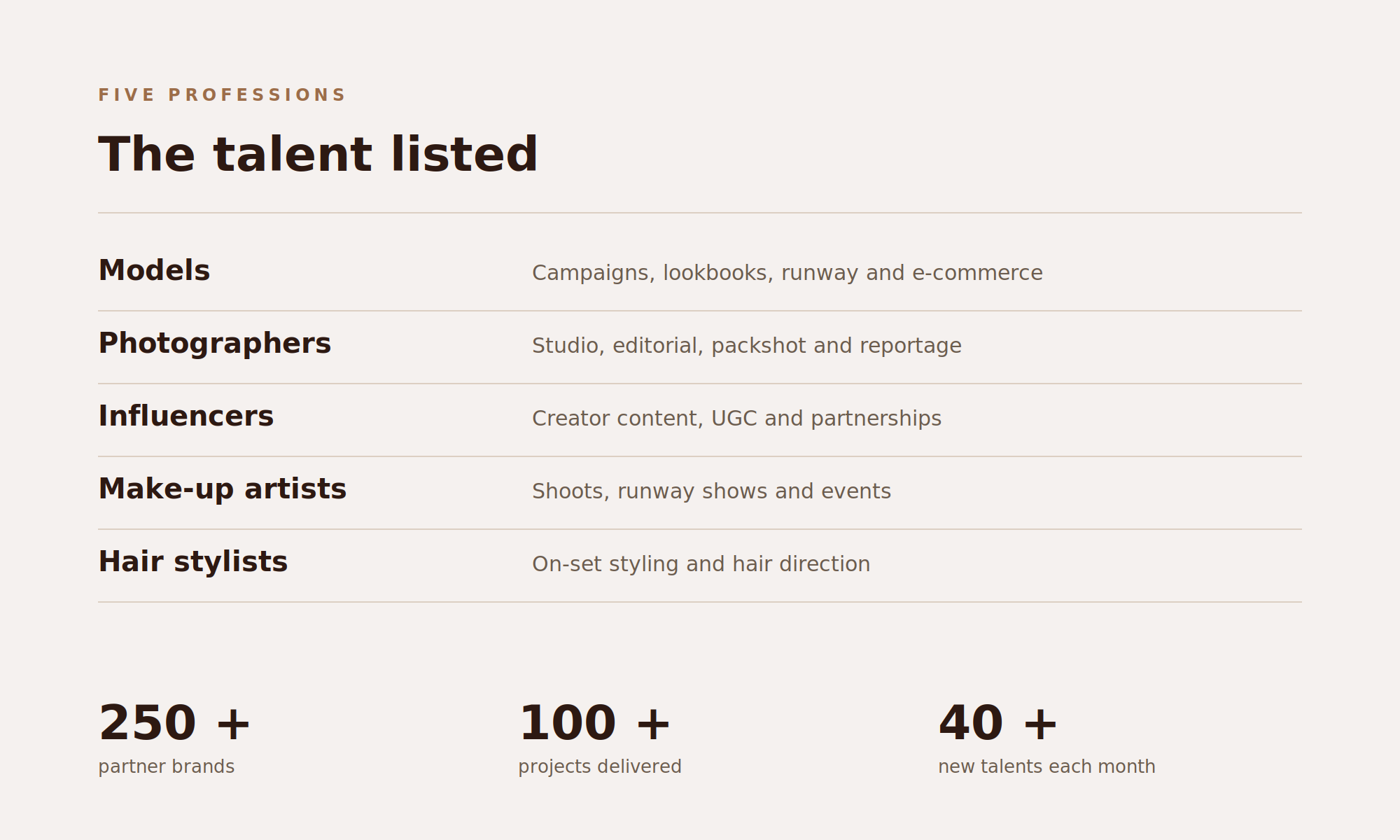
That is the principle behind the Shaare Agency directory. It brings together the five roles a fashion production needs, freely browsable, with no account to create.
You filter by role and by city, write directly to the profile you want, and agree the rate and schedule together. Shaare takes nothing from the collaboration and does not step into the negotiation.
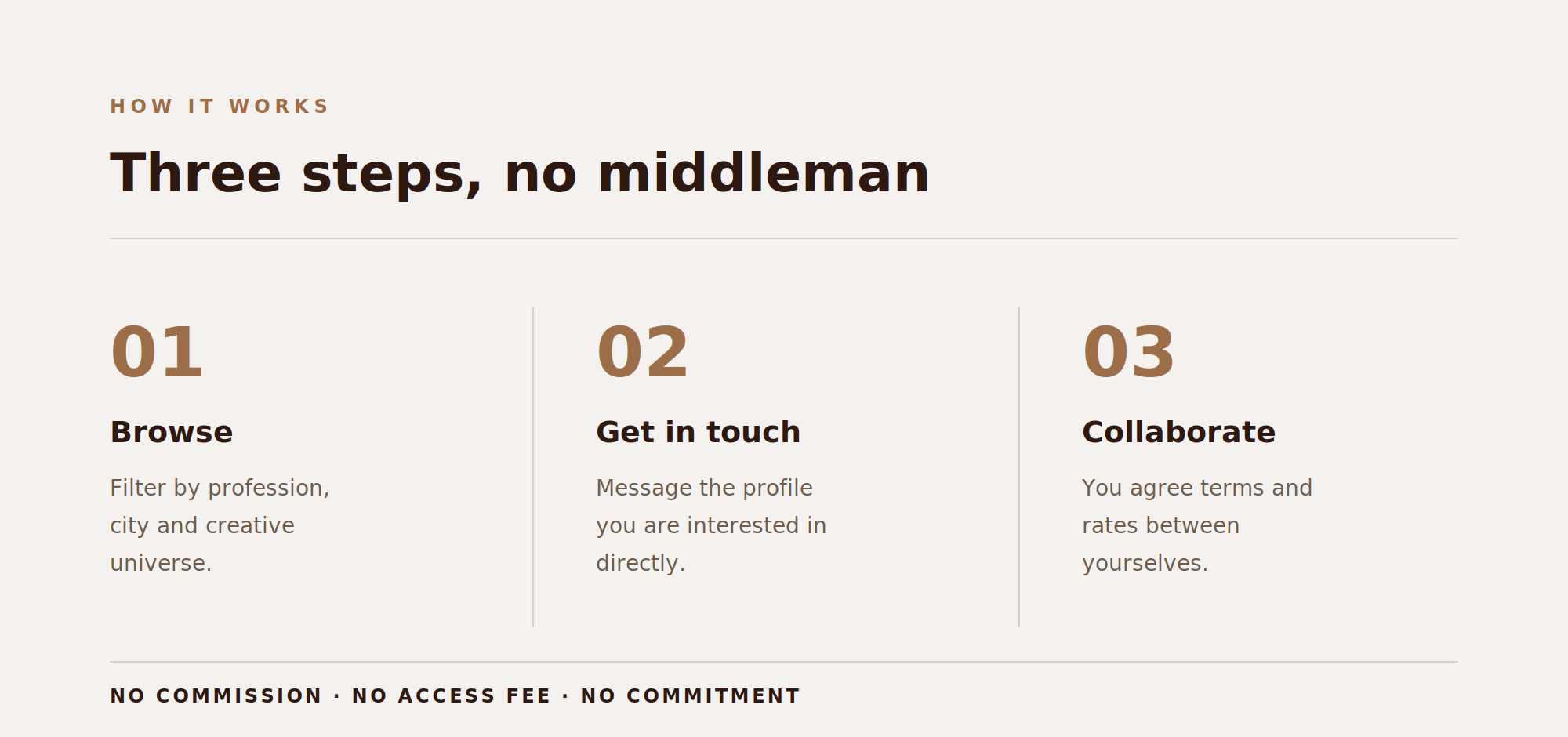
Access is free for brands because the model rests on subscriptions from the listed talent, who pay for visibility. The consequence is direct: we have no interest in filtering your exchanges or taking a cut.
Delegating the casting
Searching yourself takes time and a reasonably clear idea of the profile you want. If either is missing, send us your project, your dates and your budget, and we will come back with a shortlist.
Beyond casting, Shaare Agency handles content production, creator campaign management and events. If your need goes past an introduction, our fashion content production guide sets out how a full set-up is structured.
Frequently asked questions
How much does a model cost in Paris for a shoot?
Between 250 and 400 euros for a half day with a beginner, 400 to 600 euros for an intermediate profile, 600 to 900 euros for an experienced one. E-commerce on a full day runs between 350 and 600 euros.
How far ahead should you book?
Two to three weeks for a simple e-commerce shoot, four to six weeks for a lookbook with a team, two to three months for a campaign or a runway show. Double those lead times in September, October and during fashion weeks.
Do you need a contract to work with a model?
A written agreement is essential, covering at minimum the assignment, the fee and the image usage. The exact framework depends on the talent's status and the nature of the work.
Who pays for image rights?
The brand, on top of the shoot fee. The amount varies with media, territory and duration of use, and can come to several times the base rate.
Is the directory really free for brands?
Yes. Browsing and getting in touch are free, with no account needed, and no commission is taken on the collaboration.
Conclusion
A successful casting owes less to luck than to three decisions taken early: a realistic budget per line, a lead time that matches the complexity of the production, and a written agreement on image usage. The rest, finding the right profiles, has become the easy part.
To build your team, browse the Shaare directory and contact the talent that fits your brand directly, or hand us your search if you would rather delegate.