

Awareness is not visibility. You can be seen by a hundred thousand people and remembered by none. The difference comes down to three things: repetition, consistency and distinctiveness.
That is why brands spending heavily on acquisition can stall on awareness, while brands on modest budgets eventually settle into the minds of a specific clientele. The lever is not volume, it is constancy.
This guide covers what separates awareness from visibility, the five levers available in 2026 and how long each takes to pay back, the one that is most underestimated, and how to measure progress that never shows up in a sales table.
Visibility and awareness are not the same thing
Visibility is measured in impressions. Awareness is measured in recall, meaning the ability to be named spontaneously when someone thinks of your category.
A campaign generating a million impressions with nobody retaining the name has produced visibility and no awareness. Conversely, a brand appearing twelve times a year in front of the same audience of ten thousand people builds something durable.
Three mechanisms take you from one to the other. Repetition, because a single exposure leaves no trace. Consistency, because a brand changing its world with every campaign starts from zero each time. Distinctiveness, because an image that looks like your competitors' benefits the category, not you.
The five levers and how long each takes
They do not produce effects at the same pace, which explains most badly made trade-offs.

Influence is the fastest lever. Creator content produces exposure within days. Its effect falls away just as fast if not repeated, which is why long partnerships consistently beat one-off operations.
Brand content works over the medium term. Consistent images, published regularly, establish a recognisable world. It is slow, and it is cumulative.
Events produce a concentrated, memorable effect on a limited audience. Their value for awareness lies less in the number of people reached than in the intensity of the memory left behind.
Editorial search presence is the slowest of all, and the only one whose effect continues without reinvestment. An article that ranks brings qualified traffic for years.
Press and tastemaker relations bring borrowed credibility that nothing replaces, on an unpredictable timescale.
The most underestimated lever
It is none of the five. It is the regularity with which you use them.
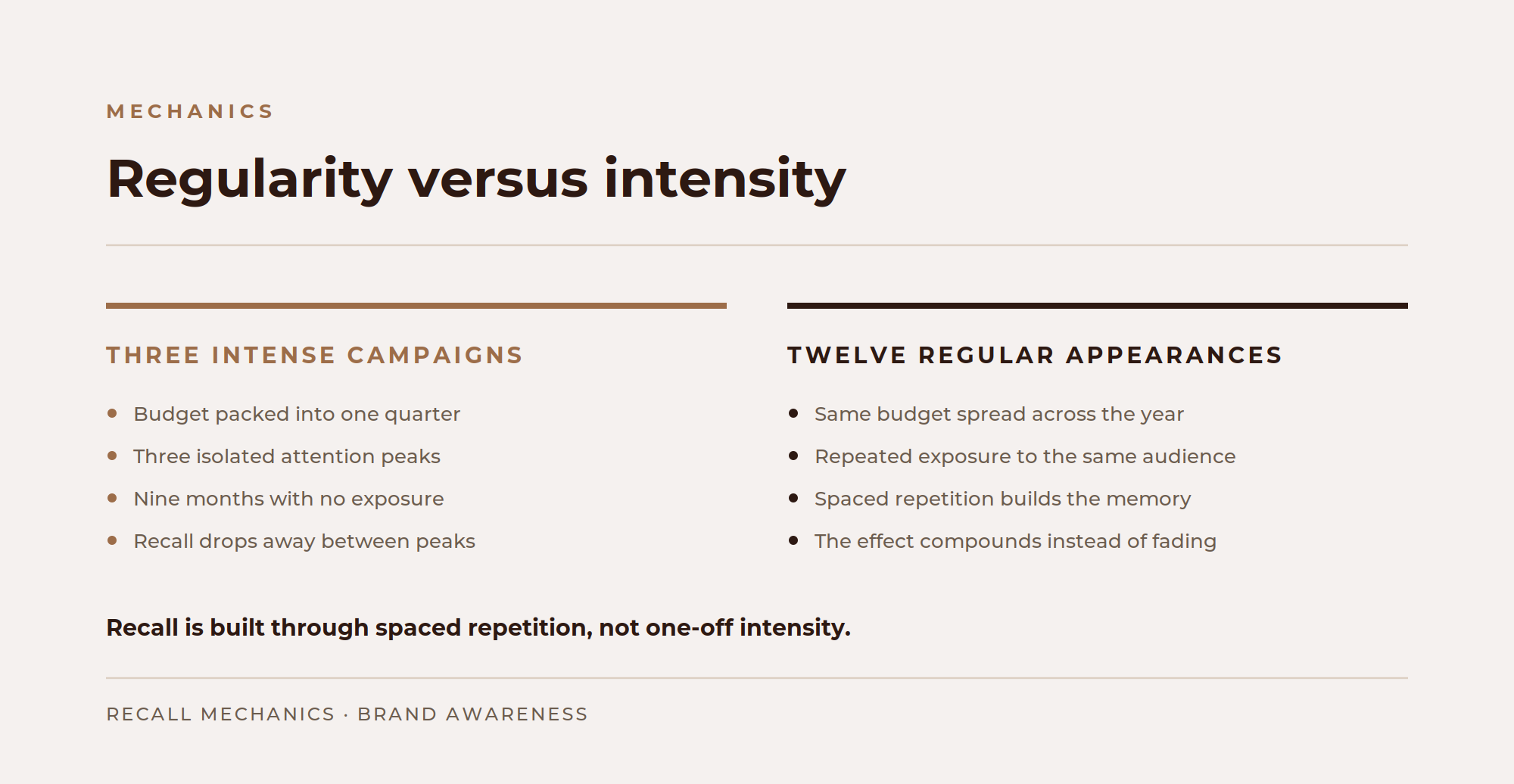
A brand publishing twelve times a year in front of the same audience builds more than a brand concentrating the same budget into three spectacular operations. The reason is mechanical: recall is built through spaced repetition, not through one-off intensity.
It is also why giving up is the first enemy of awareness. An editorial programme stopped after three months has cost its full price without producing its effect, since the effect only arrives later.
The question to ask before launching anything: can I hold this pace for twelve months? If the answer is no, cut the ambition rather than the duration.
What makes a brand distinctive
Distinctiveness is the cheapest lever and the most neglected. It needs no extra budget, it needs decisions.
Three elements are enough to be recognisable before being read: a consistent palette, a recurring framing, and a stable tone. Brands that change all three every season start from zero each time, whatever the budget committed.
The test is simple: cover your logo on your last ten images. If nobody can tell they come from the same brand, distinctiveness is the first job, before any acquisition spend.
Measuring awareness
This is the discouraging part, because none of the usual indicators fit. Four measurements do the job, provided you record a starting point.
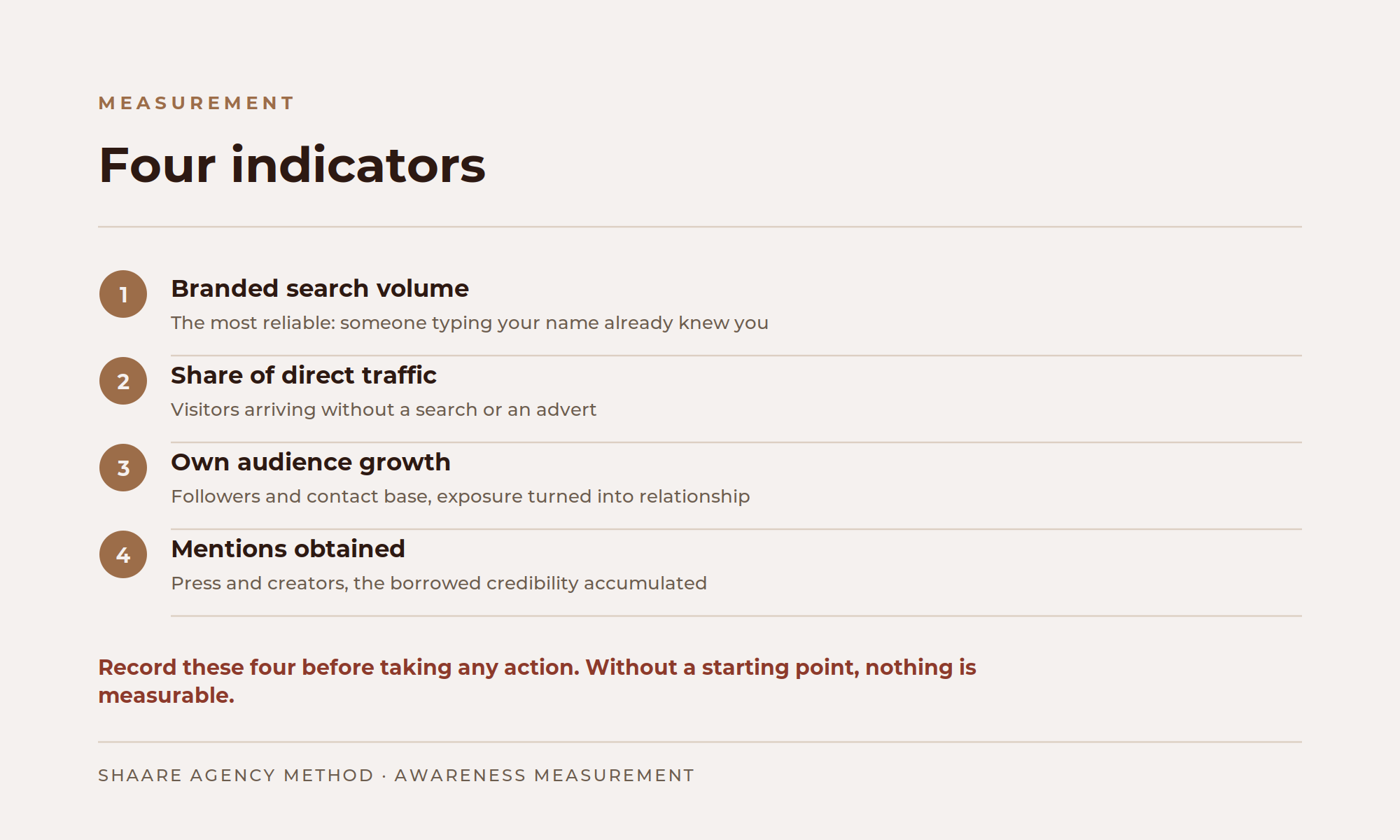
Branded search volume is the most reliable indicator. Someone typing your name already knew you. Its growth measures exactly what you are after.
The share of direct traffic, meaning visitors arriving without a search or an advert, says the same thing from another angle.
Growth of your own audience, followers and contact base, measures the share of exposure that turns into a relationship.
Mentions obtained, press and creators, measure the borrowed credibility accumulated.
Record these four today, before taking any action. Without a starting point you will not know what your efforts produced.
Building a calendar that holds
Awareness is planned by the year, not by the campaign.
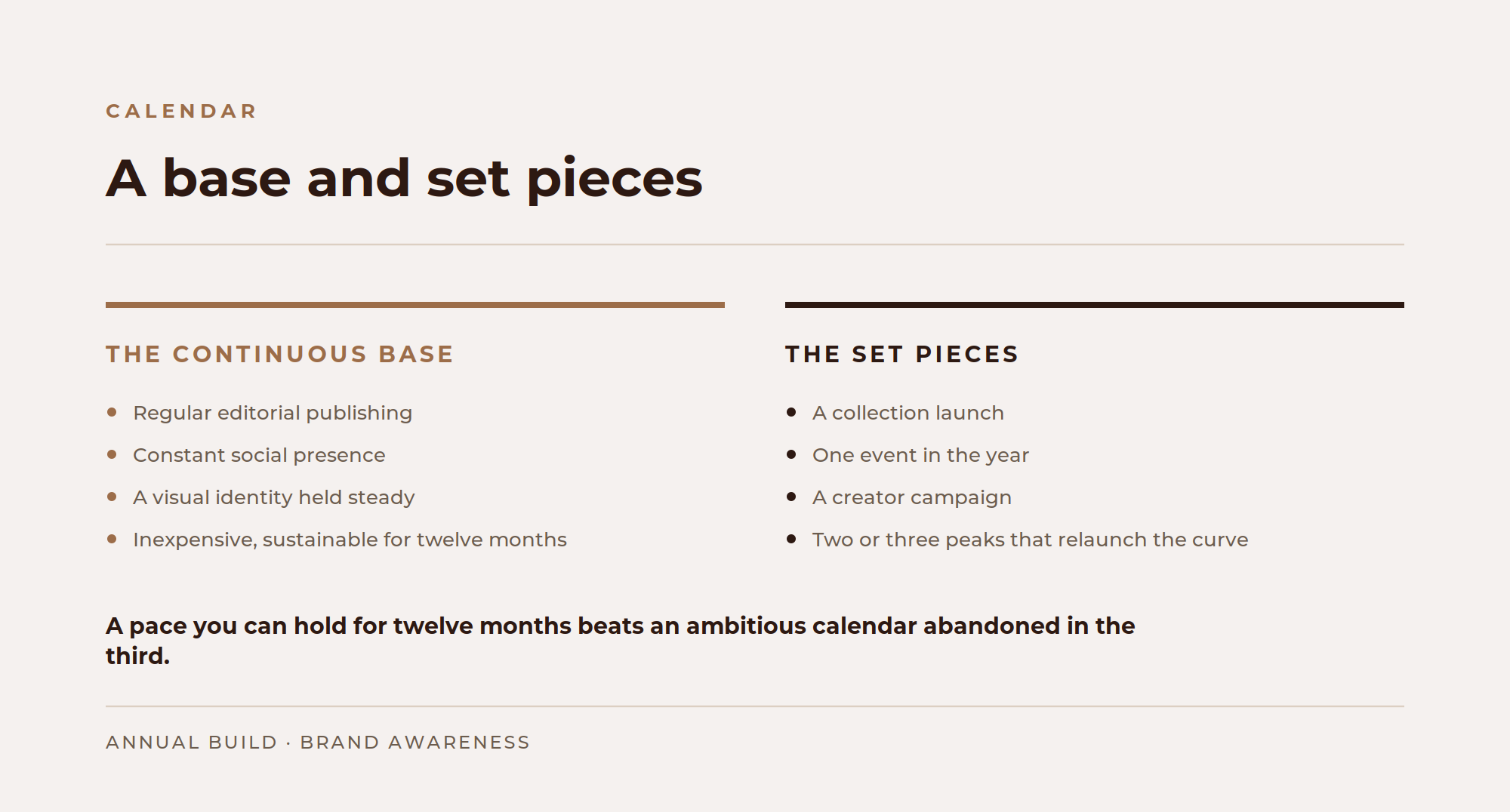
The building principle: a continuous base, inexpensive and sustainable, with two or three set-piece moments grafted onto it across the year. The base maintains recall, the set pieces create the peaks that relaunch it.
In practice, regular editorial publishing and a constant social presence form the base. A collection launch, an event and a creator campaign form the set pieces. How those three levers are articulated around a date is covered in our guide to events as a growth lever.
Frequently asked questions
How long does it take to build awareness?
The first measurable signals appear after six to twelve months of regular activity. Fast levers like influence produce immediate exposure, but recall needs repetition.
Which lever should you prioritise on a limited budget?
Distinctiveness, which costs nothing, then regularity of brand content. A recognisable brand publishing constantly beats a generic brand spending in bursts.
Does influencer marketing build awareness?
Yes, provided it is repeated. A long partnership with a creator whose audience matches your target builds more than ten one-off operations.
How do you know whether your brand is distinctive?
Cover your logo on your last ten images. If nothing ties them to one brand, that is the first job.
Should awareness be measured monthly?
A quarterly reading is enough. Monthly variation is noise on indicators that move slowly.
Conclusion
Awareness is not bought, it accumulates. It asks for less budget than constancy: a distinctive identity held over time, a publishing rhythm sustainable for twelve months, and two or three set pieces that relaunch the curve. The brands that get there are not the ones spending most, they are the ones that do not stop.
To produce that content base over time, browse the Shaare directory and build your team directly, or hand us your production.