

Events are the only lever that produces direct contact, content, press coverage and sales at the same time. They are also where emerging brands most often pick the wrong format, and therefore the wrong budget.
The confusion comes from a stubborn shortcut: equating fashion events with Fashion Week. Yet the official calendar is the least accessible and least profitable format for a brand still building its name. The figures say so plainly.
This guide covers what events actually produce, why Fashion Week is not the right entry point, the three formats genuinely open to a growing brand, what each costs, and how to measure what they return.
What events produce that no other channel does
A photoshoot produces images. An influencer campaign produces reach. An event produces four things at once, and it is that combination that gives it economic value.
- Direct contact. Watching someone touch a fabric, try a piece on, hesitate over a size teaches you in one day what no conversion table will.
- Content. A well-run event generates dozens of usable images and videos that last for months, with an authenticity a studio shoot does not reproduce.
- Press and creator relationships. A physical meeting achieves in thirty minutes what twenty emails do not.
- Sales. Immediate on the day, and deferred over the following weeks.
None of these four effects can be obtained on its own at the same cost. That is why events remain a growth lever rather than a communications expense.
The Fashion Week mirage
Paris dominates on attention, and that is not in doubt. According to a study by Onclusive covering the Spring-Summer 2026 season, Paris Fashion Week generated 25.5 million social mentions, against 5.7 million for Milan, 3.8 million for New York and 2.7 million for London. In traditional media, Paris totalled 46,302 mentions, ahead of New York at 38,815.
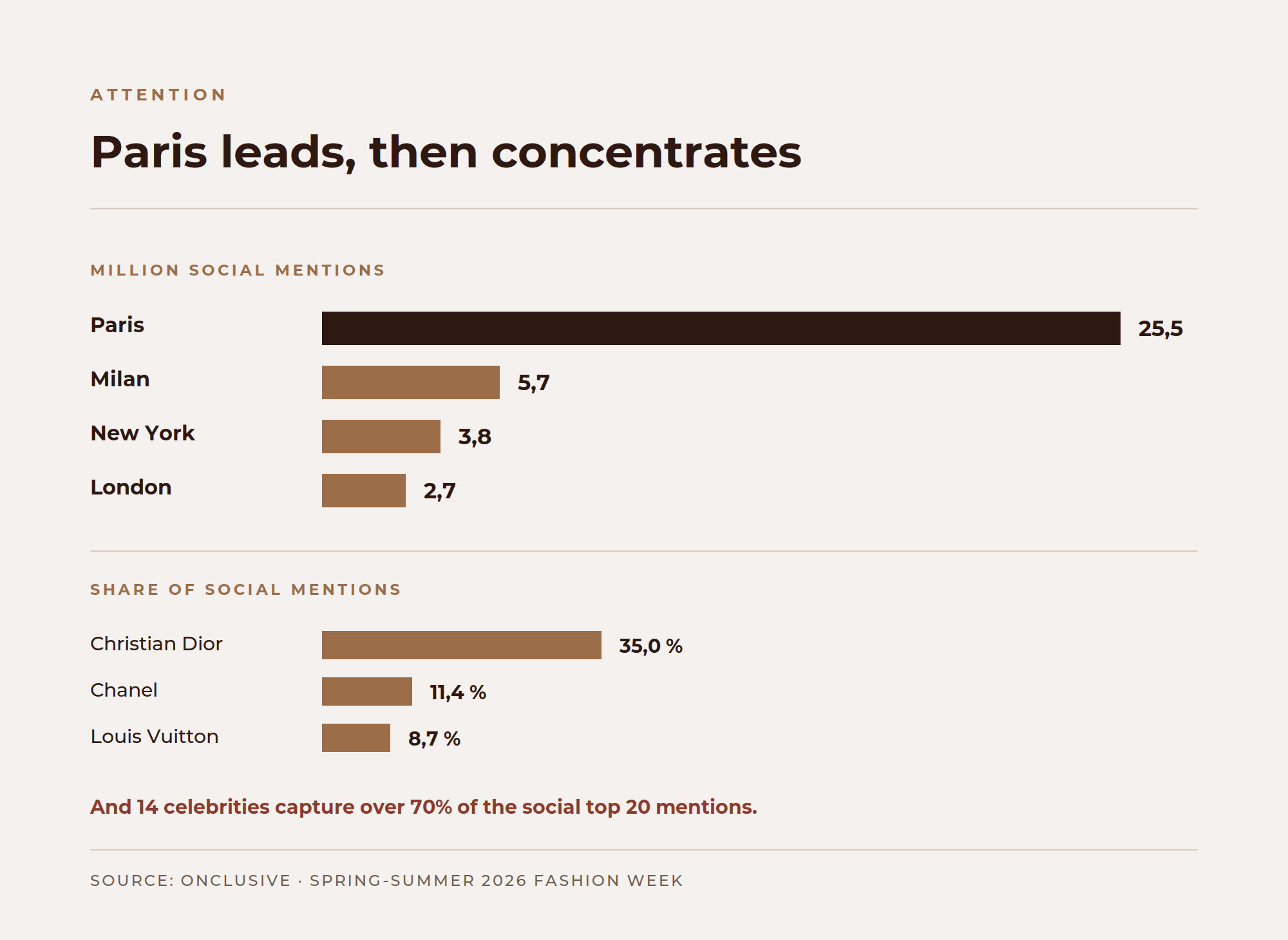
The problem shows up on a second reading. The same study shows Christian Dior alone capturing 35% of social mentions, Chanel 11.4% and Louis Vuitton 8.73%. More telling still, fourteen celebrities account for more than 70% of the mentions in the global social top 20.
In other words, Fashion Week attention is not distributed, it is captured. An emerging brand that invests to appear on the calendar buys a presence, not visibility. The entry cost is high, the competition for attention is overwhelming, and the benefit is rarely measured.
What that means in practice: the value of events for a growing brand does not come from competing with the big houses on their own ground. It comes from creating a controlled moment, at your scale, where your audience is entirely yours.
As a benchmark for what the top of the market produces, Paris haute couture week, with 29 shows, generates in the order of 200 million dollars of Media Impact Value according to Launchmetrics measurements, a figure that has tripled in three years. Those orders of magnitude do not transfer to a brand starting out, and that is precisely the point.
The three accessible formats
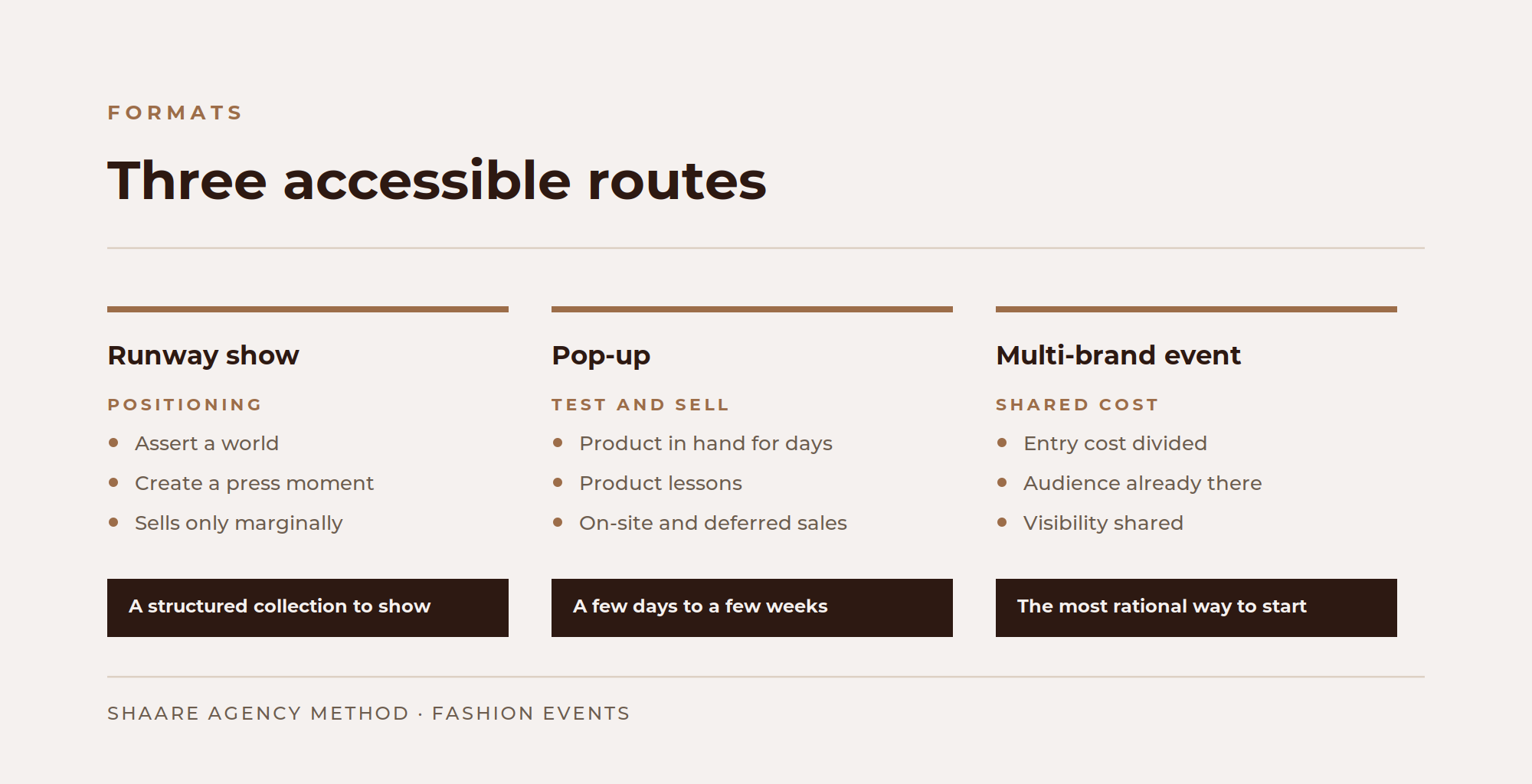
Three formats are genuinely within reach of a growing brand. They serve different objectives and are budgeted differently.
The runway show
A show is a positioning format. It asserts a world, creates a press moment, and produces highly recognisable content. It does not sell directly, or only marginally.
It earns its place when you have a structured collection to show, a story that does not come across in photographs, and a press or buyer network to gather. It does not earn its place for launching a first capsule, where it will cost a great deal for a weak commercial effect.
On budget, runway model fees vary sharply by level, from unpaid work in exchange for exposure for beginners to several hundred or several thousand euros for established profiles. On top of that sit the venue, the staging, hair and make-up, filming, and coordination.
The pop-up
The pop-up is a testing and selling format. It is the only one of the three that puts your product in your customers' hands for several consecutive days.
Its value does not lie in the revenue taken on site, which rarely covers the full cost. It lies in what it teaches you: which pieces get touched and which only get looked at, which sizes are missing, which objections recur, what price feels right. That information then shapes your whole production.
Le Marais remains the reference district for this format in Paris, with a natural footfall few other locations offer. Typical durations run from a few days to a few weeks, depending on rent and objective.
The multi-brand event
This is the most underestimated format, and often the most rational for a brand starting out. The principle is simple: several brands share the venue, the production, the communications and, above all, the audience.
Two benefits follow. The entry cost is divided, which makes the format accessible much earlier. And you reach an audience you could not have gathered alone, that of the other brands present, which often matches your customer profile without knowing you.
The trade-off is that you do not fully control the setting, and your visibility is shared. That is a favourable trade while your name is still being built.
How the budget is built
There is no such thing as an event rate, only an addition of lines whose weight varies by format. Thinking in terms of a single global envelope reliably leads to discovering costs along the way.
Five lines always structure the budget.
- The venue. The most variable and most constraining line. It depends on district, duration and season, and is booked before anything else.
- The team. Models, photographer, hair and make-up, coordination. Ranges by role and level are in our casting guide.
- The staging. Furniture, signage, lighting. This is the easiest line to contain without degrading the experience, provided it is decided early.
- The filming and photography. On an event this is an investment rather than an expense: the content produced works for months.
- Communications. Invitations, creator relays, the announcement. An event with no audience prepared is an empty room on a Thursday evening.
One trade-off comes up constantly: filming is the line brands cut first when the budget tightens, and it is almost always a mistake. A successful event without images leaves a pleasant evening. The same event with images leaves three months of content, a press pack and product-page visuals.
Preparing an event: the countdown
Almost every failed event fails for one reason: it was prepared too late. The format does not forgive improvisation, because everything converges on a date that will not move.
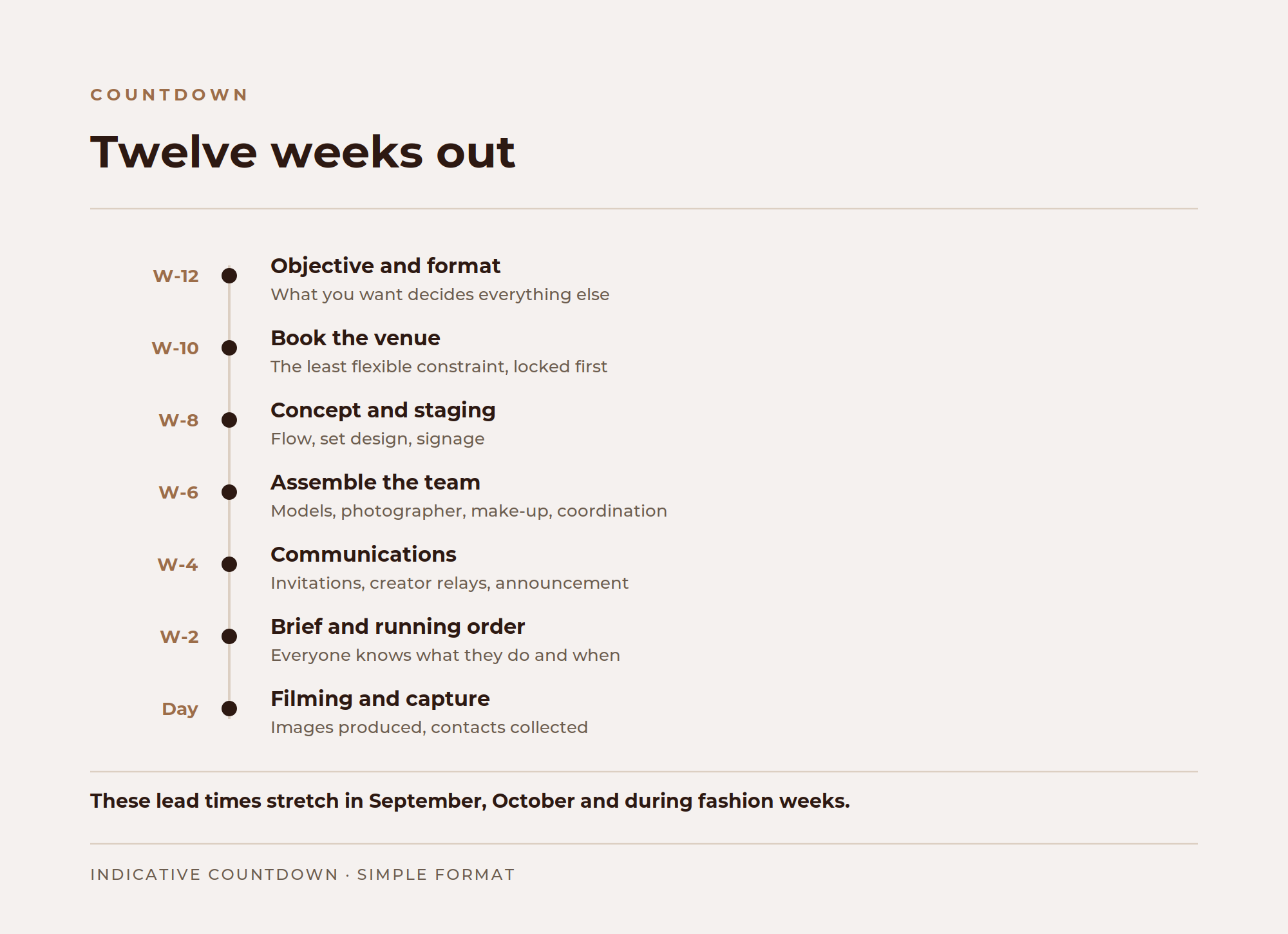
Two milestones deserve particular attention. The venue is booked first, because it determines everything else and is the least flexible constraint. The team is assembled next, four to six weeks ahead, which is the real time needed to align several people's availability on one date. Those lead times stretch noticeably in September, October and during fashion weeks. The detail on lead times and fees is in our fashion casting guide.
Measuring what an event returns
This is the step most often skipped, because an event produces a subjective satisfaction that stands in for a review. Five indicators are enough, and none can be measured retroactively.
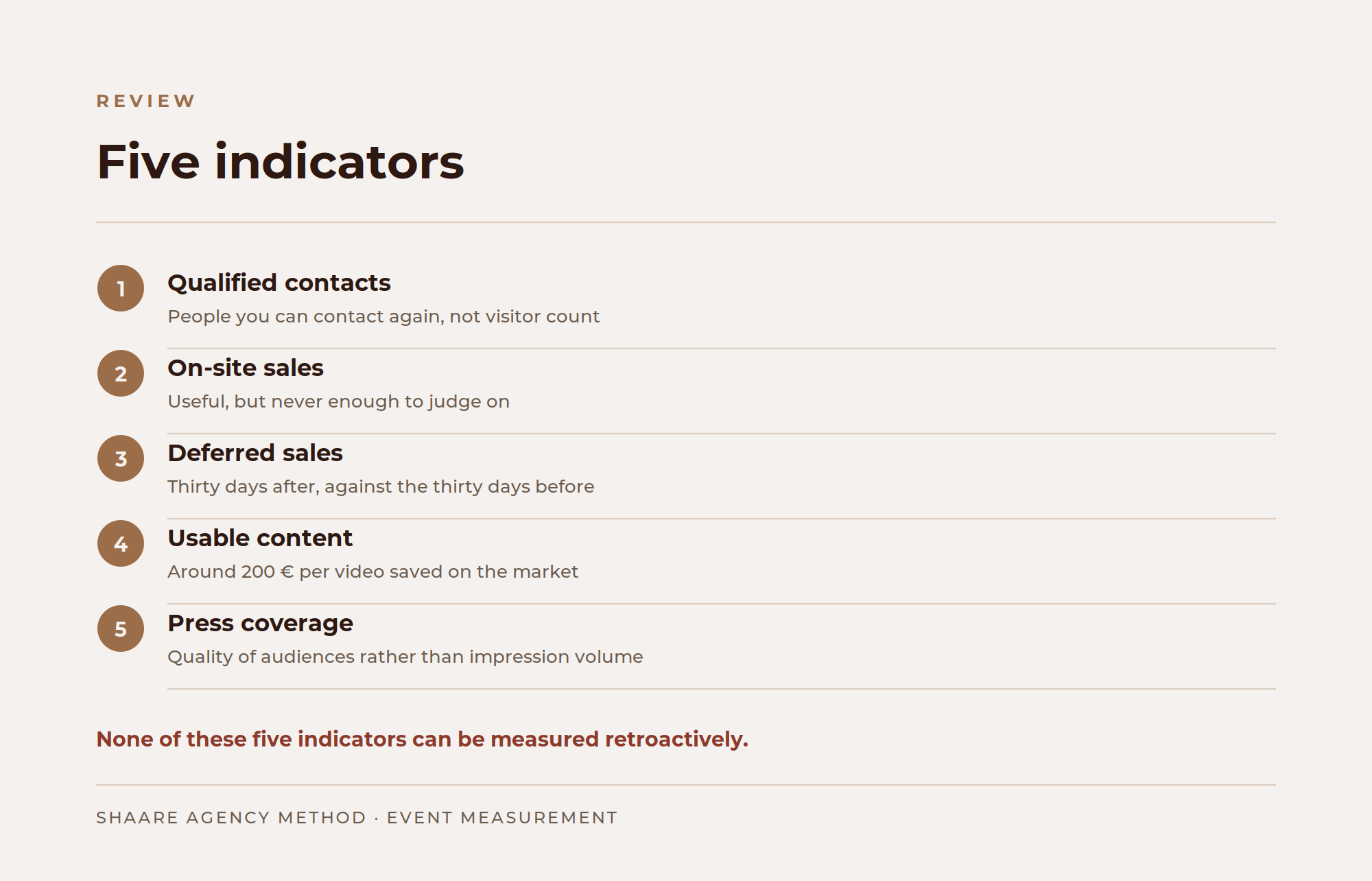
Qualified contacts. The number of people you leave with a way of contacting again, not the number of visitors. It is the most directly monetisable indicator.
On-site sales. Useful, but not sufficient. An event judged on the day's revenue alone will almost always be declared a loss.
Deferred sales. Measure your online sales over the following thirty days against the preceding thirty. That is where much of the return materialises.
Content produced. Count the genuinely usable images and videos. On the market, a creator video costs around 200 euros on average: thirty usable pieces represent a significant production saved.
Press and creator coverage. The number of pieces obtained and the quality of the audiences reached, rather than raw impressions.
The full calculation method, including how to value content, is set out in our guide to measuring ROI.
The mistakes that cost the most
- Choosing the format before the objective. A show to sell and a pop-up to position are two symmetrical misreadings.
- Planning nothing to capture contacts. With no collection mechanism, a successful event leaves nothing you can act on.
- Preparing with no content plan. If nobody is tasked with producing the images, they will not exist, and the event's main asset disappears.
- Aiming at Fashion Week too early. The entry cost is high and the attention is already captured elsewhere.
- Not planning what comes next. An event with no follow-up within ten days loses most of its commercial effect.
Frequently asked questions
Which format for a first event?
A multi-brand event, in most cases. The entry cost is shared, the audience already exists, and you learn the format before investing alone.
How far ahead should you start?
Twelve weeks for a simple format, more as soon as a venue has to be booked out or a show is planned. The team is booked four to six weeks before the date.
Does a pop-up have to be profitable on site?
Rarely, and that is not its main objective. Its value lies in the contacts, the product lessons and the deferred sales.
Should you show during Fashion Week?
Not for a brand still building. Attention there is captured by a very small number of players, and a controlled moment at your own scale produces more.
How do you know whether the event worked?
By recording five indicators defined before it: qualified contacts, on-site sales, deferred sales at thirty days, usable content and press coverage.
Conclusion
Events are not a prestige expense, they are the only lever that produces contact, content, press and sales at once. What it takes is choosing the format from the objective, preparing twelve weeks ahead, and deciding before the event what you will measure afterwards.
To build your event team, browse the Shaare directory and contact models, photographers and make-up artists directly, or hand us the whole thing, from venue to filming.