

A pop-up is the only format that puts your product in your customers' hands for several consecutive days. Its value does not show up in the weekend's takings, it shows up in what it teaches you.
It is also the most accessible event format: the entry ticket starts far below a runway show, and the commitment is measured in days rather than months. What it takes is choosing the right district, the right duration, and knowing what you are measuring.
This guide covers what a pop-up really brings, what it costs in Paris by district, the lines that sit on top of the rent, how to weigh location against duration, and the five indicators to record.
What a pop-up really brings
Three benefits, and revenue is not the first.
Product lessons. You see which pieces get touched and which only get looked at, which sizes are missing, which objections recur, at what price the hesitation starts. That information shapes your next production and cannot be obtained anywhere else.
Contacts. A visitor who comes in, tries something and leaves without buying is not a lost sale if you captured a way to reach them again. It is often the operation's main asset.
Content. A space fitted out in your own colours, with real footfall, produces images that neither a studio nor a white background replaces.
Revenue taken on site rarely covers the full cost. A pop-up judged on that criterion alone will almost always be declared a loss, when it will in fact have done its job.
What it costs in Paris
Rent is the structuring line, and it varies sixfold depending on the district.
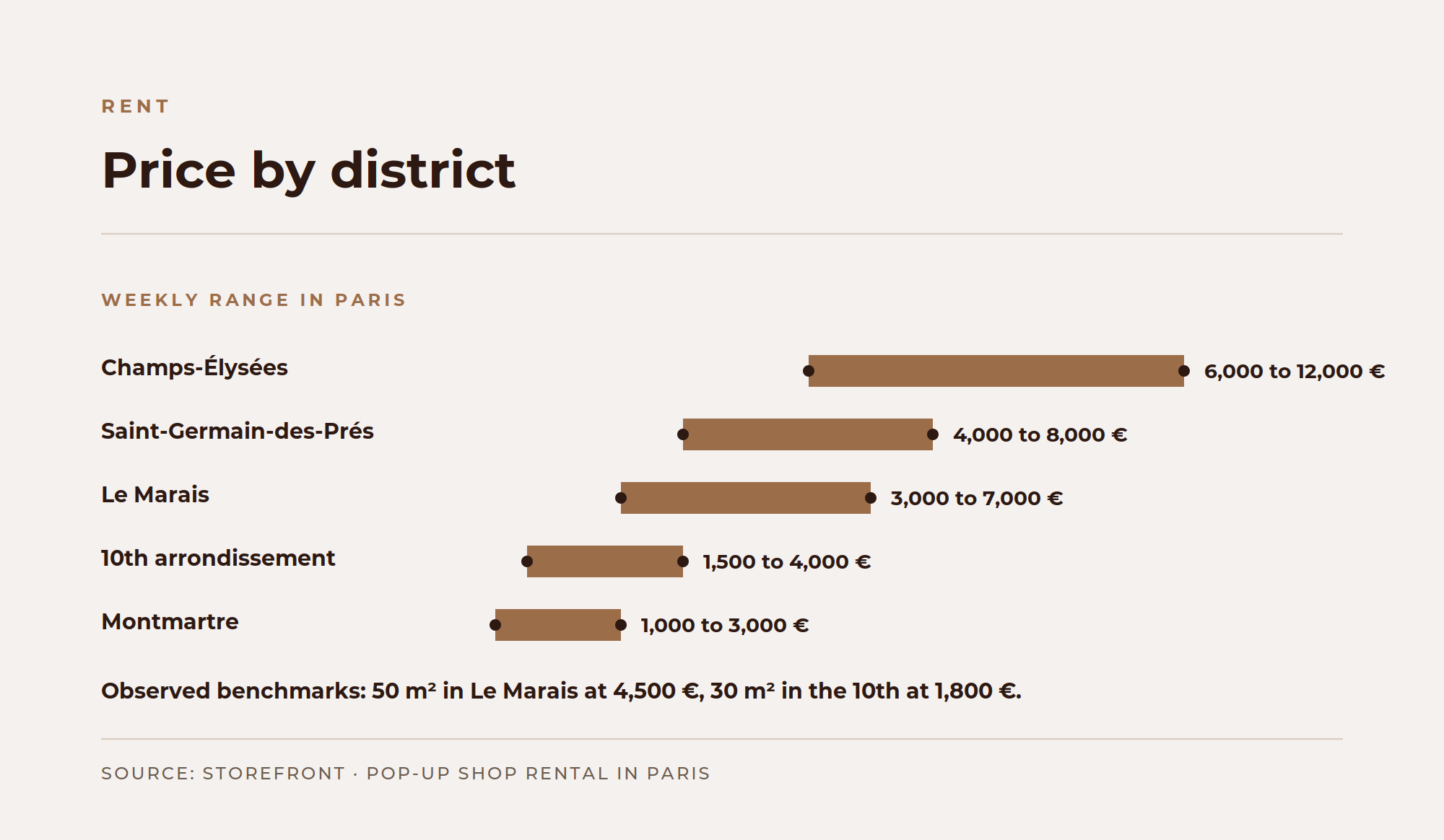
According to figures published by Storefront, weekly ranges observed in Paris run as follows: 6,000 to 12,000 euros on the Champs-Élysées, 4,000 to 8,000 euros in Saint-Germain-des-Prés, 3,000 to 7,000 euros in Le Marais, 1,500 to 4,000 euros in the 10th, and 1,000 to 3,000 euros in Montmartre.
Three concrete cases give the scale: 50 m² in Le Marais at 4,500 euros a week, 30 m² in the 10th at 1,800 euros, 40 m² in Montmartre at 2,500 euros.
What sits on top of the rent
Rent is a large share of the budget, never all of it. Four lines always sit on top, and they are what derails budgets built in a hurry.
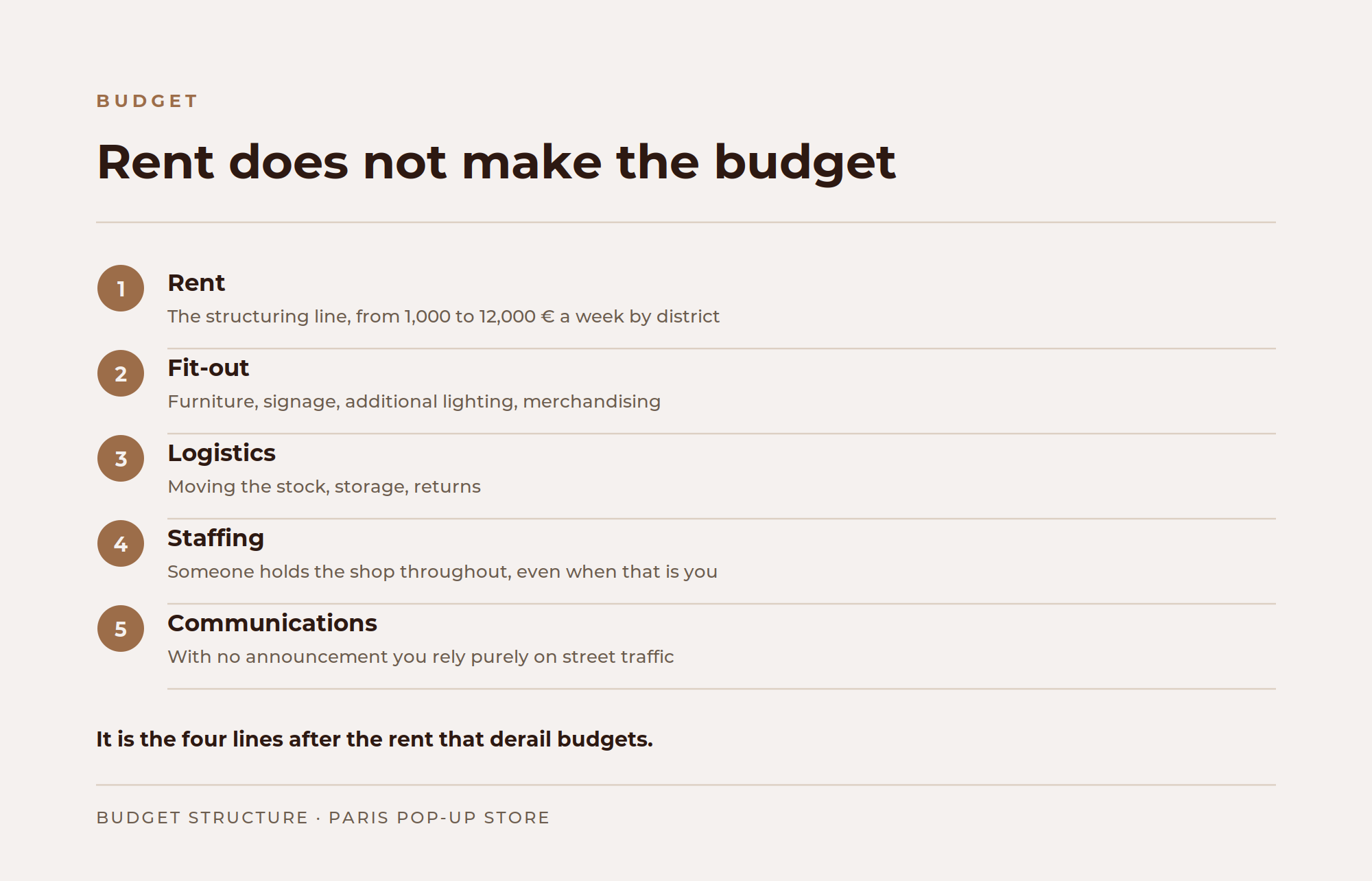
Fit-out covers furniture, signage, additional lighting and merchandising. Logistics covers moving the stock, storing it and taking it back. Staffing is the most forgotten line: someone has to hold the shop for the whole opening period, and that is not free even when it is you. Communications finally drive the footfall: a pop-up with no announcement relies purely on street traffic.
Choosing the district for the objective
Paying for Le Marais to clear stock makes no sense. Opening in Montmartre to meet buyers makes no sense either.
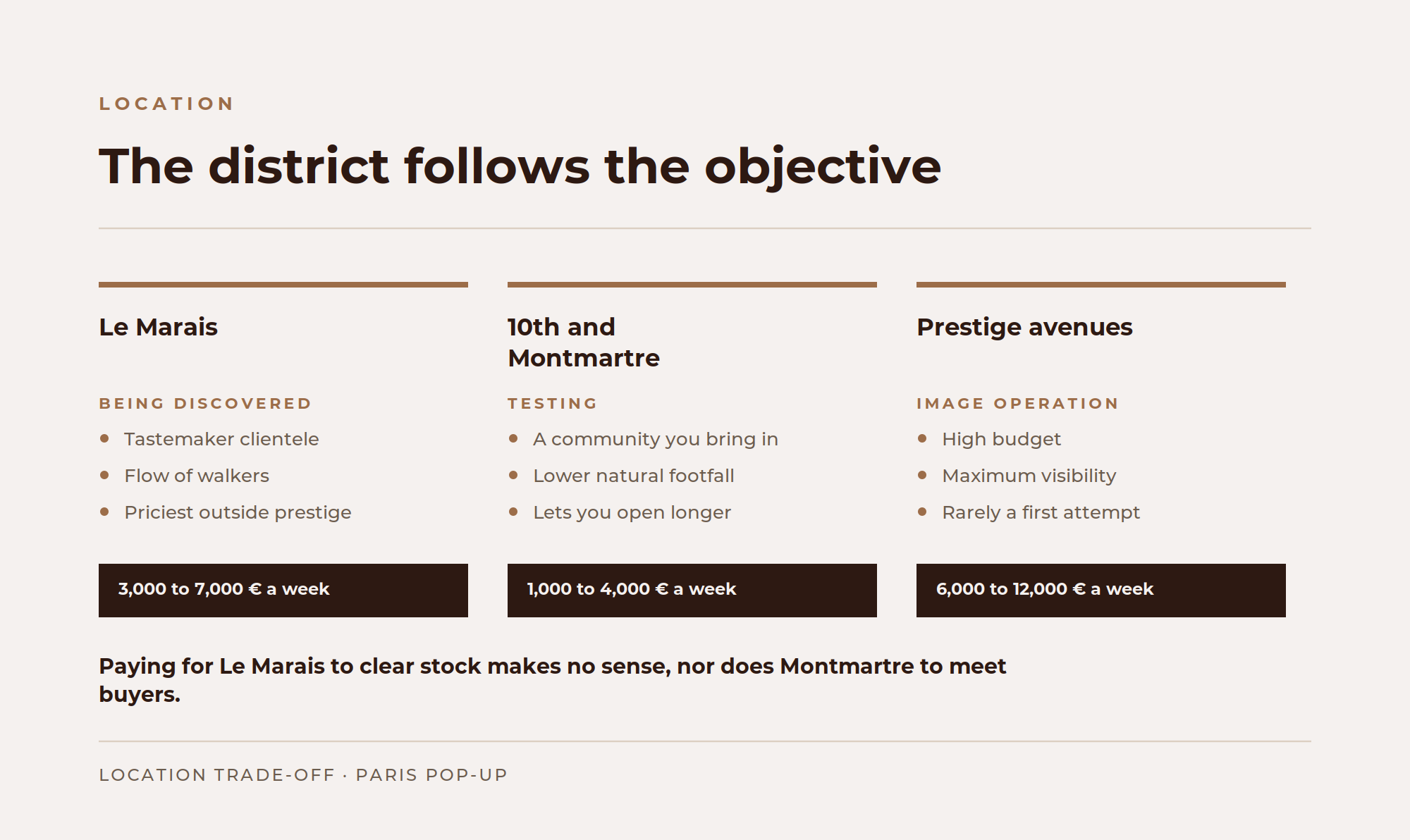
Le Marais remains the reference for a fashion brand looking for a tastemaker clientele and a flow of walkers who come in out of curiosity. It is the district where an unknown brand has the best chance of being discovered.
Outer districts, from the 10th to Montmartre, suit an objective of product testing or meeting a community you already have and will bring in through your own channels. Natural footfall is lower, but so is the cost, which lets you stay open longer.
Prestige avenues earn their place for a high-budget image operation, rarely for a first attempt.
How long to stay open
This is the most poorly calibrated trade-off. Too short and you pay for fit-out and logistics for three days of footfall. Too long and rent becomes the dominant line without the visitor numbers following.
Two practical benchmarks. A week is the minimum to amortise the installation and let word of mouth work. Beyond three to four weeks, the footfall curve flattens on most operations, unless there is a strong seasonal effect.
Season matters as much as duration. The holiday periods concentrate both demand and the highest rates, while quieter months offer a better ratio of cost to available attention, which suits an awareness operation well.
What to measure
None of these indicators can be measured retroactively. They are decided before opening.
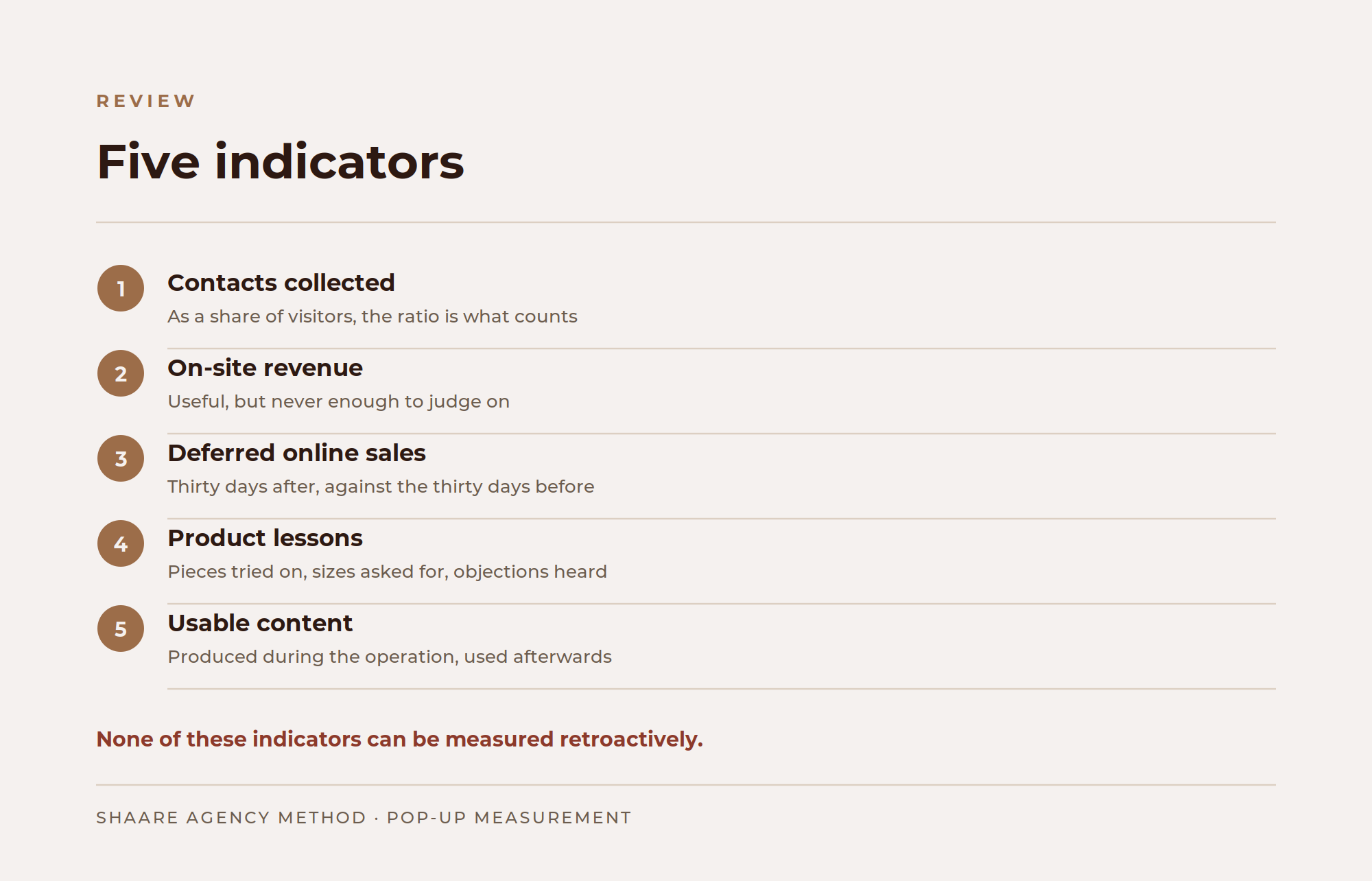
- Contacts collected, as a share of visitors. That ratio tells you whether your collection set-up works.
- On-site revenue, useful but not enough to judge on.
- Deferred online sales, over the following thirty days against the preceding thirty.
- Product lessons, noted day by day: pieces tried on, sizes asked for, objections heard.
- Usable content produced during the operation.
The full calculation method, including how to value content, is in our guide to measuring ROI.
Frequently asked questions
How much does a pop-up store cost in Paris?
From 1,000 euros a week in Montmartre to 12,000 on the Champs-Élysées, depending on district and floor area. Expect 3,000 to 7,000 euros a week in Le Marais, plus fit-out, logistics, staffing and communications.
How long should you stay open?
A week minimum to amortise the installation. Beyond three to four weeks, footfall flattens on most operations.
Does a pop-up have to be profitable on site?
Rarely, and that is not its main objective. Its value lies in the contacts, the product lessons and the deferred sales.
Which district should you choose in Paris?
Le Marais to be discovered by a fashion clientele, outer districts to test at lower cost with a community you bring in yourself, prestige avenues for a high-budget image operation.
How far ahead should you book?
Six to eight weeks for a sought-after location, more for the holiday periods where demand concentrates.
Conclusion
A successful pop-up comes down to three trade-offs: a district chosen for the objective rather than the prestige, a duration that lets word of mouth work without letting rent dominate, and a contact collection set-up installed before opening. The weekend's revenue is not the judge.
For the team and the content of your operation, browse the Shaare directory, or hand us the full organisation of your pop-up.