
A multi-brand event divides the entry cost and gives you access to an audience you could not have gathered alone. It is the most rational format for an emerging brand, and the one most often dismissed by reflex.
The reflex in question is wanting your own event, your own venue, your own evening. That is understandable and rarely the right calculation while your name is still being built: you pay for the entire set-up in order to bring in an audience you have to recruit yourself, in full.
This guide covers the calculation that makes the format rational, what you share and what you keep, how to choose which event to join, and how to measure what taking part returns.
The calculation that makes the format rational
Two variables change everything: cost and audience. At a solo event, you carry both in full.
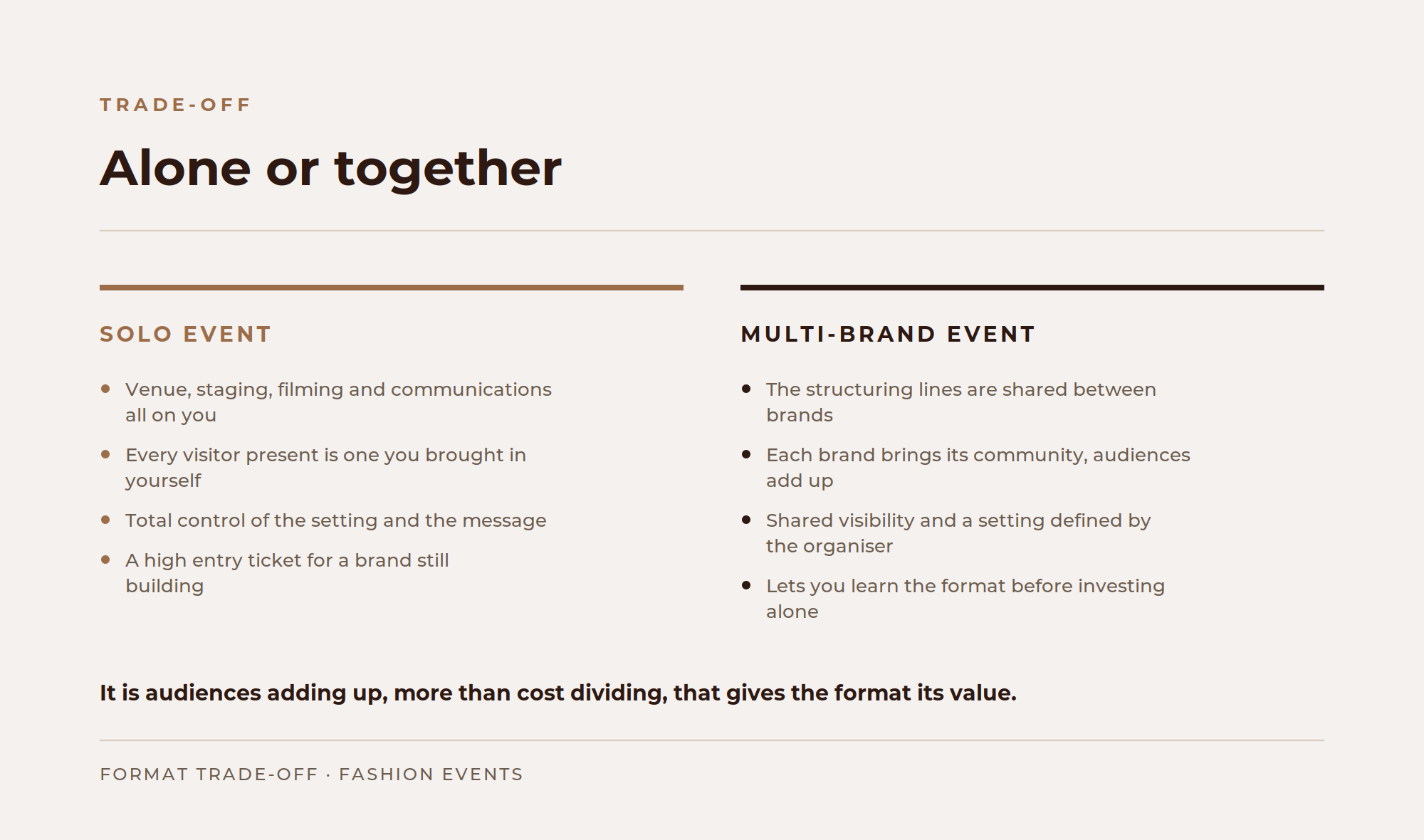
At a solo event, the venue, the staging, the filming and the communications rest on you alone, and every visitor present is one you brought in. At a five-brand event, the structuring lines are shared, and above all each brand brings its own community.
It is the second effect that matters most, and it is systematically underestimated. You do not only get a divided cost: you get access to the audiences of the four other brands present, which often match your customer profile without knowing you. For an emerging brand, that is exactly the population hardest to reach on your own.
What is shared, what stays yours
The boundary is clear, and it is worth checking before committing.
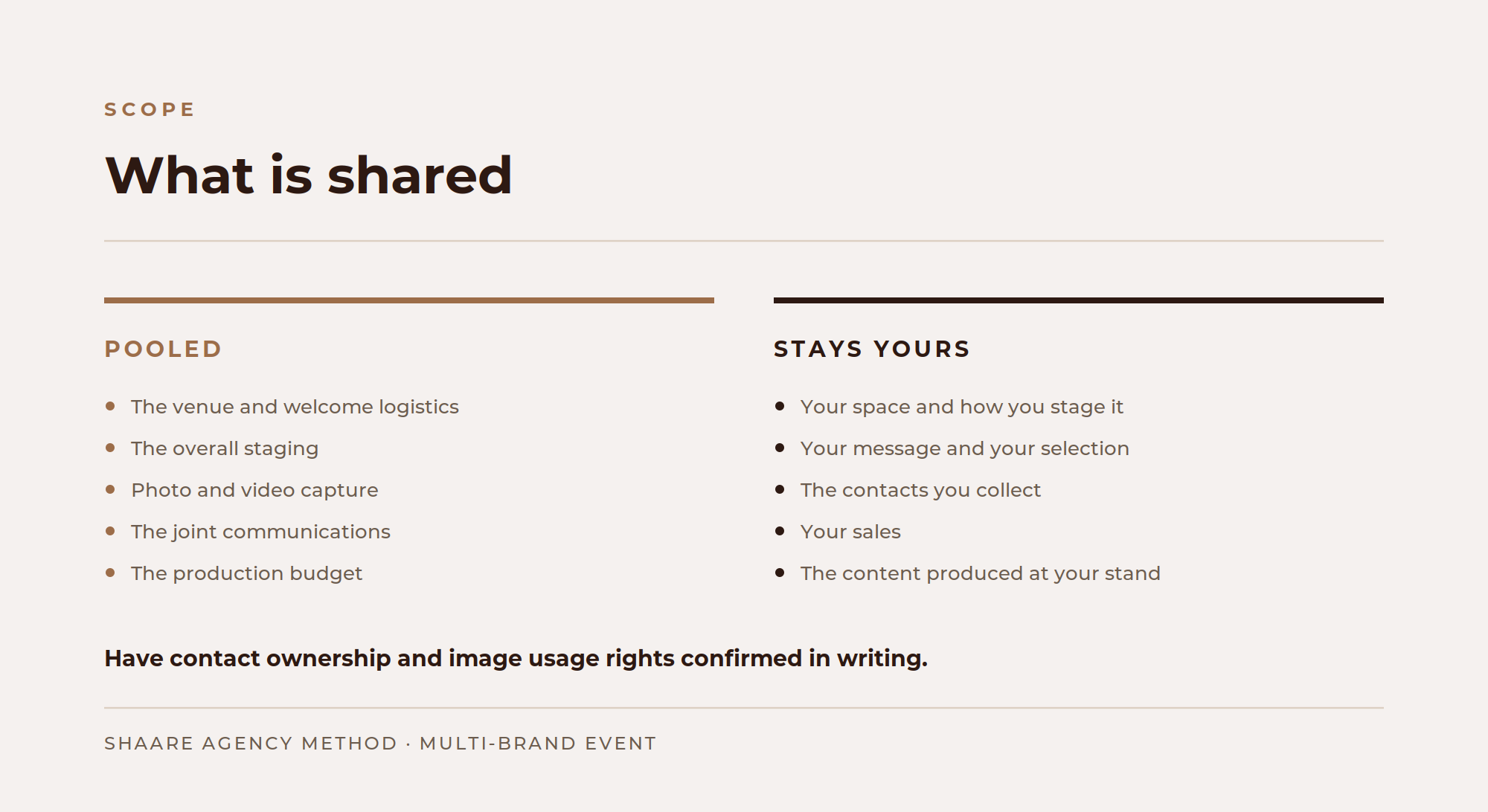
Shared: the venue, the overall staging, the filming, the joint communications, the welcome logistics and the production budget.
Yours: your space and how you stage it, your message, the contacts you collect, your sales, and the content produced at your stand. That last point deserves to be confirmed in writing with the organiser, because it determines a share of the value you take away.
Choosing which event to join
Not all multi-brand events are equal, and the visitor number announced is the least reliable criterion of all.
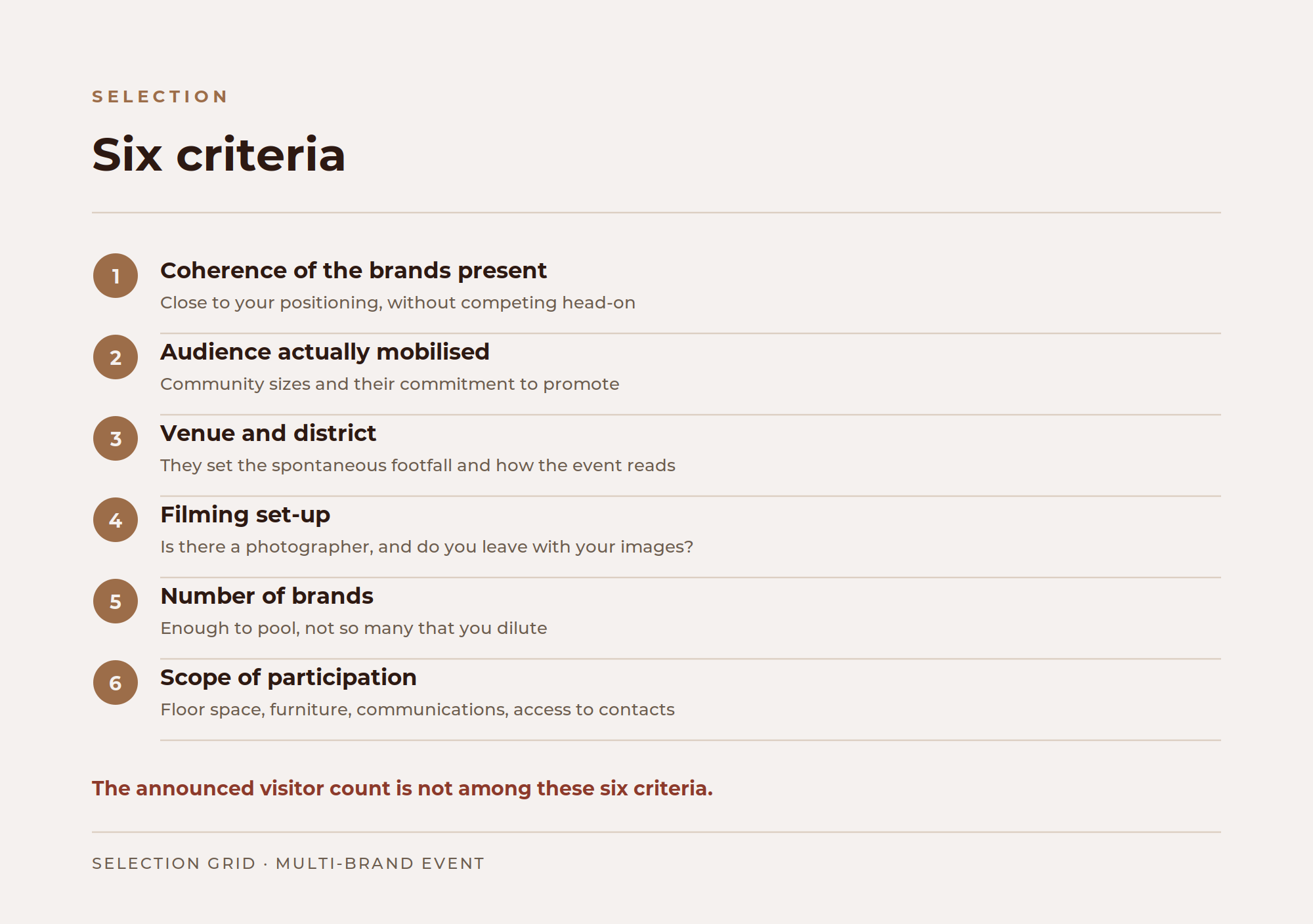
Coherence of the brands present. This is criterion number one. Brands positioned close to yours, without competing on the same product, attract exactly the clientele you are after. A mismatched line-up attracts a curious but unqualified crowd.
The audience the participants actually mobilise. Ask about the other brands' community sizes and their commitment to promote it. That is what drives attendance, not the organiser's promise.
The venue and the district. They determine spontaneous footfall and how the event is perceived.
The filming set-up. Is there a photographer, and do you leave with your images? If not, plan your own.
The number of brands. Too few and the pooling does not work. Too many and your visibility dilutes while the public remembers nothing.
Exactly what participation covers. Floor space allocated, furniture provided, presence in the communications, access to contacts. Have those four points confirmed in writing.
Preparing your participation
A brand that turns up with a rail and nothing else leaves with a good evening. A prepared brand leaves with contacts, content and sales.
Four things are decided beforehand. A tight selection of pieces, designed to be understood in ten seconds by someone who does not know you. A collection mechanism for contacts, as simple as a notebook or a form on a tablet, but existing. An offer specific to the event, giving a reason to buy now rather than think about it later. And a follow-up plan for the next ten days, without which the contacts you collected go cold.
Tell your own community too. Many brands count on everyone else's audience and forget to bring theirs, which weakens their position at the next event.
The habit that changes the outcome: identify the two or three brands on the line-up whose customers most resemble yours, and talk to them during the event. The collaborations that start between brands on these occasions often produce more than the evening itself.
Measuring what taking part returns
The same indicators as for any event, with one nuance specific to the format.
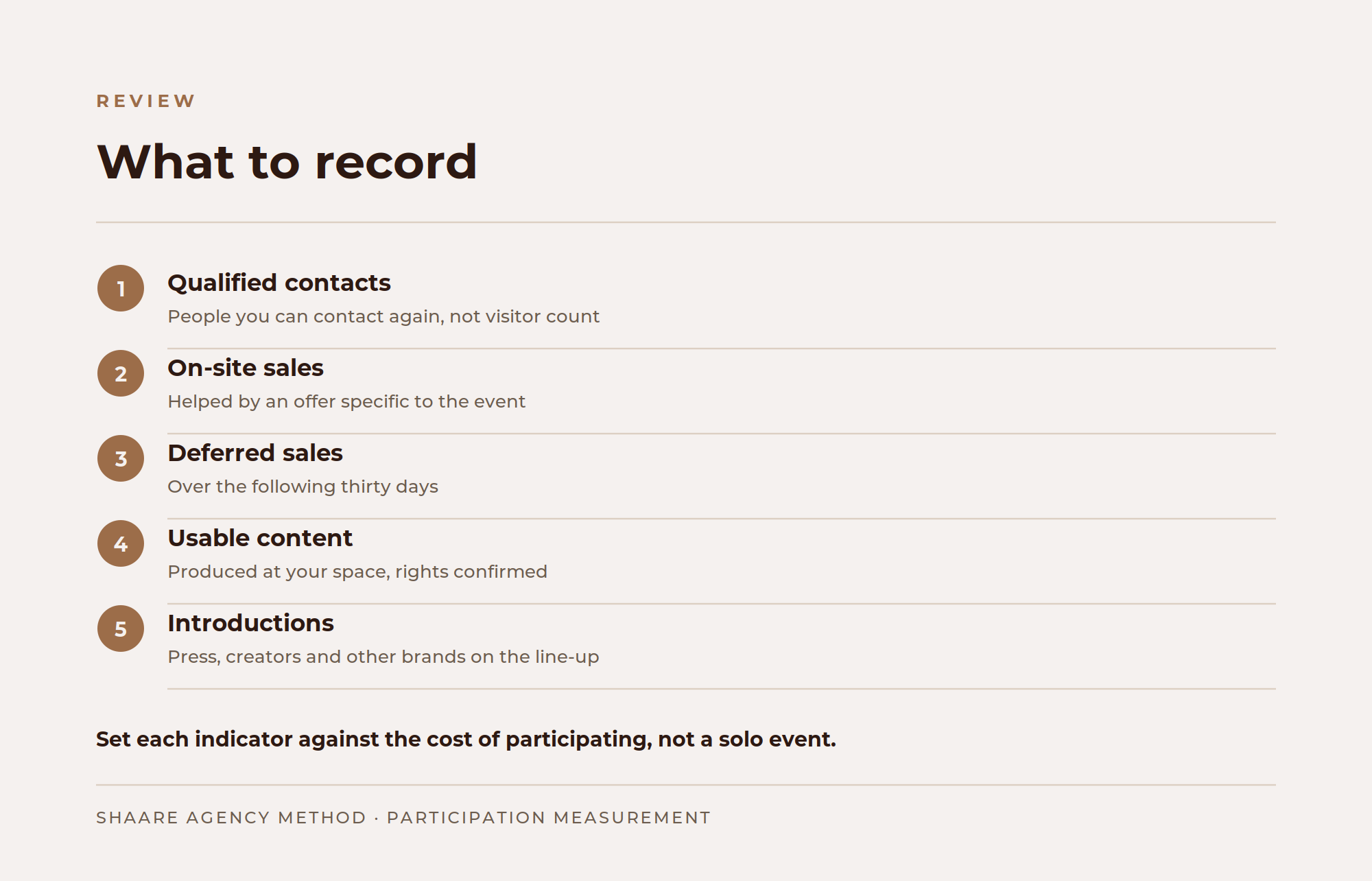
Record qualified contacts collected, on-site sales, deferred sales at thirty days, usable content, and introductions obtained, whether press, creators or other brands.
The nuance of the format: set those results against the cost of participating, which is a fraction of a solo event. A participation generating ten qualified contacts and three usable pieces of content for a few hundred euros does not have the same return as an own event generating thirty for ten times the price. The full calculation method is in our guide to measuring ROI.
The most common mistakes
- Choosing on the announced visitor count. It is the least verifiable figure and the least correlated with results.
- Not bringing your own community. The format rests on reciprocity, and organisers notice.
- Arriving with no collection mechanism. Without contacts, all that remains is an evening.
- Showing too many pieces. An audience discovering a brand remembers one silhouette, not a collection.
- Not following up. Without contact within ten days, most of the commercial effect is lost.
Frequently asked questions
How much does taking part in a multi-brand event cost?
It depends on the venue, the duration and the number of brands. The point of the format is that this cost is a fraction of organising an event alone, for a larger audience.
How many brands is ideal?
Enough for the pooling to work and for each brand to bring its audience, not so many that yours dilutes. Check the coherence of the line-up rather than its size.
Is it risky to show alongside competitors?
Brands that are close without being substitutes strengthen the line-up's appeal. Head-on competitors on the same product at the same price are best avoided.
Do you keep the contacts you collect?
Yes, they are yours. Have it confirmed in writing with the organiser, along with the right to use images produced at your space.
Should you prepare a special offer?
Strongly recommended. With no reason to buy on the day, a share of interested visitors leaves telling themselves they will think about it.
Conclusion
The multi-brand event is the entry format for fashion events: it divides the cost, adds up the audiences and lets you learn the format before investing alone. Its success owes less to which event you pick than to your preparation, and in particular to three things installed before you arrive: a legible selection, a collection mechanism and a follow-up plan.
To understand where this format sits in a full set-up, read our guide to events as a growth lever. And to build your team, browse the Shaare directory or join one of our multi-brand events.