

A runway show is prepared six months ahead and rarely runs on a budget below several tens of thousands of euros. It is a positioning format, not a selling format, and that distinction decides everything else.
Confusing the two is expensive. A brand expecting a show to generate revenue will be disappointed. A brand expecting an assertion of its world, a press moment and a content asset that works for a year will have made the right calculation.
This guide covers what a show actually produces, how its budget is built, the six-month countdown, the ratios for sizing the venue and the team, and the alternatives when the format does not yet match your scale.
What a show produces, and what it does not
A runway show is the most expensive format in fashion events, and the only one that condenses a whole collection into twelve minutes. It produces three things.
An assertion of your world. The staging, the music, the casting and the pace say in a few minutes what a lookbook takes a season to establish.
A press and buyer moment. Gathering journalists, content creators and multi-brand buyers in one place achieves in an evening what weeks of individual outreach do not.
A content asset. Video capture, backstage photographs, floor images: a well-filmed show feeds your channels for months.
What it does not produce is direct revenue. Sales come afterwards, through press, buyers and content. A show judged on the evening's takings will always be declared a loss. Where this format sits in a wider set-up is covered in our guide to events as a growth lever.
The real budget
There is no such thing as a runway show rate. The figure is built line by line, and the spread is considerable depending on ambition and venue.
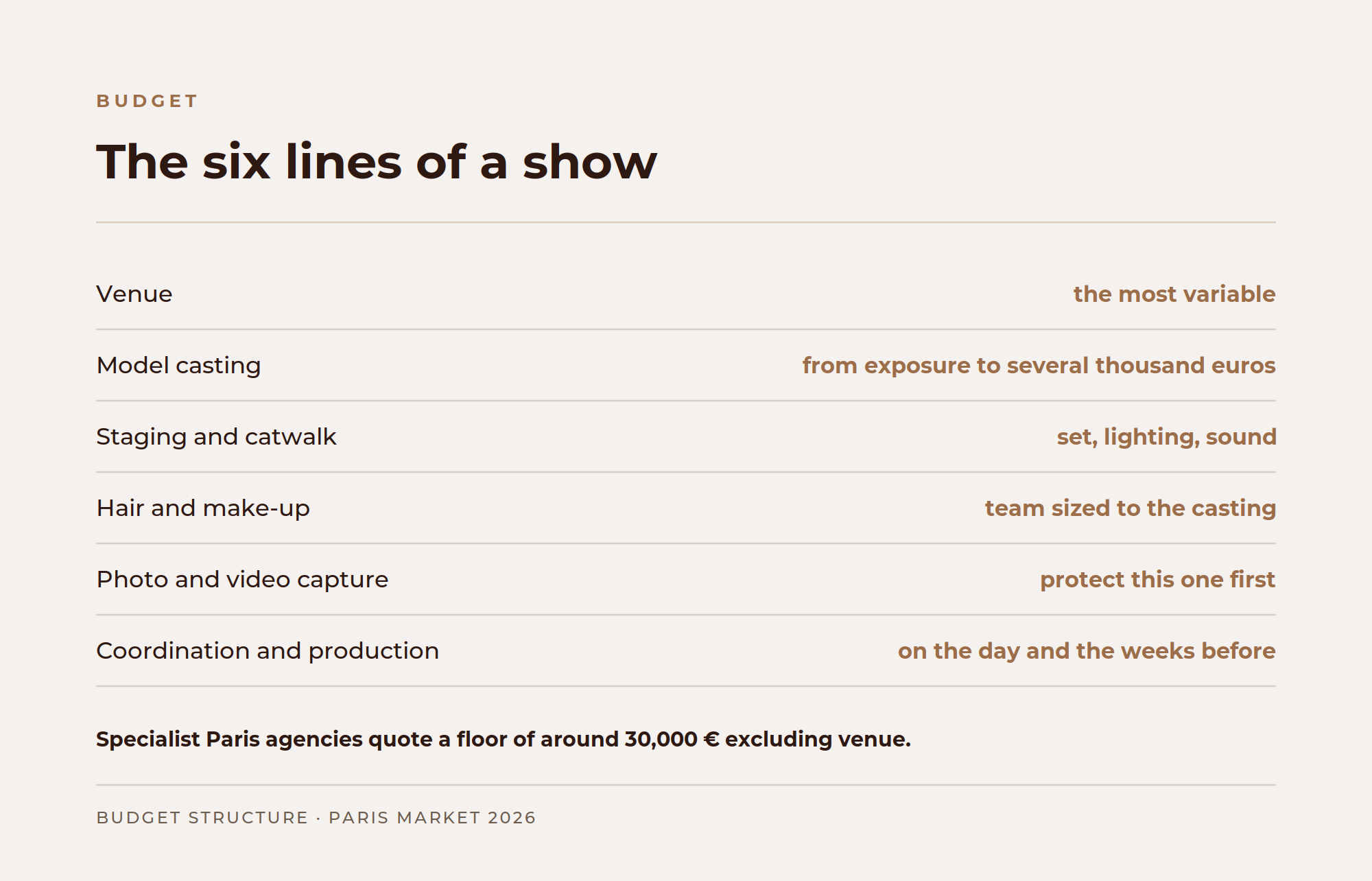
Specialist Paris event agencies commonly quote a floor of around 30,000 euros excluding venue rental for a properly produced show, with budgets reaching a million for the major houses. Those figures reflect the upper segment of the market and should not be read as the format's compulsory entry ticket: they indicate what a show costs when handed to a firm operating the city's most prestigious venues.
Two lines deserve particular attention.
Casting. Runway model fees are the most widely spread line in the sector. A beginner sometimes works for exposure alone, an established profile sits between several hundred and a few thousand euros, and the most established profiles go well beyond that. Detailed ranges are in our fashion casting guide.
Filming. This is the line brands cut when the budget tightens, and it is almost always a mistake. A show without images leaves a successful evening and nothing else. The same show filmed leaves months of content and a press pack.
The countdown: six months
The format does not forgive delay, because everything converges on a date that will not move and the constraints stack up.
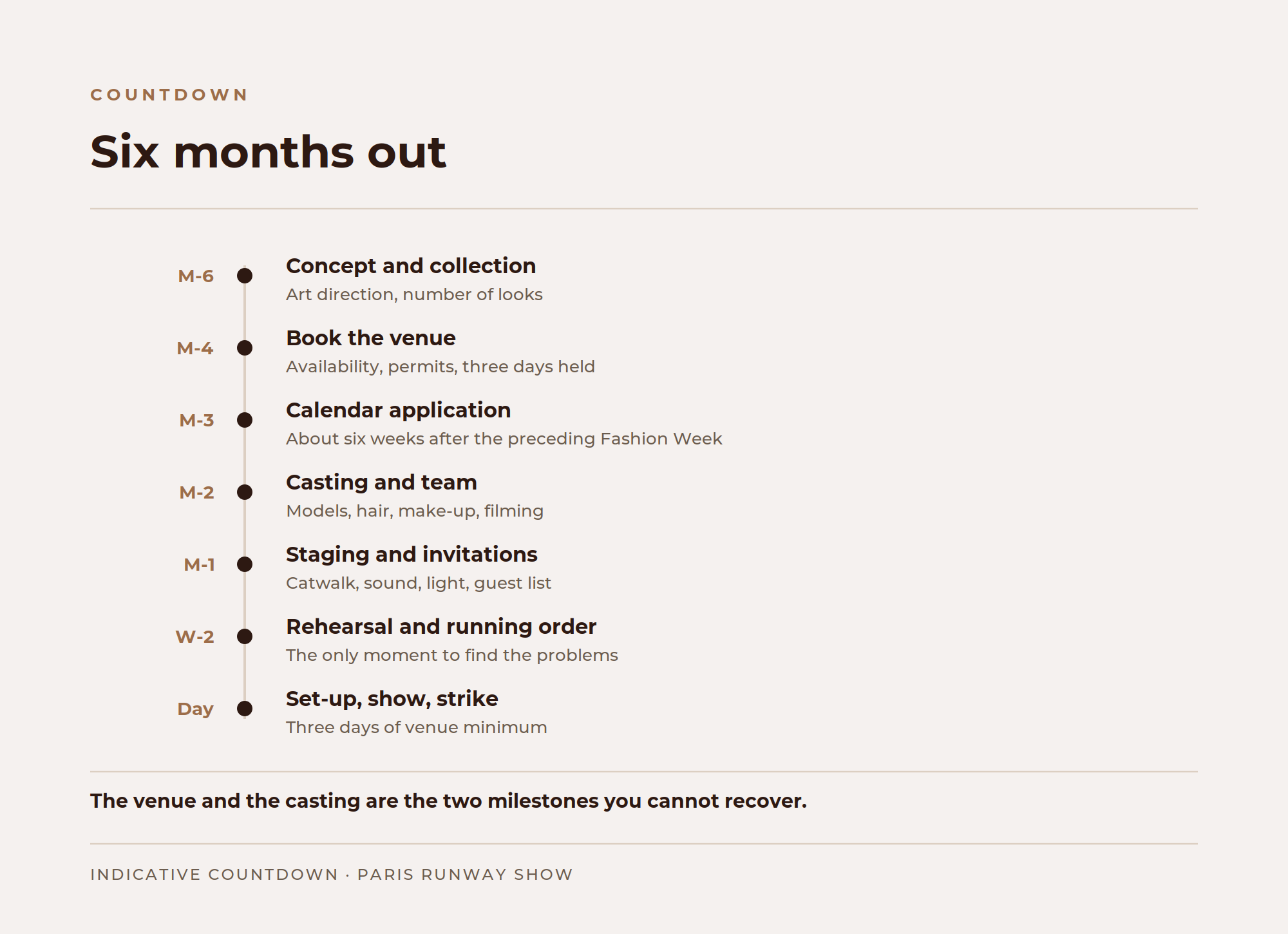
The venue is booked three to four months before the date, the time needed to secure availability and obtain any permits. Plan to hold it for at least three days: set-up, rehearsal, show, strike. A runway show is not installed on the morning itself.
If you are aiming for the official Paris Fashion Week calendar, applications go to the Fédération roughly a month and a half after the preceding Fashion Week. That deadline is easy to miss and comes round again six months later.
Sizing the venue and the team
Three simple ratios avoid nasty surprises at the site visit.
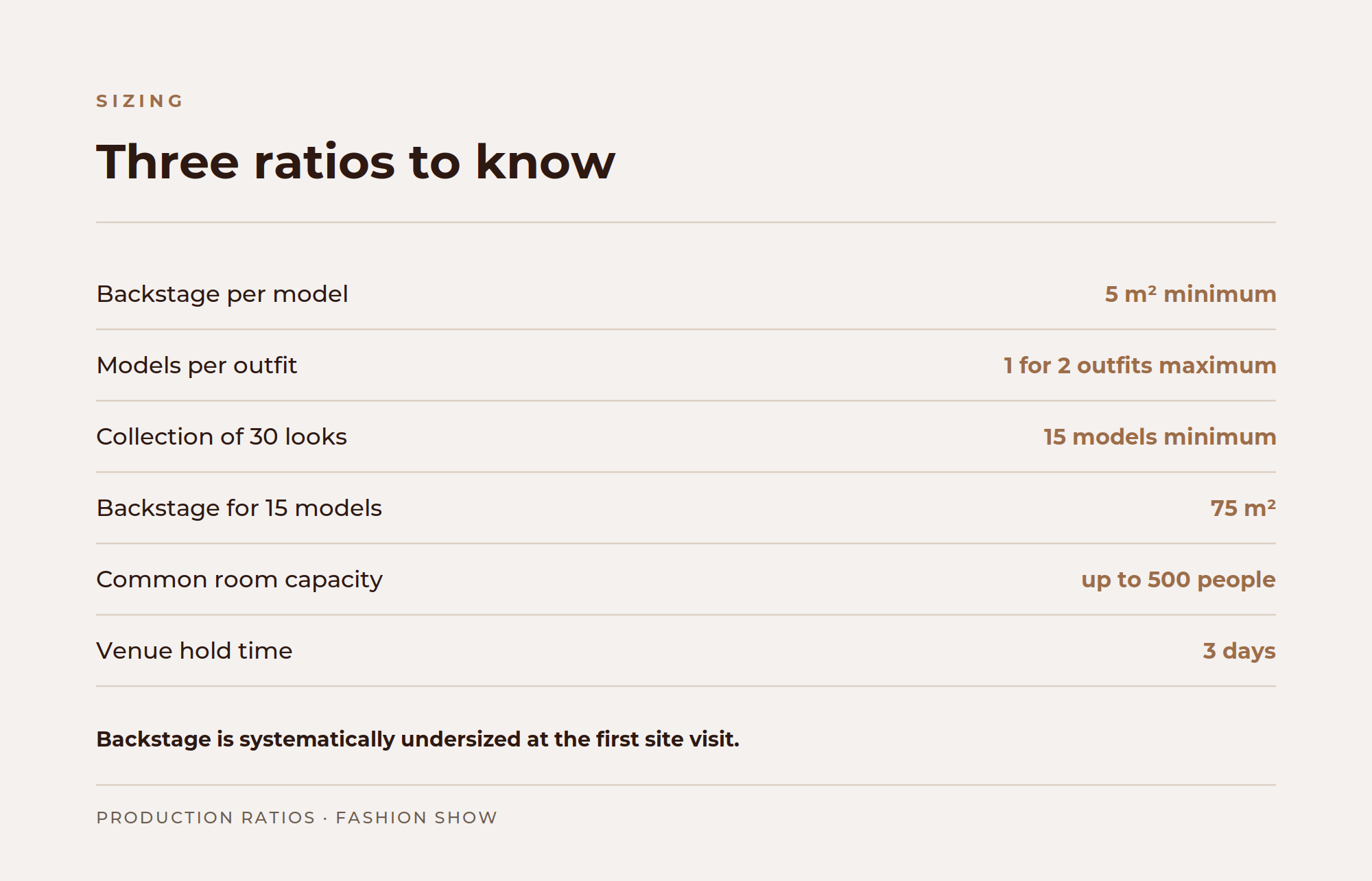
Five square metres of backstage per model. That is the workable minimum for dressing, make-up and changes. A show with fifteen models therefore needs seventy-five square metres at the back, on top of the room itself.
One model for two outfits at most. Beyond that, changes become impossible to hold within the pace of the show. A collection of thirty looks therefore calls for at least fifteen models.
A room capacity matched to your real guest list. Paris venues suited to the format commonly hold up to five hundred people. A half-empty room does more damage than one that is slightly too small.
The final weeks checklist
Failed shows rarely fail on the concept. They fail on the execution of the last three weeks.
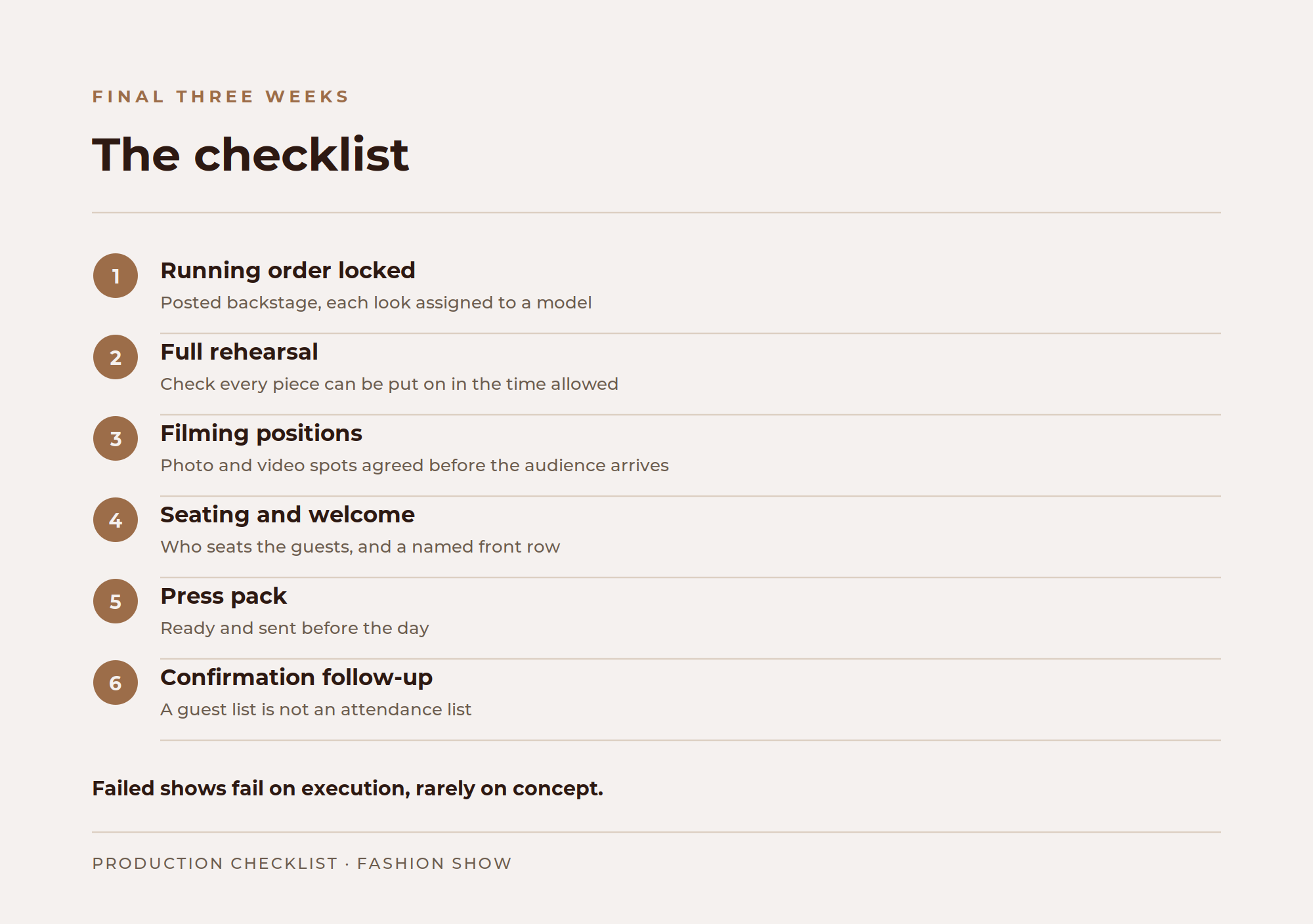
Three points account for most incidents. The running order must be locked and posted backstage, with each model's look assigned. The rehearsal is the only moment you discover that a piece cannot be put on in thirty seconds. And the filming set-up must be positioned before the audience arrives, with photo positions agreed in advance.
The part everyone forgets: decide who greets and seats the guests. A badly handled front row in front of journalists is the kind of detail noticed more than the collection.
If the budget does not stretch yet
A runway show is not the only way to show a collection, and it is not the most rational one for a brand still building.
A showroom gathers buyers and press over several days, at a fraction of the cost, and allows one-to-one contact a show does not. A static presentation shows the pieces worn without the logistics of a catwalk. A multi-brand event shares the cost and the audience with other brands, which often makes it the best entry point.
None of these three is a budget runway show. They are different formats, serving the same goal of showing the work with an entirely different economy.
Frequently asked questions
How much does a fashion show in Paris cost?
The budget is built line by line. Specialist agencies quote a floor of around 30,000 euros excluding venue for a full production, with far higher figures at the top of the market. A tighter production remains possible by making trade-offs on venue and casting.
How far ahead should you start?
Six months. The venue is booked three to four months out, and the team four to six weeks before the date.
How many models do you need?
One model for two outfits at most. A collection of thirty looks therefore needs at least fifteen models.
Can you show during Fashion Week without being on the official calendar?
Yes, many shows take place off-calendar. The trade-off is very strong competition for attention on those exact dates.
Should the show be filmed?
Yes. Filming is what turns an evening into an asset usable for months, and it is the line to protect first when the budget tightens.
Conclusion
A successful show rests on three decisions taken early: a positioning objective owned rather than a hope of sales, a venue booked three to four months ahead, and a filming budget protected to the end. The rest can be organised.
To build your casting and technical team, browse the Shaare directory and contact profiles directly, or hand us the full production of your show.