
Finding a model in Paris has never been easier. Booking one properly, on the other hand, means settling five points that most brands discover on the morning of the shoot.
The gap between the profile you spotted and the model who turns up on time, in the right size, with a written agreement on image usage, is decided entirely in the two weeks before. That is where days get lost.
This guide covers the process of booking a model for a shoot or a campaign in Paris: what the request must contain, how to shortlist without losing a week, the fitting, the written agreement, and how the day itself runs.
Shoot or campaign: two different bookings
The distinction drives the fee, the duration and above all the contract.
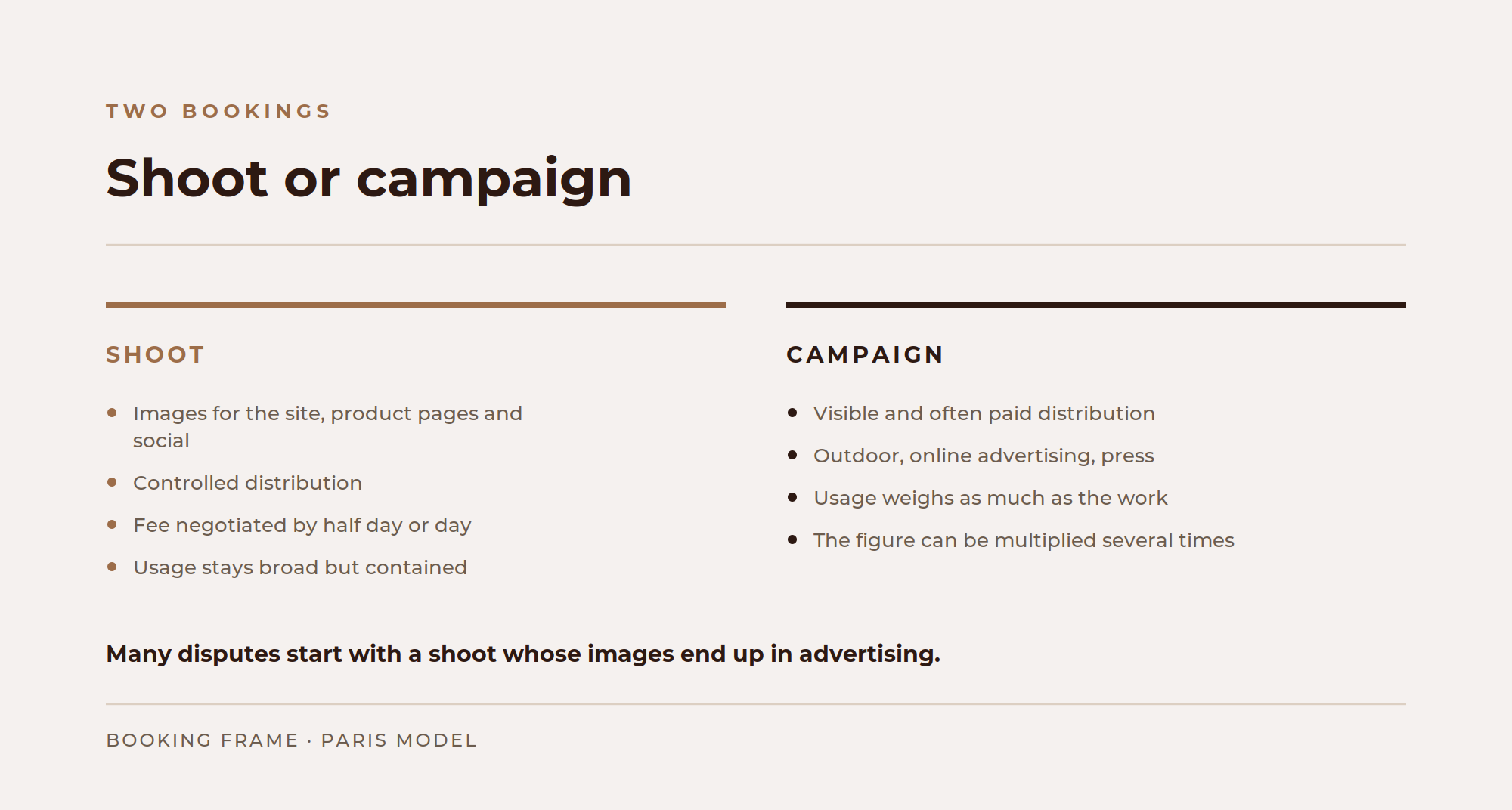
A shoot produces images for your site, your product pages and your social channels. The usage is broad but the distribution stays controlled. The fee is negotiated by half day or day.
A campaign means more visible and often paid distribution: outdoor, online advertising, press. Usage then weighs as much as the work itself in the final figure, and can multiply it several times over.
Many disputes start here: a shoot negotiated as a shoot whose images end up in advertising. That gap is settled beforehand, never after.
What your request must contain
Models receive a lot of vague enquiries. The ones that get a fast reply give everything in a single message.
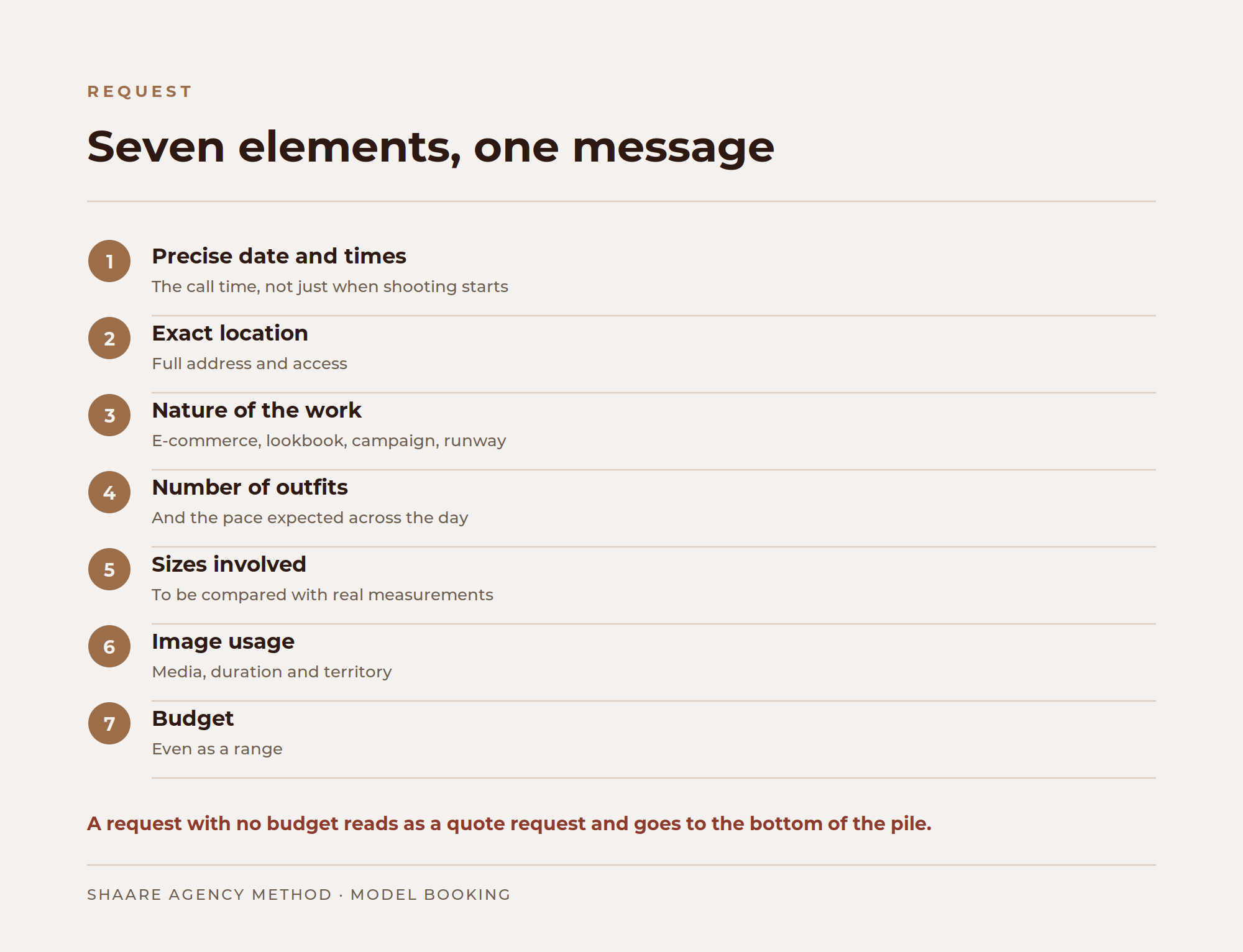
The precise date and call times, the exact location, the nature of the work, the number of outfits, the sizes involved, the intended image usage with its duration and territory, and the budget. A request with no budget reads as a request for a quote and goes to the bottom of the pile.
The pay benchmarks by experience level, and realistic booking lead times by production type, are in our fashion casting guide.
Shortlisting without losing the week
The trap is comparing thirty profiles. Three criteria cut the list down fast.
Fit with your world. Not beauty, fit. A stunning profile that does not match your clientele produces images that do not convert.
Consistency of the book. Look at the floor, not the ceiling. Two exceptional images in a portfolio signal one good session, not a steady level.
Measurements against the actual pieces. This is the most concrete criterion and the one checked too late most often. An impossible fitting on the morning of the shoot costs you the half day.
The fitting: the half hour that saves the day
This is the step almost every brand skips, and the one that produces the most incidents.
A fitting beforehand, even a quick one, even remotely with precise measurements, lets you check that the pieces hang correctly, spot the ones that need altering or pinning, and build the running order knowing what works. Thirty minutes upfront regularly saves two hours on set.
If a physical fitting is impossible, ask for full measurements and compare them against your actual pieces, not against your theoretical size chart.
The written agreement, and what it must cover
This is the point that turns a successful collaboration into a dispute, or the reverse.
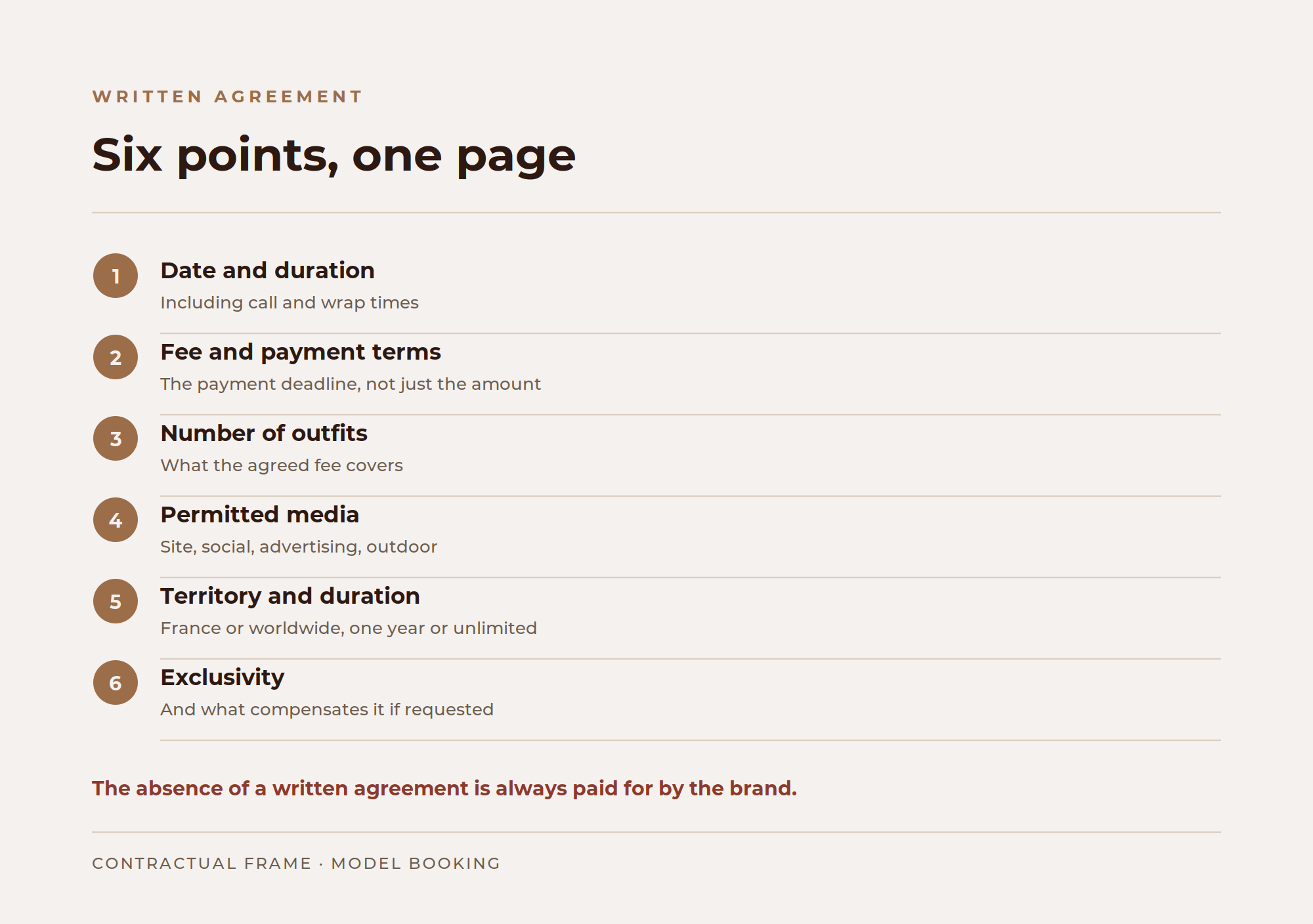
The agreement covers the date and duration, the fee and when it is paid, the number of outfits, the permitted media, the territory and duration of image use, and whether it is exclusive. The same shoot billed at a base rate for one year of web use in France commonly negotiates at several times that figure for a broad, long licence.
The applicable framework depends on the model's status and the nature of the work. For a major campaign or a long-term commitment, have the document reviewed by a lawyer before signing.
On the day
Three points settled beforehand are enough for the day to go well.
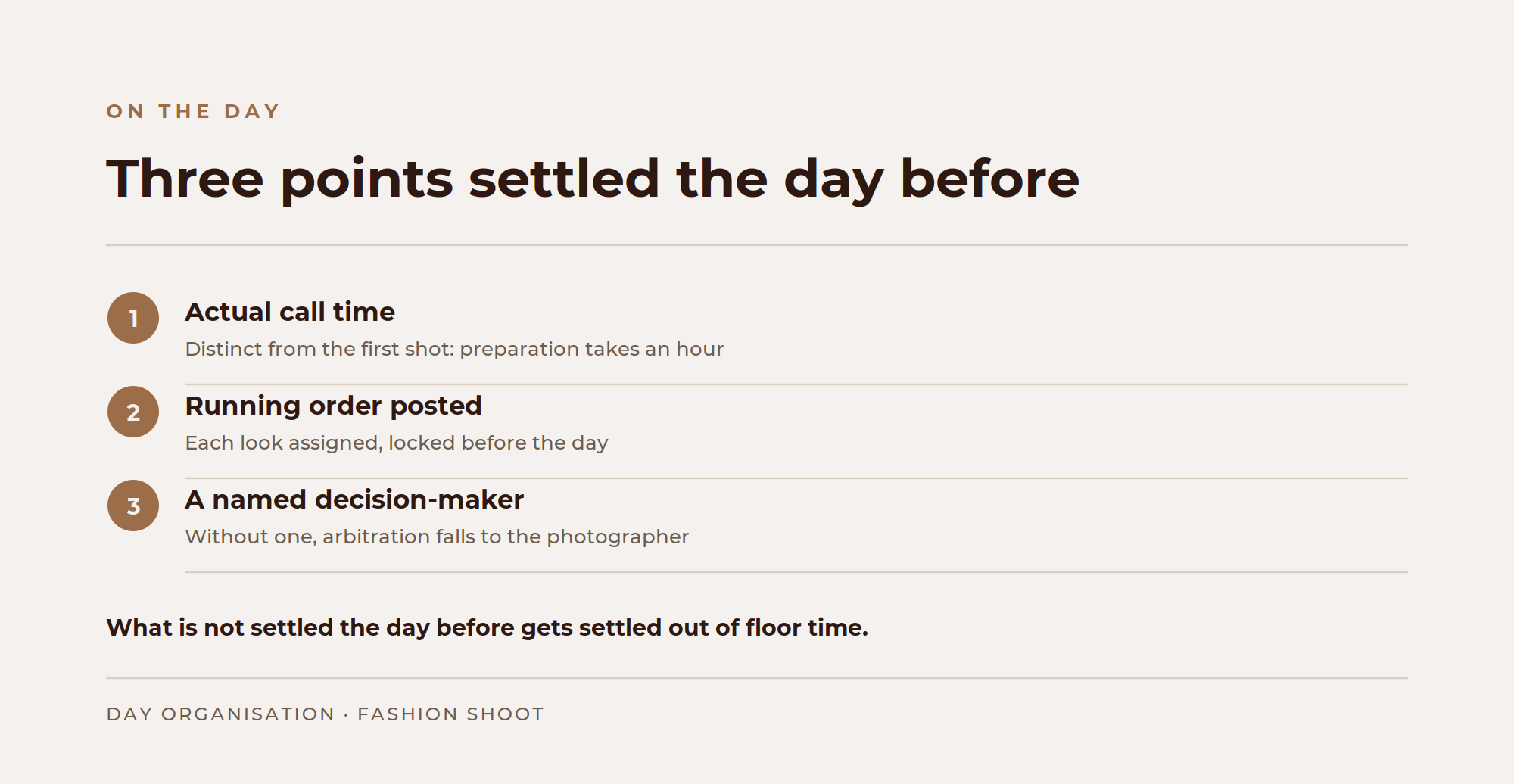
The actual call time, distinct from the time shooting starts: hair and make-up take time, and a model called for the first shot starts the day an hour late.
The running order, with the look assigned, posted on site. That removes hesitation and pointless changes.
The decision-maker, meaning the person who settles questions. Without one, arbitration falls to the photographer, which is not their job and shows in the images. How to organise that is covered in our guide to briefing a shoot team.
The mistakes that cost a day
- Checking measurements too late. The leading cause of a lost half day.
- Not specifying image usage. Renegotiating afterwards is always done from a weak position.
- Calling the model for the first shot. Preparation takes an hour and belongs in the schedule.
- Booking too late. Good profiles go weeks ahead, more in September, October and during fashion weeks.
- Skipping the written agreement. It protects both sides and runs to one page.
Frequently asked questions
How far ahead should you book a model?
Two to three weeks for a simple e-commerce shoot, four to six weeks as soon as a full team has to be aligned. Double those lead times in September, October and during fashion weeks.
Is a fitting needed before the shoot?
Strongly recommended. Thirty minutes upfront regularly saves two hours on set and lets you lock the running order.
How does image usage change the fee?
Considerably. One year of web use in France and broad advertising distribution are not the same price, and the gap can come to several times the base rate.
Do you have to go through an agency?
Not necessarily. An agency brings curation and administrative handling, at a cost passed on to you. Direct contact suits you when you know what you are looking for and want to keep control of the budget.
Who prepares the running order?
The brand, or the stylist if you have one. It must be locked before the day and posted on site.
Conclusion
Booking a model comes down to five things settled beforehand: a complete request in one message, measurements checked against the actual pieces, a fitting even a quick one, a written agreement on image usage, and a call time distinct from the shooting time. The rest goes smoothly.
To contact models in Paris and beyond directly, browse the Shaare directory, with no middleman and no commission, or hand us your casting.