

Most brands start their casting from scratch at every production. They search, compare, negotiate, brief, then start again three months later. That cost appears on no quote, and it is the highest line in the content budget.
The alternative exists and takes little effort: build a core of four or five people you work with regularly. Photographer, model, make-up artist, sometimes a stylist. Brands that do it produce faster, cheaper, and with a visual consistency that one-off casting cannot deliver.
This guide covers what repeated casting really costs, what a recurring team gains you, how to build that core without any formal commitment, and what makes a good collaborator walk away.
The hidden cost of casting every time
It is invisible because it is never invoiced. It is paid in time and in inconsistency.
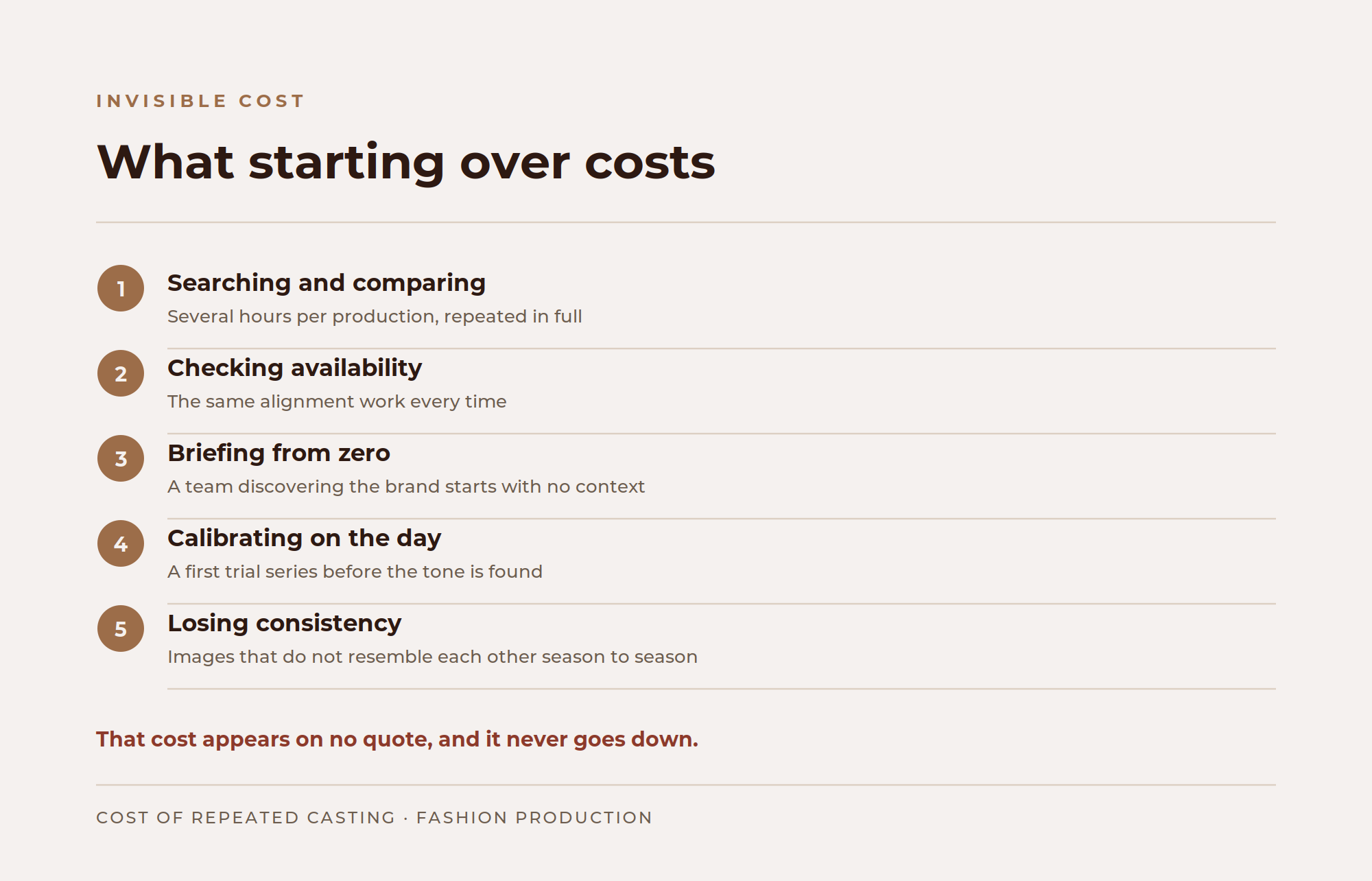
Searching for profiles, checking availability, negotiating, briefing from zero, then discovering on the day how each person works: that cycle takes several hours per production, and it repeats in full every time.
On top sits a cost that is less measurable and heavier. A photographer discovering your brand shoots a first trial series before finding the tone. A model who does not know your pieces takes an hour to understand how they fall. Every new collaboration consumes part of the day in calibration.
And the result shows: a brand changing team every season produces images that do not resemble each other, which attacks distinctiveness directly, meaning what makes a brand recognisable before it is read.
What a recurring team gains you
Four effects, three economic and one strategic.
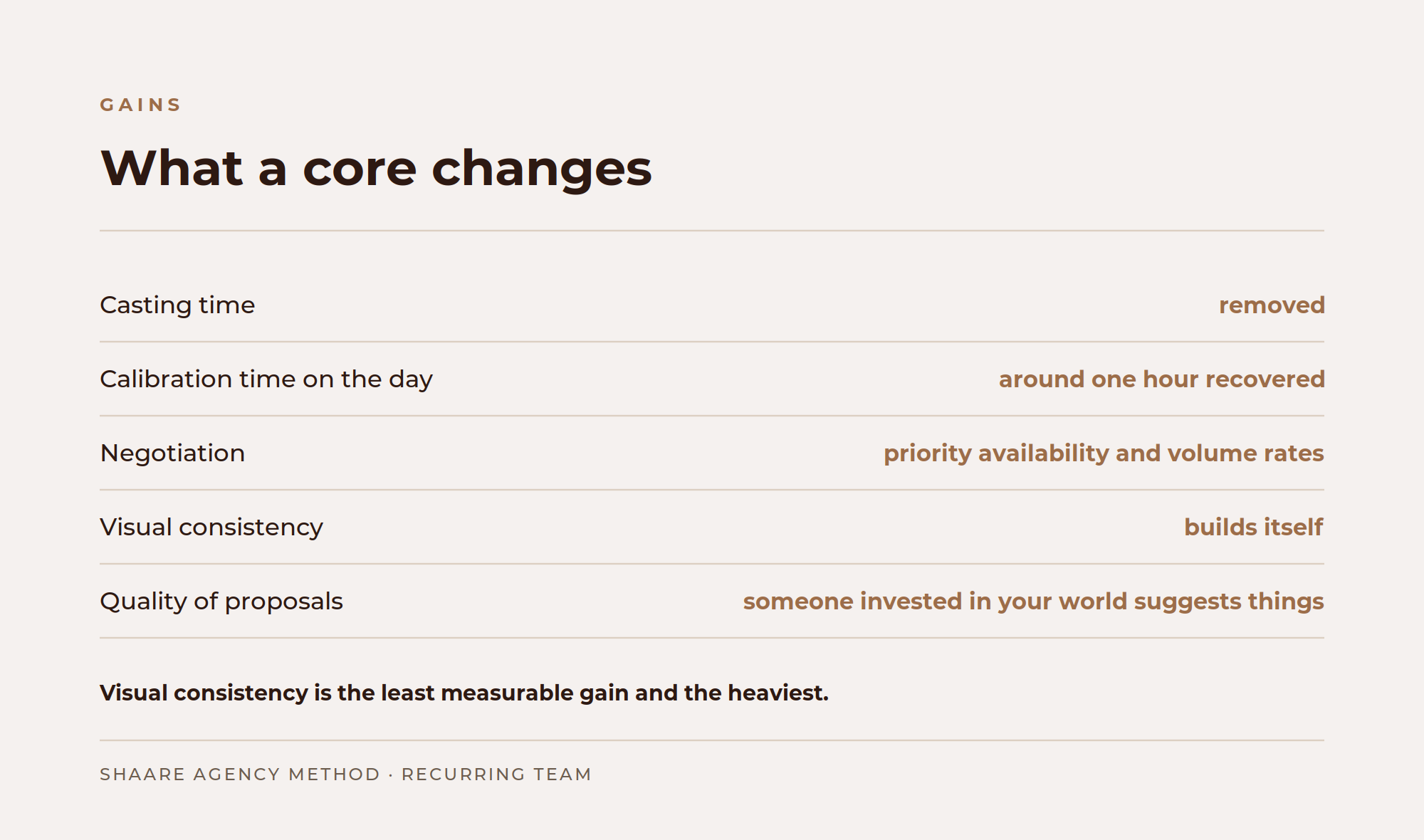
Casting time disappears. One message, one date, done. For a brand producing six times a year, the saving is substantial.
Calibration time disappears too. A team that knows your pieces, your lighting and your standards is operational from the first series. On a studio day that often means an hour recovered, roughly ten extra images.
Negotiation gets simpler. Talent who work with you regularly have an interest in the relationship, which opens arrangements a one-off supplier would not consider: priority availability, flexibility on dates, volume rates.
Visual consistency builds itself. That is the strategic gain. Brands recognisable at a glance almost all have a recurring photographer. It is the cheapest awareness lever there is, as set out in our guide to growth levers.
How to build that core
No contract, no exclusivity, no volume commitment. The method has three steps.
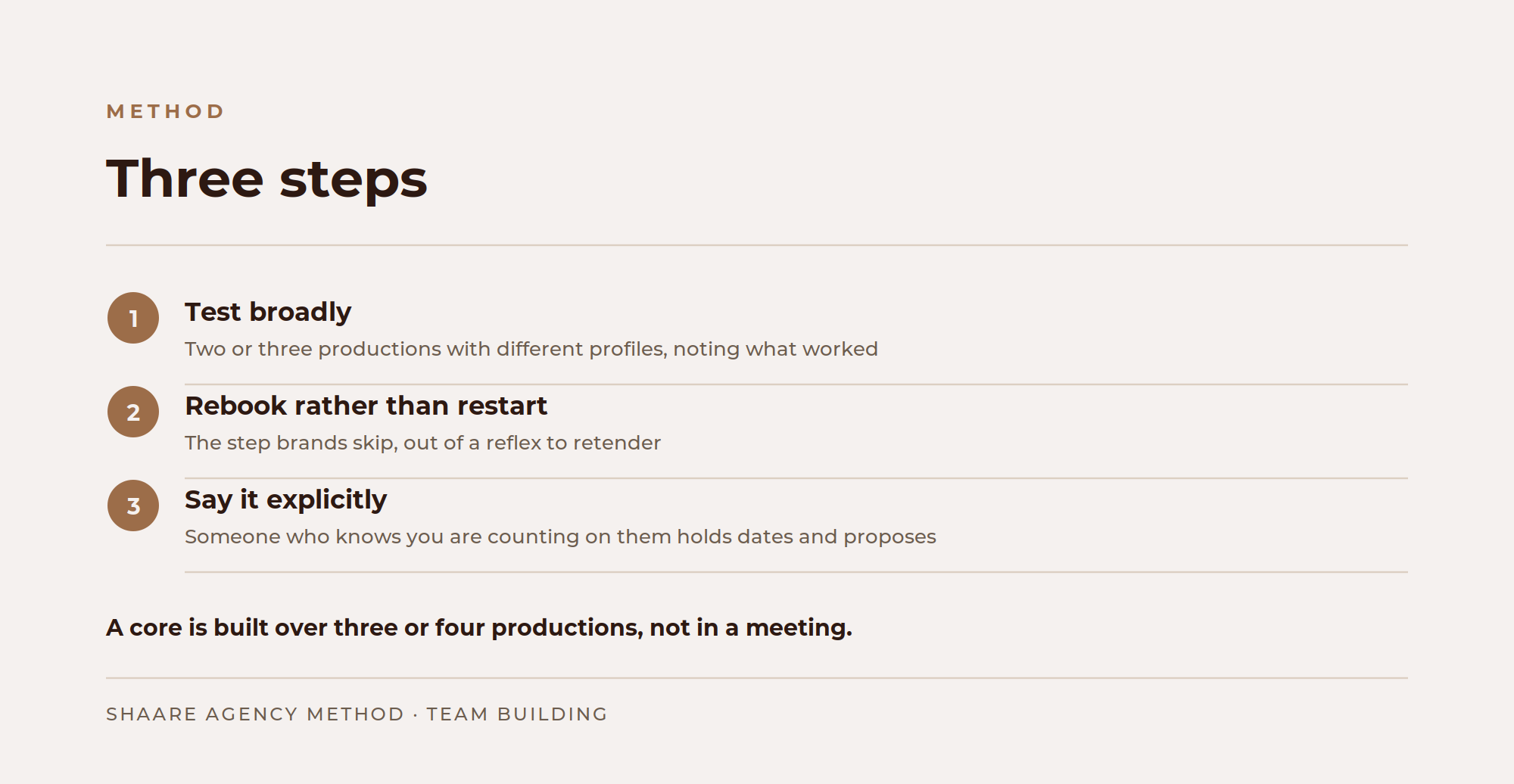
Test broadly across two or three productions. Work with different profiles, noting each time what worked and what took energy. Technical skill is not the only criterion: punctuality, the ability to propose and ease of exchange matter as much over time.
Rebook rather than restart. As soon as a collaboration goes well, offer the next production to the same person. This is the step brands skip, out of a reflex to put everything back out to tender.
Say it explicitly. Talent told you intend to work with them regularly behave differently: they hold dates, they propose, they invest in your world. That sentence costs nothing and changes the relationship.
To identify the starting profiles, the casting method, rates by role and lead times are in our fashion casting guide.
The possible forms of commitment
Between one-off work and an exclusivity contract, three intermediate forms work well.
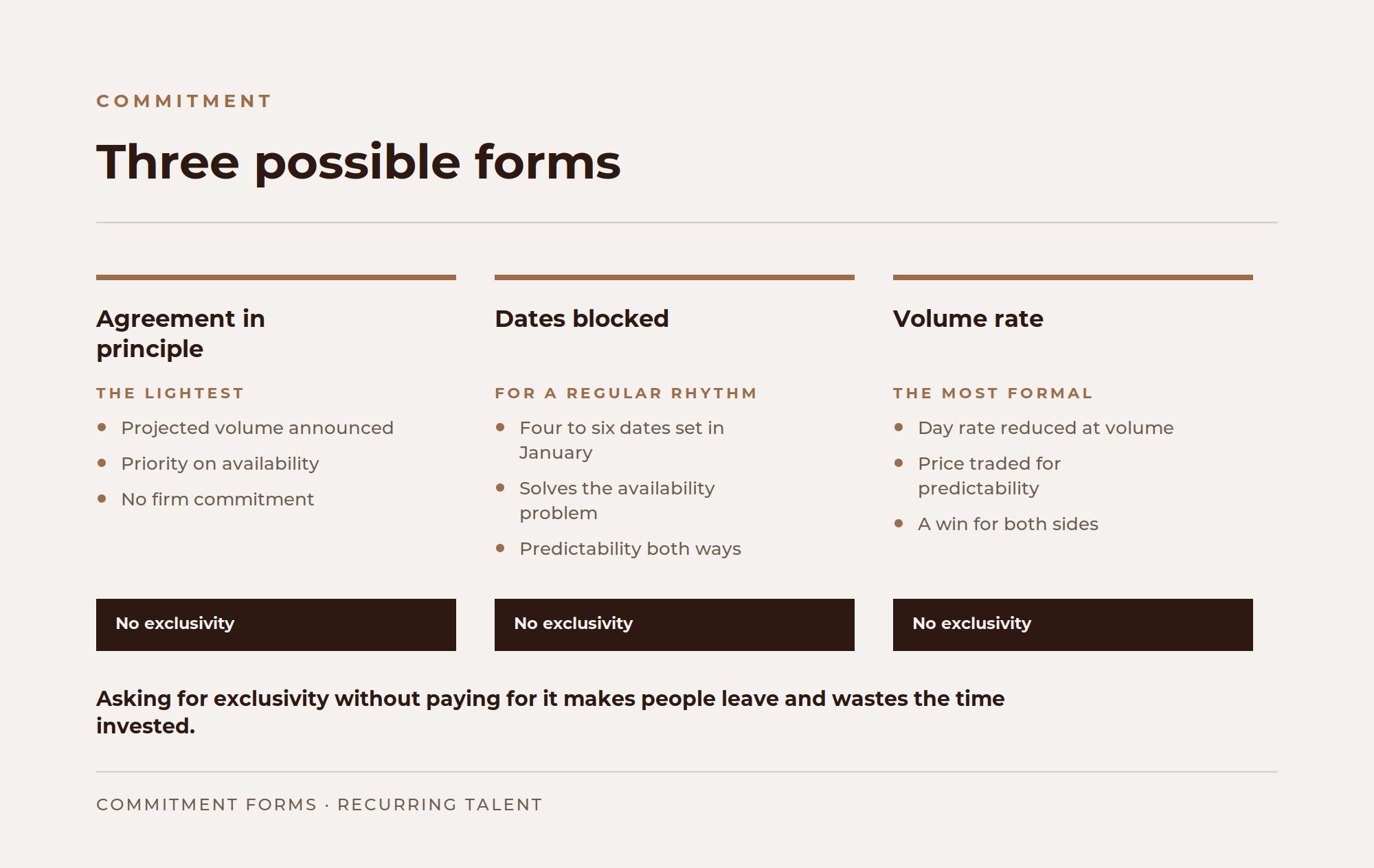
An agreement in principle is the lightest: you announce a projected volume for the year, the person gives you priority on their availability. No firm commitment either way.
Dates blocked in advance suit brands producing on a regular rhythm. You set the four or six dates of the year in January, which solves the availability problem that is the main cause of a team falling apart.
A volume rate formalises the relationship without constraining it: a day rate reduced beyond a certain number of days in the year. It is a winning negotiation for both sides, trading price for predictability.
What not to do: ask for exclusivity without paying for it. Someone who can no longer work for other brands without compensation will leave, and you will have lost both the relationship and the time invested in building it.
What makes a good collaborator leave
Recurring teams rarely fall apart over rates. They fall apart over three things.
- Payment terms. This is the first cause, by far. A freelancer paid at sixty days ends up favouring clients who pay at thirty.
- Late or vague briefs. Someone who has to chase information at every production ends up seeing the brand as expensive in energy.
- No feedback. Working without ever knowing whether the images were used, or what worked, wears down motivation faster than any disagreement over rates.
None of these three costs anything to fix, and together they largely determine who accepts your dates once their diary fills up.
Frequently asked questions
How many people in a core?
Four or five covers the essentials: a photographer, one or two models, a make-up artist, possibly a stylist. Beyond that the relationship becomes one-off again.
Do you need to sign a contract?
Not necessarily. An agreement in principle on projected volume plus dates blocked in advance is enough in most cases. Each assignment is still contracted individually.
Can you negotiate a lower rate by working regularly?
Yes, and it is a legitimate negotiation: you trade predictability for price. Asking for exclusivity without compensation, however, makes people leave.
How many productions before a stable core?
Three or four productions is usually enough to identify the profiles where collaboration flows.
What if someone becomes unavailable?
That is the argument for having two profiles per role on the critical ones, and for blocking your dates at the start of the year rather than six weeks ahead.
Conclusion
Working with the same people over time is the cheapest optimisation in the content budget: it removes casting time, removes calibration time, opens rate arrangements and builds the visual consistency that makes a brand recognisable. It needs neither contract nor exclusivity, only the decision to rebook rather than restart.
To identify the profiles to build that core with, browse the Shaare directory and contact them directly, with no middleman and no commission.