
A failed product launch rarely fails for lack of means. It fails on sequencing: the images arrive after the store opens, the creators are contacted in launch week, and the event gets decided once everything else has shipped.
The three levers of a launch, the shoot, influence and the event, do not fire at the same moment and do not produce the same effect. Firing them all together on the day means paying three times for a single spike of attention that drops away within forty-eight hours.
This guide covers what each lever produces, the sequence that makes them work together, how to split the budget between them, and the thirty days after launch that most brands let slip.
Three levers, three functions
They are not interchangeable, and using all three is not compulsory.
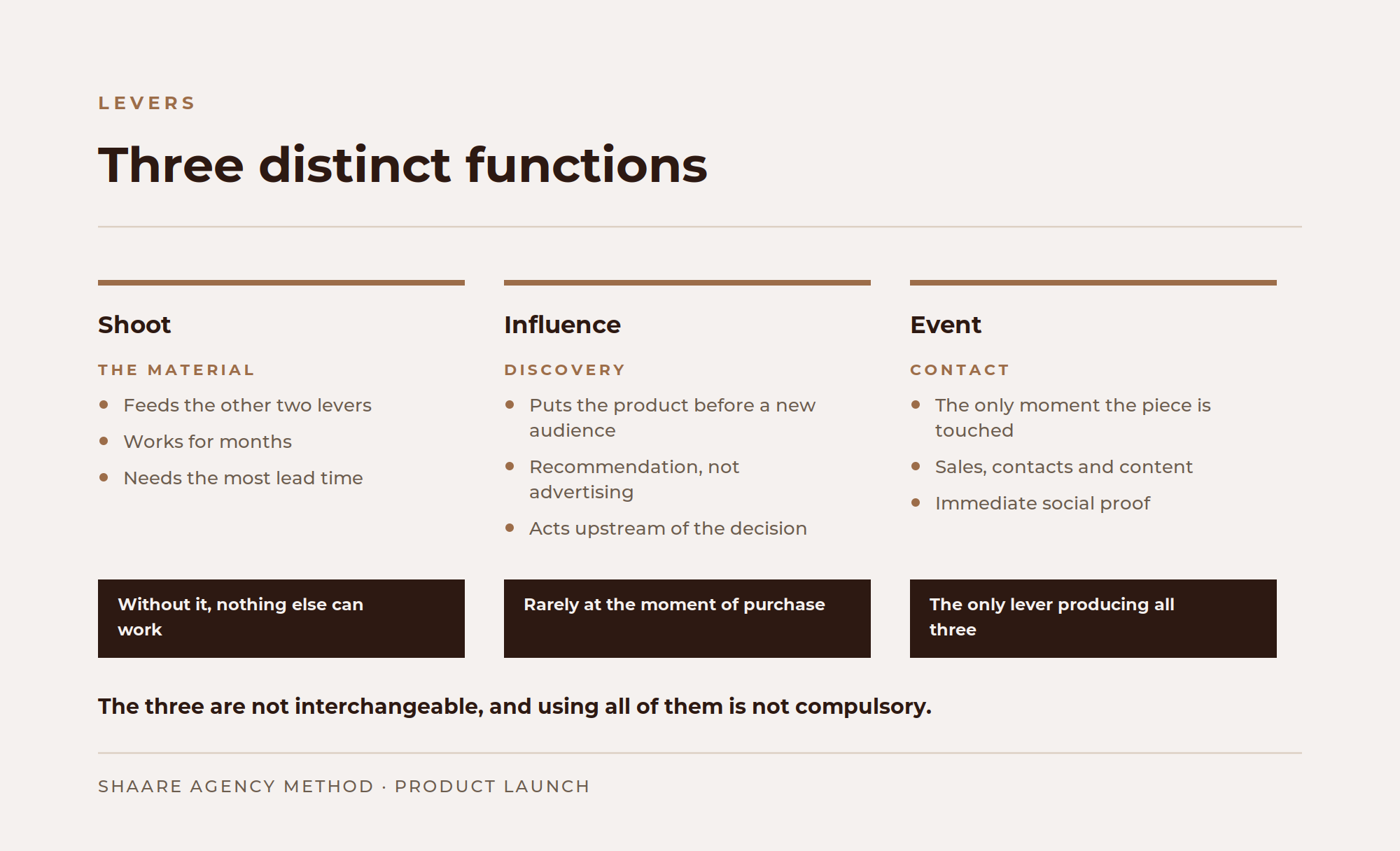
The shoot produces the material. Without images, neither of the other two levers has anything to work with: a creator has nothing to share, an event has nothing to announce, a product page does not convert. It is the foundation, and it needs the most lead time.
Influence produces discovery. It puts the product in front of an audience that does not know you, with a recommendation that carries further than an advert. It works upstream of the decision, rarely at the moment of purchase.
The event produces contact and proof. It is the only moment someone touches the piece, and the only one generating sales, contacts and content at once.
The sequence
This is the heart of it. The order matters more than the budget.
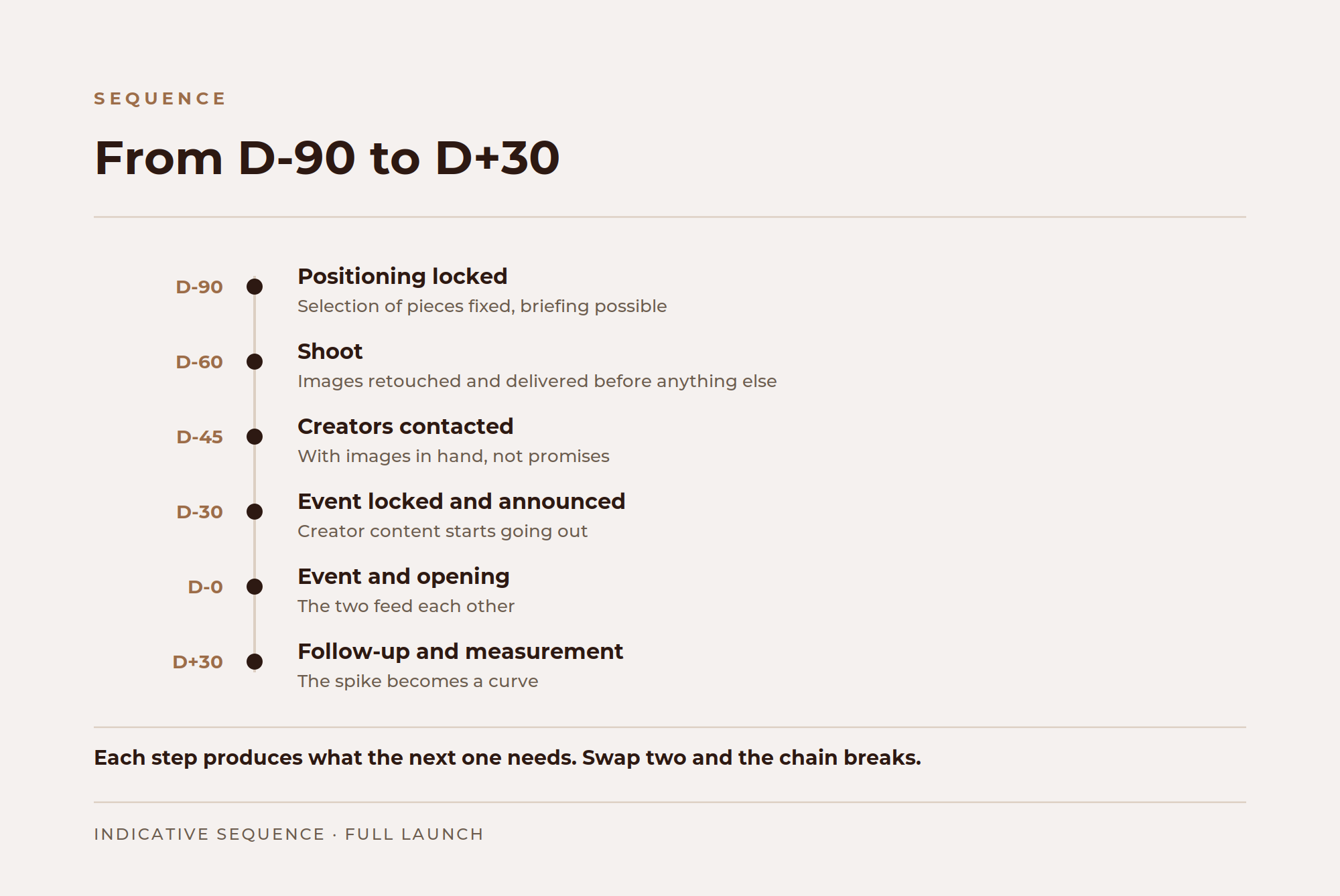
At D-90, the positioning and the selection of pieces are locked. That is what lets you brief a shoot with something other than intentions.
At D-60, the shoot takes place. That lead time is not comfort: the images have to be retouched and delivered before anyone else can work. Building a workable brief is covered in our guide to briefing a shoot team.
At D-45, creators are contacted, with the images in hand. A creator who receives a full brief and images two weeks ahead produces far better content than one approached three days before.
At D-30, the event is locked and announced, and creator content starts going out. It builds awareness while you fill the room.
At D-0, the event takes place and the store opens. Each feeds the other.
At D+30, the follow-up draws on the content produced at the event. This is the phase that turns a spike into a curve.
Splitting the budget
There is no universal key, but one simple principle avoids the most common mistake.
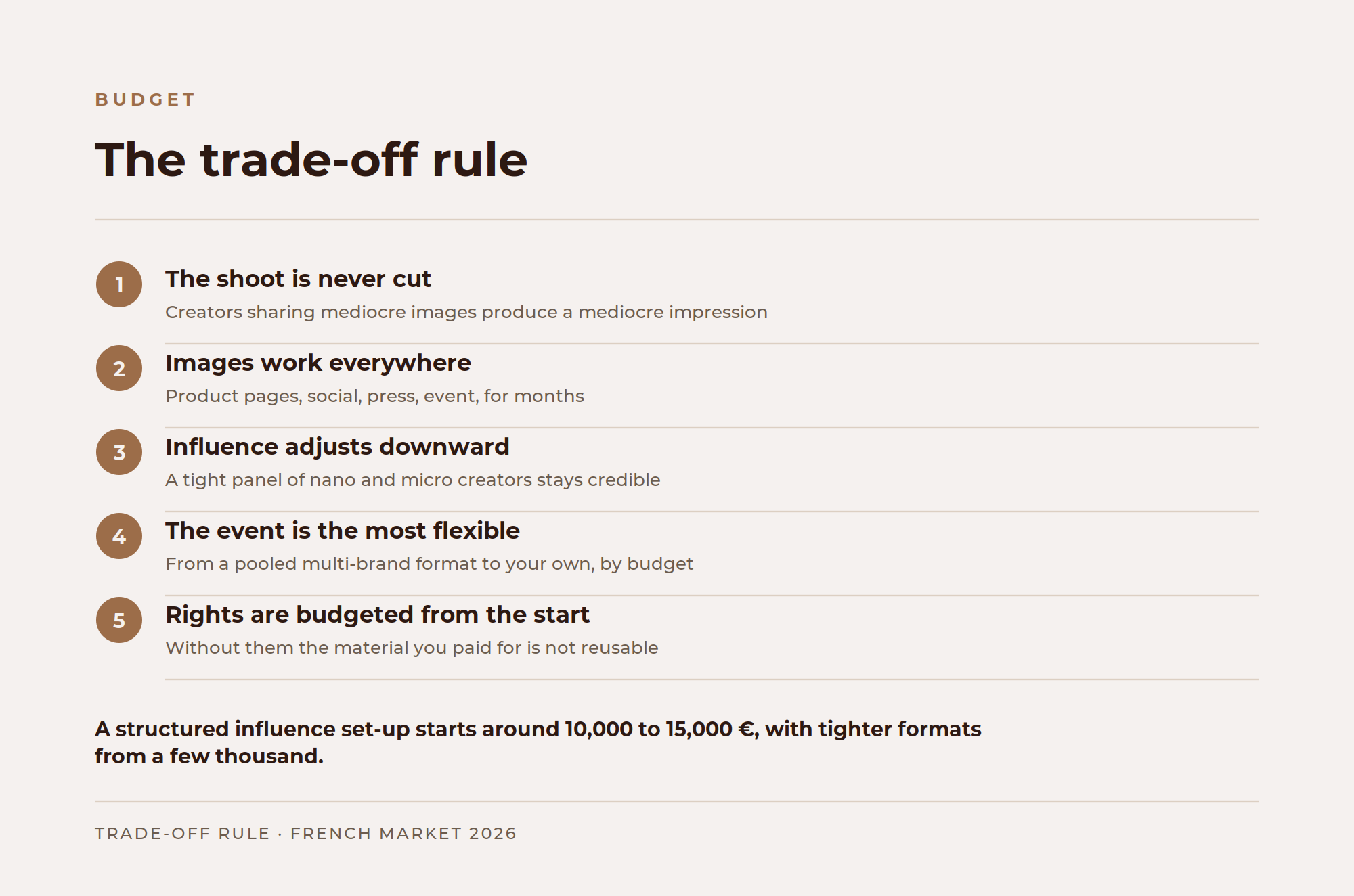
The principle: never cut the shoot to fund influence. Creators sharing mediocre images produce a mediocre impression, on an audience you will not see again. The reverse holds: excellent images compensate for a modest influence set-up, because they work everywhere, for months.
Two framing benchmarks. A credible influence set-up starts around 10,000 to 15,000 euros for a structured campaign, and tighter formats exist from a few thousand euros on a panel of nano and micro creators. Full ranges are in our guide to influencer campaign costs.
What must exist before opening
Four things, and none can be recovered afterwards.
- The complete image set. Packshots, worn shots, details and at least one context image per piece. A product page with four or more images converts markedly better than one with a single image.
- Usage rights negotiated. On the shoot and on creator content alike. Without them you cannot reuse the material you paid for.
- The measurement instruments. Discount codes per creator, tracked links, a baseline recorded before launch.
- Stock matched to the ambition. Running out during the attention peak is the most frustrating failure there is.
The thirty days after
This is the phase brands neglect most, and the one that separates a launch from a flash in the pan.
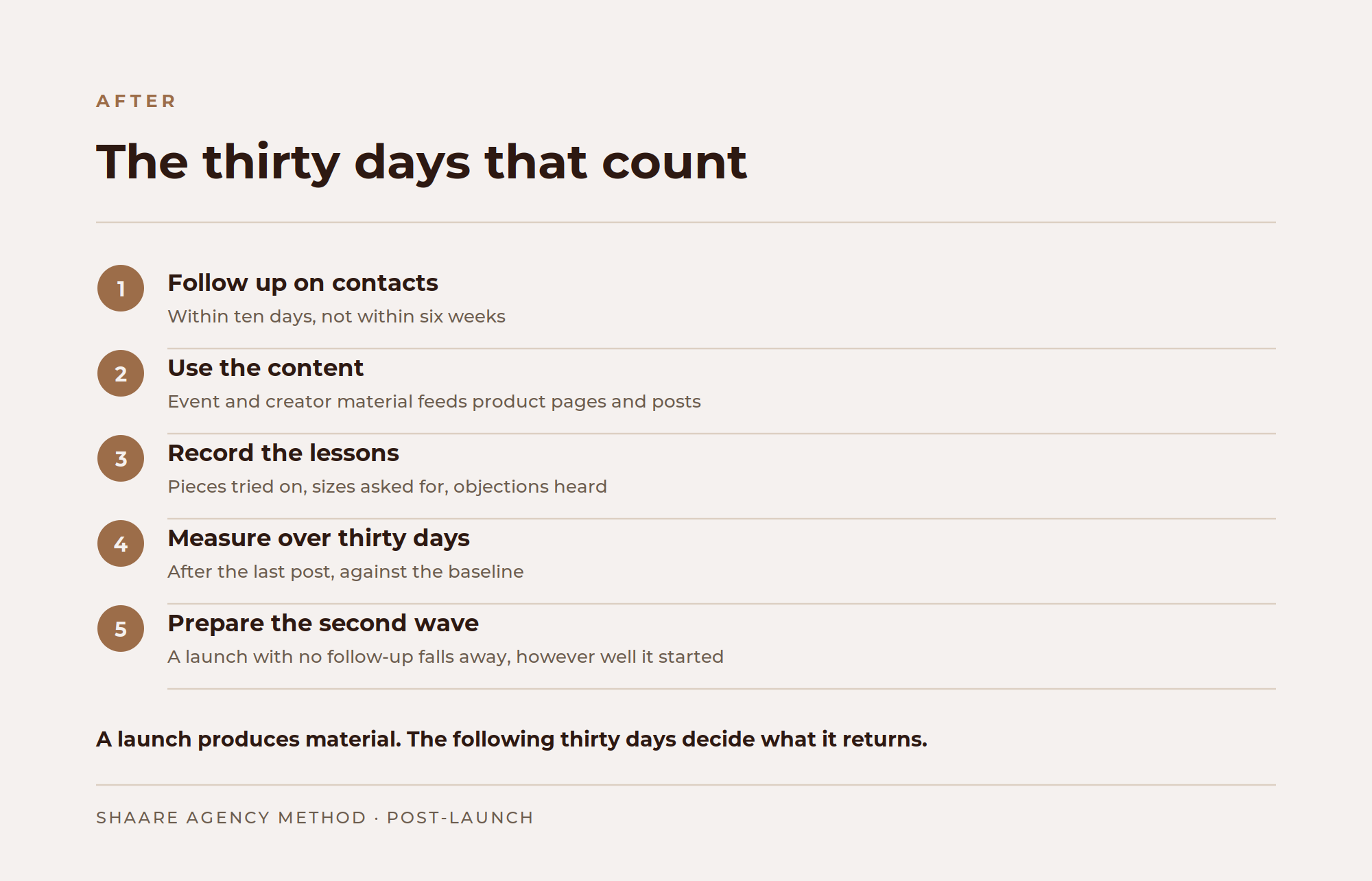
The content produced at the event and by creators feeds your channels, your product pages and your follow-ups. Contacts collected get a message within ten days, not within six weeks. And the lessons from the floor, pieces tried on, sizes asked for, objections heard, shape the next production.
It is also the measurement window: thirty days after the last post is a reasonable benchmark for judging the whole set-up, following the method in our guide to measuring ROI.
The habit that changes everything: before launching, decide what your second wave will be. A launch with no planned follow-up falls away, however well it started.
The most expensive mistakes
- Shooting too late. Everything else depends on it, and the delay propagates through the whole set-up.
- Contacting creators in launch week. The good profiles are booked, and those who accept produce under pressure.
- Releasing everything on the same day. A forty-eight-hour spike costs as much as a thirty-day curve and returns less.
- Neglecting usage rights. You pay for a production you will not be able to reuse.
- Planning nothing afterwards. Most of the return happens in the weeks that follow, not on the day.
Frequently asked questions
Do you need all three levers at every launch?
No. The shoot is unavoidable, the other two are chosen by objective and budget. A launch with good images and a tight influence set-up beats a full set-up done badly.
How far ahead should you start?
Three months for a full set-up. The shoot happens two months before opening, creators are contacted six weeks ahead.
Can you launch without an event?
Yes. The event brings direct contact and content, but a well-sequenced online launch works without it.
What share of the budget should go to the shoot?
There is no universal rule, but never cut it to fund influence. The images work everywhere and for months.
How do you know whether the launch worked?
By recording a baseline beforehand, then measuring over thirty days after the last post: attributed sales, contacts collected, content produced and audience growth.
Conclusion
A successful launch is not an addition of means, it is a sequence. The shoot produces the material, influence produces discovery, the event produces contact, and the following thirty days turn all of it into a curve rather than a spike. Sequencing costs nothing, and it is what makes the difference.
To build your launch team, browse the Shaare directory and contact profiles directly, or hand us the whole set-up, from shoot to event.