
France still draws fashion brands from all over the world. But since summer 2026, selling there takes less boldness than preparation: regulatory compliance has become the first filter, well before marketing.
Paris remains the global capital of fashion, French e-commerce is one of the most mature in Europe and local shoppers put real value on quality and durability. For an international brand, France is a showcase as much as a market.
Yet this market has its own rules, stricter than most of its neighbours. This guide covers what an international brand needs to know to enter the French market in 2026: the real state of the market, the obligations to meet before the first sale, how to adapt your offer, the possible entry channels and how to build local awareness.
The French market in 2026: demanding but open
Let's start with the figures, because they say most of it. According to the Institut Français de la Mode, clothing revenue fell 1.9% in the first quarter of 2026. But that drop hides two opposite trends: in-store sales are falling sharply while online sales grew 2.2%.

Second-hand fashion grows by around 20% a year and France alone accounts for nearly a quarter of Europe's second-hand fashion market. For an international brand, the message is clear: French shoppers buy less, but better, and increasingly online. A brand that arrives with a story of quality, durability and a real identity has room. A brand that competes on price alone runs into platforms that are already established.
For a closer look at these trends, read our analysis of the French fashion market.
Why France is still a strategic step
Beyond volume, France offers three advantages that are hard to find elsewhere.
- An international showcase. Being present in Paris, whether during Fashion Week, in a showroom or through a pop-up, builds credibility you can reuse in every other market.
- A mature e-commerce market. According to Fevad, French consumers spent €196.4 billion online over the year. Online shopping is a habit, fashion included.
- A gateway to Europe. A brand that complies in France, whose textile rules are among the strictest in the EU, is better prepared for other European markets.
Compliance: the real entry ticket
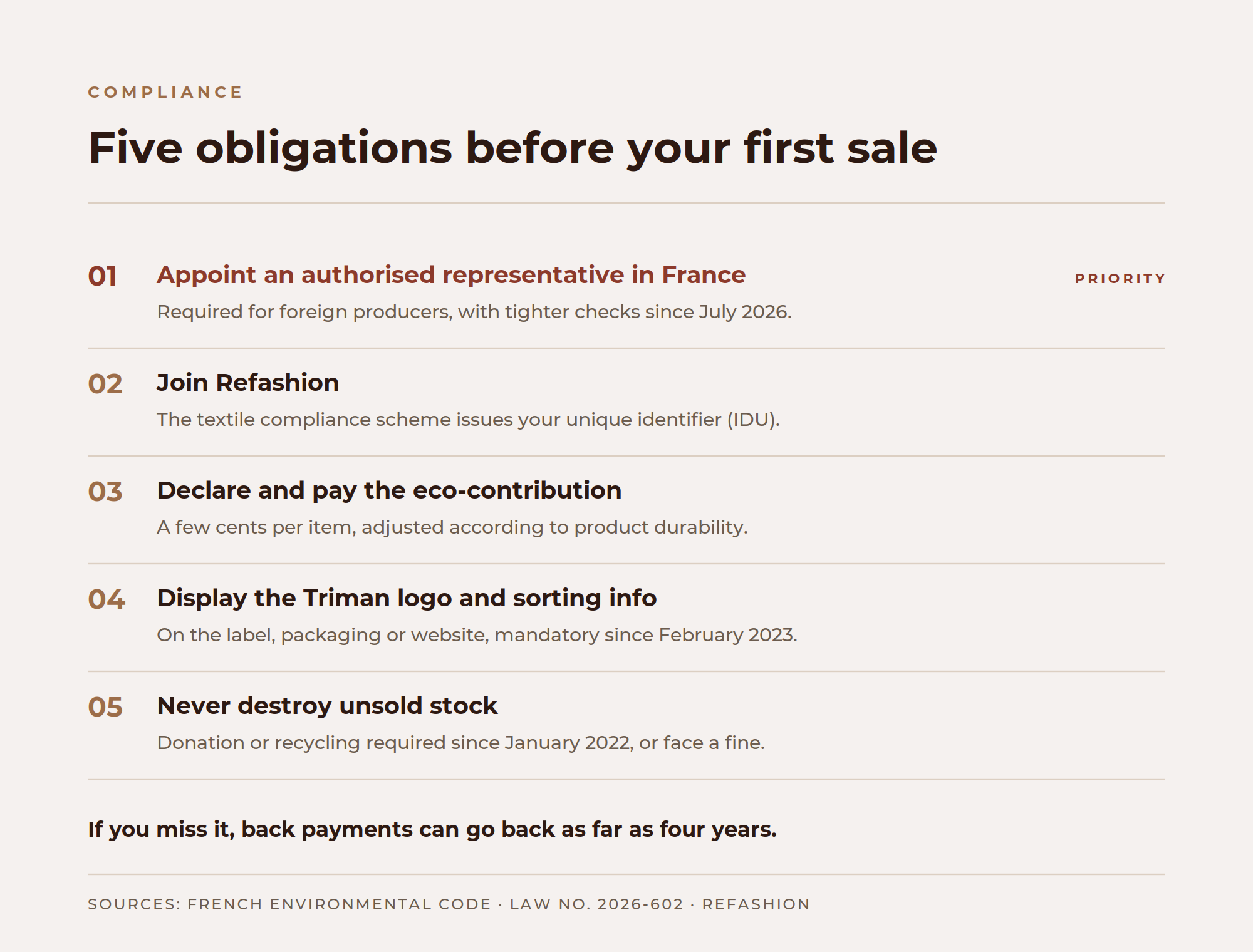
This is the point most international brands discover too late. Since 2007, France has run an extended producer responsibility (EPR) scheme for clothing, household linen and footwear. Any company placing these products on the French market, including from abroad and including through online sales, is considered a "producer" under the law.
Appoint an authorised representative in France
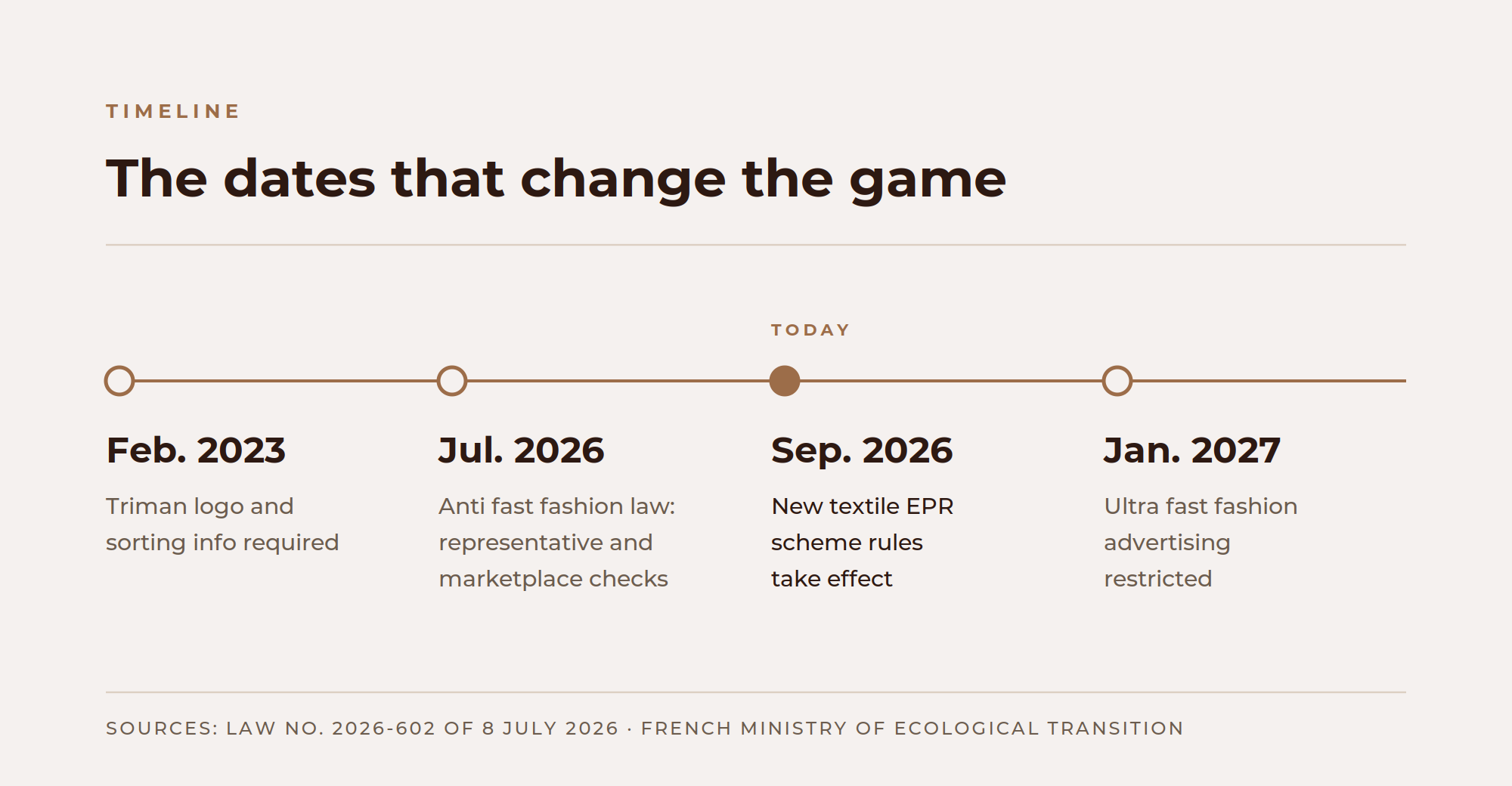
A brand without a French establishment must appoint an authorised representative, a company based in France that takes on the scheme's obligations on its behalf. The law of 8 July 2026 aimed at reducing the environmental impact of the textile industry tightened this requirement and the related checks. It is now the first thing commercial partners verify.
Join Refashion and pay the eco-contribution
Refashion is the approved compliance scheme for textiles. Membership gives you a unique identifier (IDU) proving the brand is compliant. Every item placed on the market carries an eco-contribution of a few cents, adjusted according to product durability. The exact scale is published every year.
Display the Triman logo and sorting information
Since February 2023, textile products sold in France must carry the Triman logo together with sorting instructions. It can appear on the product, the packaging or, in some cases, the sales website.
Never destroy unsold stock
Since January 2022, destroying unsold non-food products has been banned in France. They must be donated, reused or recycled. Fines can reach €15,000 for a company.
Key point: marketplaces must check that their third-party sellers meet their EPR obligations. A non-compliant brand can therefore be blocked by its own distribution partners. And if you miss the registration, back payments to the compliance scheme can go back as far as four years.
The pace is picking up. The July 2026 law mainly targets ultra fast fashion, with advertising restrictions from January 2027, but its effects reach every brand through tighter checks.
On top of these obligations there is a voluntary layer: since October 2025, brands can display an environmental cost on their products using the official method. It is not mandatory, but French shoppers increasingly expect it.
Adapting your offer to French shoppers
Once compliance is sorted, you still have to win customers over. French shoppers are demanding about details international brands often underestimate.
- Language. French law requires consumer information to be in French: product pages, composition labels, terms of sale, warranties. A clumsy translation is spotted instantly and costs credibility.
- Pricing. Prices are shown tax included, with 20% VAT. A brand that adds duties or VAT at checkout loses a large share of its baskets.
- Sizing. A size guide aligned with European sizes, with precise measurements, sharply reduces returns.
- Returns. The 14-day withdrawal right is a legal minimum. Simple, free returns within France have become a trust standard.
- Customer service. Answering in French, quickly, often makes the difference against a competing brand.
Choosing your entry route
There is no perfect channel. Each entry route trades off control, speed and the investment required.

Direct-to-consumer website
This route gives the most control: full margin, customer data and full ownership of your image. In return, you have to build all the traffic yourself, which means investing in content and acquisition.
Marketplaces
They bring an instant audience, but take high commissions and impose their own presentation rules. They also check sellers' EPR compliance, which makes the regulatory file unavoidable.
Showroom and wholesale
To reach multi-brand stores, Paris showrooms remain a key step, especially during fashion weeks. Plan around six months ahead of the target season.
Event and pop-up
A pop-up or event in Paris lets you test how French shoppers respond within a few days, meet press and content creators, and leave with localised content. It is often the best starting point before investing in a permanent channel.
Building local awareness
A brand can be well known at home and completely unknown in France. Awareness is rebuilt market by market, through three levers.
Content made for France
Reusing campaigns from your home market is tempting, but rarely effective. Visuals shot in Paris with local talent speak more directly to French shoppers. For product pages, our e-commerce lookbook photography guide covers the expected standards.
French content creators
Influence is still the fastest way to build credibility with an audience that does not know the brand yet. Micro-influencers, closer to their community, are often the best entry point. To structure this, read our influencer marketing guide, keeping in mind that French law strictly regulates influencer activity, including how partnerships must be disclosed.
A one-off physical presence
A well-run event generates sales, content and press coverage all at once. It suits brands that do not yet have a team on the ground particularly well.
Shaare tip: for a brand arriving without a local network, the hardest part is often assembling a reliable team in Paris: photographer, models, make-up artist, content creators. A fashion talent directory lets you contact them directly, with no intermediary and no commission.
Costly mistakes to avoid
- Selling before being compliant. Back payments and being blocked by platforms cost far more than joining the scheme upfront.
- Translating instead of adapting. A word-for-word product page does not sell. Tone, references and sizing must be thought through for France.
- Showing prices without tax. Surprise charges at checkout drive French shoppers away.
- Betting everything on one channel. A marketplace alone does not build a brand. A website alone, with no traffic, does not sell.
- Arriving without local content. Visuals designed for another market immediately give away a brand that does not know its audience.
Frequently asked questions
Does an international brand need a French company to sell in France?
No. It can sell from abroad, but it must appoint an authorised representative based in France to take on its extended producer responsibility obligations, and register with Refashion.
How much is the textile eco-contribution?
A few cents per item on average. The amount depends on the product category and on an adjustment system that rewards durability. The scale is published every year by Refashion.
Does the anti fast fashion law apply to every brand?
Its toughest measures, such as advertising restrictions, target ultra fast fashion. But the tighter checks on authorised representatives and platform verification affect every brand selling in France.
Do I need to translate my website into French?
Yes. Consumer information must be available in French. Beyond the legal requirement, it is a major conversion factor.
Which channel should I start with?
For a brand with no local awareness, testing the market with an event or pop-up in Paris, then growing direct online sales, is often the safest sequence.
Conclusion
Choosing to enter the French market is a realistic ambition for an international fashion brand, as long as things happen in the right order: get compliant before selling, adapt your offer rather than translate it, then build awareness with local content and talent. For the broader steps of structuring a brand, our guide to launching a fashion brand in France completes the picture.
To bring your Paris team together, from photographers to content creators, explore the Shaare directory or let us organise your launch event.